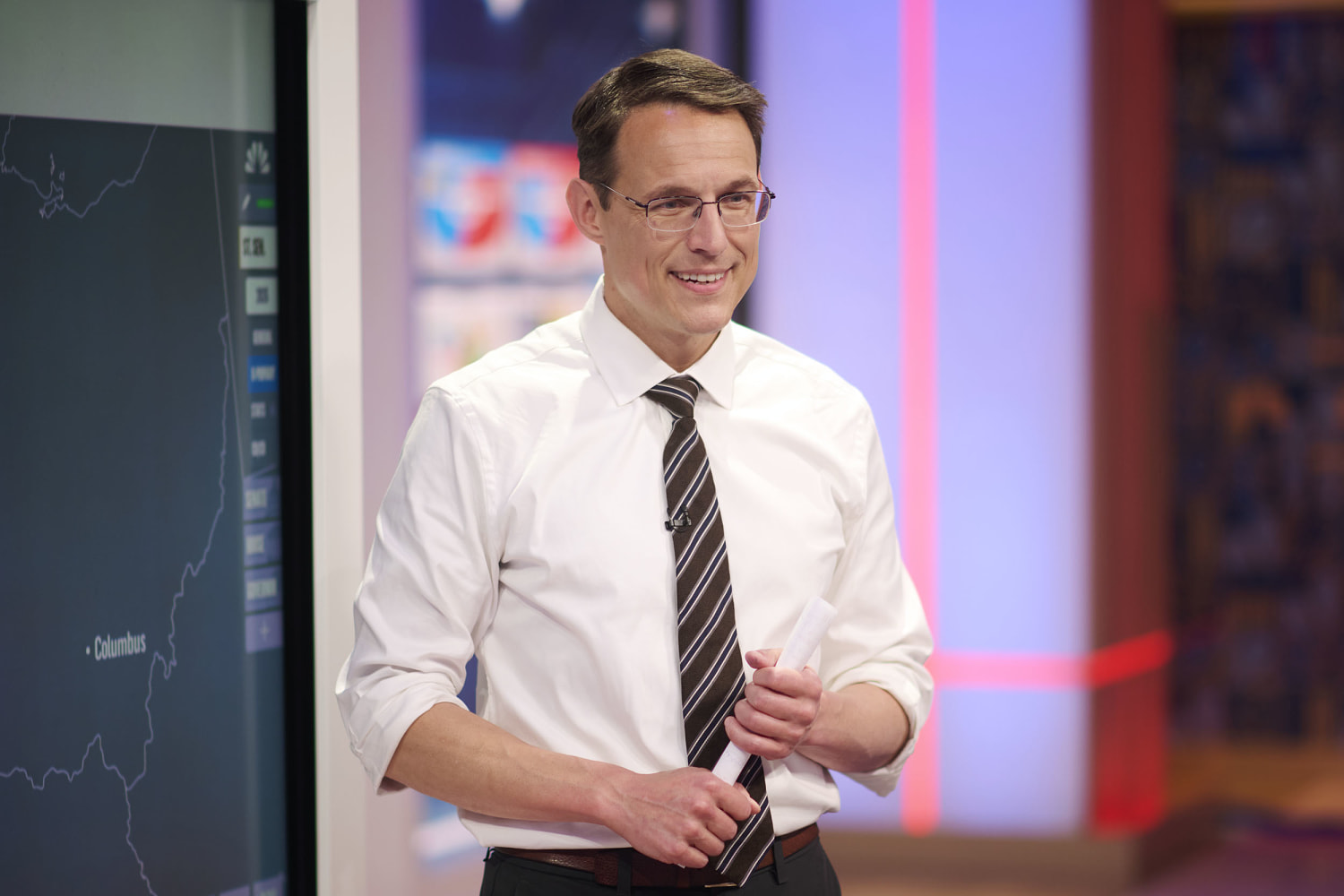
The Board Doesn't Sleep
The whiteboards don't erase easily when you’ve been pressing down with a dry-erase marker for fourteen consecutive hours. By three in the morning on an election night, the air inside a network studio smells faintly of industrial coffee, chemical markers, and the subtle, metallic tang of raw adrenaline.
Most people see a television screen divided into neat red and blue grids. They see percentage bars ticking upward in smooth, digital increments. But behind the glass, standing under lights so hot they bake the collar of a button-down shirt, Steve Kornacki sees something entirely different. He sees millions of frantic human decisions collapsing into a single county in Pennsylvania. He sees the panicking campaign managers dialing local clerks, the precinct volunteers stacking paper ballots in gymnasium basements, and the quiet shift of a working-class neighborhood that nobody spent enough time visiting in September.
We treat midterms like a sport, but they aren't a game. They are a nationwide autopsy of the collective mood.
When you ask a question about a midterm election, you aren't really asking about turnouts, sample sizes, or historical precedents. You are asking a much scarier question: What are we becoming, and why does nobody seem to agree on the answer?
The Map Is Not the Territory
Imagine a quiet street in Maricopa County, Arizona.
It’s five-thirty on a Tuesday morning. The air is still crisp before the desert heat settles in like a thick blanket. A woman named Sarah—a hypothetical voter, but one built from the exact demographic cross-currents that keep pollsters awake at night—stands in her kitchen waiting for her coffee to brew. She has lived in this suburb for twelve years. Her grocery bill has doubled since she bought her house. Her kids go to public school three miles away.
She isn't reading white papers on tax policy. She isn't watching cable news panels where five people in sharp suits interrupt each other for an hour.
What Sarah feels is a low-frequency hum of uncertainty.
When she walks into her polling place later that afternoon, she carries every anxious thought from the last two years with her. The rent hikes. The headlines about foreign wars. The strange, alienating feeling that the political parties are speaking a language designed for a completely different country than the one she lives in.
Then, hours later, her vote gets translated into a single numeric digit on a screen in New York City.
That is where Kornacki comes in. The man stands at the board, sleeves rolled up, clutching a dry-erase marker like a weapon against chaos. His job is not just to tell us who is winning. His job is to translate Sarah’s quiet, private decision into a pattern that makes sense to a nation desperate for structure.
He zooms in on Maricopa. He traces the margins with his fingers. He taps the screen—once, twice, three times—drilling down into a single precinct that shifted by three percentage points compared to four years ago.
That tiny shift is not an accident of arithmetic. It is Sarah standing in her kitchen at five in the morning, deciding that enough is enough.
Why Midterms Feel Like a Slow-Motion Wreck
Presidential elections are easy to understand. They are big, loud, cinematic blockbusters. Two main characters face off, the drumroll builds for eighteen months, and someone takes an oath on a stage in front of the Capitol.
Midterms are complicated, messy, and deeply weird.
Instead of one big national story, a midterm is actually 435 separate, furious arguments happening simultaneously in the House of Representatives, alongside thirty-four distinct battles for the Senate and dozens of gubernatorial showdowns. It is a mosaic built out of local grievances.
Historical gravity pulls heavily against the party sitting in the White House. Since the Civil War, the president's party has lost seats in almost every single midterm election. It is an almost mechanical law of American politics: enthusiasm is fueled by anger, not satisfaction. The voters who lost the last election are furious, organized, and ready to march to the polls. The voters who won are often tired, distracted, or quietly disappointed that victory didn't solve all their problems overnight.
Yet, despite this historical rulebook, every cycle feels entirely unprecedented while it is happening.
When you track these races, you quickly realize how fragile the consensus really is. A candidate makes an off-hand comment at a county fair in Iowa, and suddenly a race that looked safe six months ago begins to bleed support. A sudden economic shock half a world away ripples through gas stations in Ohio, shifting the math by a critical point and a half.
We want politics to be a science. We want to believe that if we just input enough data, run enough Monte Carlo simulations, and survey enough voters, the future will unlock itself like a simple equation.
It doesn't.
Human beings are messy, unpredictable, and stubborn. They lie to pollsters because they don't want to sound uneducated. They change their minds in the car on the way to the polling station because they heard a radio ad that struck a nerve. They stay home because it started raining at four in the afternoon and the line at the middle school stretched around the block.
Reading the Ink Drops
Watching an election night unfold through raw data is like trying to read a novel one letter at a time.
Early returns roll in from Florida or Indiana, and the internet immediately melts down into a frenzy of hot takes and instant declarations. But Florida counts votes fast; other states process mail-in ballots over days. If you don't know which precincts count their in-person ballots first and which ones process mail receipts late into the night, you are looking at a house of mirrors.
This is where the obsessive attention to detail matters.
Consider the "mirage." In some states, the first numbers to hit the screen represent rural counties where votes are tallied rapidly by hand or simple optical scanners. The map flashes dark red. Panic ensues on one side; celebration erupts on the other. But three hours later, the dense urban centers and sprawling suburban rings begin reporting their electronic tallies. The red map suddenly turns blue, vote by vote, layer by layer.
The reverse happens just as easily. A candidate looks like they are cruising to an overwhelming victory at 10 PM, only for the late-arriving mail-in ballots to slowly erode that lead until it evaporates into thin air by sunrise.
It isn't magic, and it isn't a conspiracy. It is simply the mechanical reality of how fifty different states, with thousands of independent county boards, process millions of pieces of paper.
To look at that board and actually understand what is happening requires a mind that can store thousands of historical baselines simultaneously. You have to know that a democrat winning a specific district in suburban Philadelphia by five points is actually a bad sign for them if they needed to win it by eight points to balance out the rural turnout coming in from the western hills later that night.
It is a game of margins, played out in real-time across four different time zones.
The Invisible Pressure Inside the Studio
Have you ever wondered what happens during those commercial breaks when the cameras cut away from the big board?
The studio lights stay blaring. The floor managers step in with napkins to dab sweat off foreheads. Producer voices crackle in tiny earpieces, barking out fresh numbers coming in from county election boards in Michigan, Nevada, and Georgia.
It is an environment of intense, sustained pressure. One wrong calculation, one misread line of data broadcast to millions of anxious viewers, can send shockwaves across the political landscape.
Outside the climate-controlled studio, political operatives are watching those exact same numbers on their phones. Campaign headquarters are either filled with quiet, suffocating dread or premature popping champagne corks. Donors are pacing in high-rise corner offices. Legislative aides are already drafting contingency plans for what happens if their boss loses a committee chairmanship.
All of that human tension, all of that ambition, fear, and power, gets funneled directly into a single touch-screen board operated by a guy who looks like he hasn't slept in thirty-six hours and subsists entirely on energy bars and pure curiosity.
What makes that spectacle so magnetic isn't just the outcome of the races. It is the sheer, raw transparency of the process. In an era where almost everything we consume feels polished, rehearsed, and engineered by public relations teams, watching someone do high-stakes arithmetic live on national television feels startlingly real.
There are no teleprompters for that kind of work. You either know the baseline vote total of Lackawanna County in 2018, or you don't. You either understand why a shift in the Latino vote in the Rio Grande Valley changes the entire map, or you get left behind by the story.
What the Math Leaves Out
Yet, even with every board accounted for and every precinct fully reported, data has a strict limit.
Numbers can tell us what happened. They can show us that suburban women broke away from a party, or that young voters turned out in record numbers in a college town, or that rural voters surged beyond expectations.
They cannot tell us why people feel the way they do.
They cannot measure the quiet desperation of a small-town business owner who spent two years struggling to keep his doors open, only to feel ignored by the people making decisions thousands of miles away. They cannot quantify the anger of a young graduate who feels like the economic promises made to their generation were broken before they even got started. They cannot capture the deep, emotional attachment people have to their communities, their traditions, and their visions of what the country ought to be.
When we lean into the numbers so heavily, we risk treating voters like static variables in an algorithm. We map them by zip code, by income bracket, by race, and by education level, as if those categories completely define who they are and what they care about.
But people break out of their categories all the time.
That is why every election cycle delivers a shock that leaves the pundits stammering on live television. A district that was supposed to be safe suddenly flips. A candidate who was written off as unviable months ago walks away with a decisive victory.
Those moments aren't failures of the math; they are reminders of human agency. They are the moments when millions of individual people walk into tiny curtained booths, grab a pen, and decide to surprise the world.
The Long Road to Wednesday Morning
Eventually, the sun starts to rise.
The frantic energy of midnight gives way to the quiet, exhausted reality of Wednesday morning. The studio lights finally dim down a notch. The coffee in the pot has turned thick and bitter. The big board is covered in fingerprints, streak marks, and a sea of finalized percentages.
Some races will take days—or even weeks—to fully resolve as final ballots are meticulously counted, double-checked, and certified. The cable news chyrons will settle into a steady rhythm of post-game analysis, trying to craft a neat, tidy narrative out of what was actually a chaotic, multi-directional storm.
Politicians will claim mandates. The losers will make excuses. Analysts will immediately start projecting what all of this means for the next big presidential race two years down the line, spinning the wheel all over again before the ink on this election is even dry.
But if you look past the spin, past the victory speeches and the concession calls, you are left with something simple and profound.
A country of over three hundred million people, full of wildly conflicting dreams, anxieties, and beliefs, just used paper, ink, and digital code to negotiate how they want to be governed.
It is noisy. It is frustrating. It leaves almost everyone involved feeling at least a little bit disappointed.
Yet, as the last precinct reports and the final numbers lock into place on that smudged whiteboard, you realize that the chaos isn't a glitch in the system.
The chaos is the system—a living, breathing, unscripted argument that we all participate in, one single vote at a time.