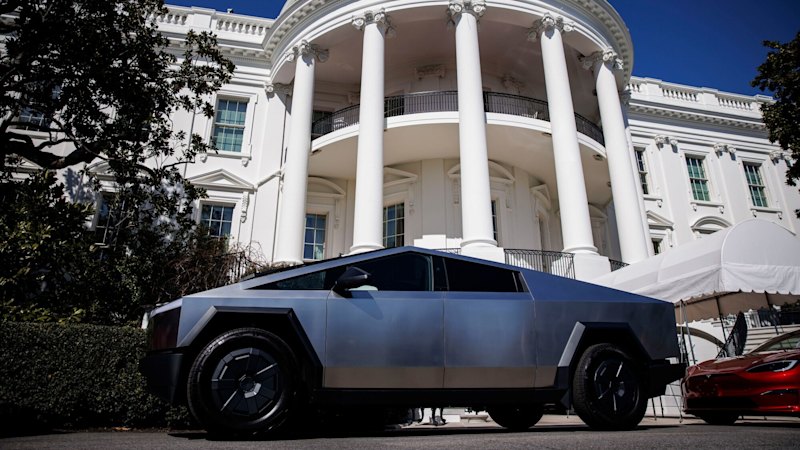
Terminating an active vehicle line within three years of initial delivery represents a deliberate capital reallocation rather than a simple admission of product failure. When Tesla halts Cybertruck production next year, the decision reflects the cold arithmetic of automotive manufacturing, where fixed asset depreciation, battery cell opportunity costs, and tooling complexity collide with demand elasticity. Standard automotive journalism frames a cancellation around styling controversies or executive whims, missing the underlying operational constraints that govern Gigafactory Texas. Understanding the wind-down requires stripping away narrative noise and examining the structural mechanics of how high-variance hardware programs lose internal competition for capital, floor space, and battery supply.
The Capital Allocation Equation in Heavy Manufacturing
Automotive manufacturing operates on brutal capital intensity. Unlike software, where marginal distribution costs approach zero, every physical vehicle architecture demands billions of dollars in upfront capital expenditure before a single unit generates revenue. When an automaker evaluates whether to sustain or terminate a program, the decision hinges on the relationship between contribution margin and the opportunity cost of factory capacity.
- Sunk Cost Fallacy Avoidance: Accounting write-downs on specialized stamping presses and casting machines look catastrophic on a quarterly income statement, yet rational operators ignore sunk capital when making forward-looking production decisions. The relevant metric is whether future gross profits exceed ongoing variable production costs and dedicated sustaining engineering expenses.
- Floor Space Opportunity Cost: A Gigafactory is a finite volume of climate-controlled, high-power industrial real estate. Every square meter dedicated to assembling a low-volume, low-margin truck is square meterage unavailable for high-turn models, stationary energy storage assembly, or next-generation autonomous vehicle platforms.
- Battery Cell Cannibalization: Lithium-ion cell production remains the primary bottleneck across the electric vehicle sector. Allocating a large-format 123-kilowatt-hour battery pack to a single heavy pickup truck consumes enough raw cathode material to build two standard-range passenger sedans or multiple commercial Megapack modules.
If the gross margin per kilowatt-hour on the Cybertruck falls below the gross margin per kilowatt-hour on the Model Y or stationary grid storage, continuing truck production actively destroys enterprise value. Management does not pull the plug because the truck lacks fans; management pulls the plug because the cells yield higher returns elsewhere.
Structural Manufacturing Bottlenecks of Exoskeleton Architecture
The Cybertruck departed from unibody and body-on-frame conventions by utilizing an ultra-hard 30X cold-rolled stainless steel exoskeleton. While visually distinct, this material choice introduced severe metallurgical and assembly penalties that resisted standard automotive learning curves.
In conventional automotive stamping, mild steel or aluminum sheets deform predictably under hydraulic pressure, allowing high-speed progressive dies to stamp out complex compound curves every few seconds. Cold-rolled stainless steel exhibits extreme yield strength and severe springback—the tendency of the metal to partially return to its original flat shape after bending force is removed. Compensating for springback requires over-bending the material, which accelerates die wear and introduces micron-level dimensional variance across batches of rolled steel coils.
This dimensional variance cascades down the assembly line:
- Tolerance Stacking: When body panels fail to conform to sub-millimeter tolerances, robotic welding cells cannot rely on blind spatial coordinates. They require real-time optical vision systems to map each seam dynamically, slowing cycle times and increasing capital equipment maintenance.
- Thermal Distortion: Joining thick stainless steel sheets via laser welding generates localized heat zones. Without traditional body-on-frame substructure to absorb or hide minor warping, thermal expansion creates visible surface ripples that cannot be easily corrected with conventional body filler or paint, since the exterior remains bare metal.
- Repairability Friction: The absence of conventional crumple-zone bolt-on panels means minor collision damage frequently requires cutting and re-welding structural sections. This drives up actuarial insurance premiums, which directly increases the total cost of ownership for prospective buyers and depresses repeat commercial fleet orders.
In manufacturing engineering, complexity that does not translate into higher willingness-to-pay acts as a permanent tax on gross margin. When an assembly line cannot achieve takt time—the rate at which a finished product must be completed to meet customer demand—fixed overhead gets amortized over too few units, trapping the vehicle in negative or near-zero margin territory.
Demand Elasticity and the Reservation Conversion Mirage
Early narrative coverage relied heavily on a reported backlog of over one million refundable reservations. In demand forecasting, low-friction deposits ($100 refundable placeholders) represent option value, not binding purchase intent. Evaluating true market depth requires distinguishing between speculative early adopters and sustainable mass-market cohorts.
The conversion funnel collapsed due to three compounding macroeconomic and product shifts between the 2019 unveiling and production ramp:
First, Price-to-Specification Inversion altered the value proposition. The initial anchor price of $39,900 for a rear-wheel-drive configuration established a psychological baseline. When production realities forced launch pricing above $80,000 to $100,000, the vehicle moved out of the mass-market light-duty pickup segment and into the luxury performance niche. Demand elasticity in the $90,000+ vehicle tier is high; the addressable market shrinks exponentially above the $70,000 threshold, particularly when elevated benchmark interest rates inflate monthly financing payments.
Second, Towing Physics and Energy Density limited commercial fleet adoption. Internal combustion pickups carry energy-dense diesel or gasoline that can be replenished in five minutes, suffering minimal range degradation under heavy aerodynamic drag. Electric pickups face the fundamental physics of aerodynamic drag ($F_d = \frac{1}{2} \rho v^2 C_d A$) combined with rolling resistance under payload. Towing a 7,000-pound trailer routinely cuts effective electric range by 45% to 55%. For commercial contractors, fleet operators, and rural buyers—the core demographics that sustain high-volume truck lines like the Ford F-150—a 150-mile towing range paired with trailer-unfriendly charging stall layouts represents an operational non-starter.
Third, Regulatory and Geographic Isolation capped global scale. Unlike the Model 3 or Model Y, which serve North America, Europe, and Asia from identical core architectures, the Cybertruck is functionally restricted to North America. European pedestrian safety regulations strictly prohibit rigid, sharp-edged front exteriors that fail to absorb impact energy, while narrow urban infrastructure and vehicle weight classifications above 3.5 metric tons require commercial driver licensing in key European jurisdictions. A platform incapable of global homologation cannot amortize its research and development costs across international volume.
The Engineering Spillover Defense
Evaluating the program purely on direct vehicle profitability misses a secondary strategic mechanism: subsidized research and development. Even when a hardware product fails commercially, its subsystems frequently survive as foundational architecture for subsequent product generations.
During the Cybertruck development cycle, Tesla transitioned key vehicle subsystems away from legacy automotive standards:
- 48-Volt Low-Voltage Architecture: Traditional vehicles rely on 12-volt electrical systems dating back to the mid-twentieth century. Stepping up to 48 volts reduces current by a factor of four for a given power load ($P = IV$), allowing thinner copper wiring harnesses, lower resistive losses, and reduced vehicle mass.
- Steer-by-Wire and Rear-Wheel Steering: Eliminating the physical mechanical steering column between the steering wheel and the front rack allows software-defined steering ratios, essential for tighter turning radii on long-wheelbase vehicles and necessary redundancy for autonomous driving platforms.
- 800-Volt High-Voltage Powertrain: Higher system voltage enables faster DC fast-charging rates and thinner high-voltage busbars, improving thermal management under sustained heavy load.
- Dry-Cathode 4680 Cell Manufacturing: The structural battery pack served as the primary commercial proving ground for dry-electrode coating processes, designed to eliminate wet-slurry baking ovens and shrink battery factory footprints.
From an organizational perspective, the Cybertruck functioned as a high-budget engineering testbed. The direct unit economics failed, yet the intellectual property, supplier tooling for 48-volt components, and steer-by-wire actuators directly de-risk future autonomous robotaxi and mass-market platforms. The strategic error was not developing the subsystems; the error was wrapping them in an unscalable stainless steel exoskeleton rather than deploying them into a high-volume unibody crossover.
Strategic Execution Playbook for Industrial Wind-Downs
Terminating a flagship hardware line without triggering supply chain contagion or brand erosion requires disciplined operational sequencing. When executing a multi-quarter production sunset, leadership must manage four distinct operational fronts simultaneously.
1. Tier-1 Supplier Liability Containment
Automotive supply contracts typically include minimum volume guarantees and dedicated tooling amortization schedules. Abruptly halting purchase orders triggers immediate breach-of-contract claims and liquidity crises among sole-source suppliers. Management must transition supplier agreements from production run-rates to spare-parts banking. By negotiating a final "all-time buy" of specialized components—such as custom gigacastings, unique glass panels, and proprietary actuators—the manufacturer fulfills minimum volume commitments while securing the mandatory 10-to-15-year regulatory replacement parts inventory in a single continuous batch before dismantling the tooling.
2. Asset Redeployment and Write-Down Timing
Accounting standards require immediate impairment charges once an asset's carrying value exceeds its recoverable cash flows. Rather than dripping write-downs across multiple quarters, corporate finance teams concentrate the non-cash impairment into a single fiscal period to clear the balance sheet. Simultaneously, industrial engineers audit the assembly line to separate bespoke equipment from fungible assets. Custom stainless-steel roll-forming machines go to scrap or secondary auction, while general-purpose KUKA/FANUC six-axis welding robots, autonomous guided vehicles (AGVs), and paint-shop curing ovens are stripped, reprogrammed, and redeployed to higher-margin lines within the same facility.
3. Residual Value and Warranty Ring-Fencing
Discontinued vehicles suffer rapid depreciation on secondary markets as buyers fear parts scarcity and stranded software support. To prevent brand contagion across the broader vehicle lineup, the manufacturer must publicly commit to long-term over-the-air software parity and ring-fence dedicated service bay capacity. Maintaining certified pre-owned floor pricing through captive financing arms prevents balance-sheet shocks for existing leaseholders and preserves customer trust for future product launches.
4. Engineering Talent Reallocation
The most valuable asset trapped inside a failing hardware program is the systems engineering team that solved its manufacturing edge cases. High-performing engineers inevitably leave organizations when placed on maintenance-mode teams. Leadership must immediately dissolve the standalone vehicle program office and reallocate lead structural, metallurgical, and firmware engineers into high-priority growth initiatives—specifically autonomous fleet infrastructure, humanoid robotics actuators, and stationary grid-scale battery systems—before competitors poach the talent during the wind-down announcement.
The Strategic Trajectory
For institutional investors and automotive executives, the termination of the Cybertruck confirms a fundamental law of industrial scaling: manufacturing physics always overrides brand narrative. When a product architecture violates core principles of mass-market manufacturability—global homologation, repairability, and energy-to-weight efficiency—no amount of brand equity can rescue its unit economics.
Expect Tesla to reallocate the freed Gigafactory Texas floor space and 4680 cell capacity directly toward two higher-yield verticals: commercial Megapack energy storage and dedicated autonomous Cybercab production. Stationary storage eliminates aerodynamic drag penalties, completely bypasses consumer styling preferences, and converts raw lithium-ion cells into predictable, multi-year utility contracts with superior gross margins. Simultaneously, repurposing the 48-volt and steer-by-wire architectures into a compact, unibody autonomous platform allows the company to capture the structural cost reductions it originally sought, unburdened by the metallurgical dead weight of a stainless steel truck.