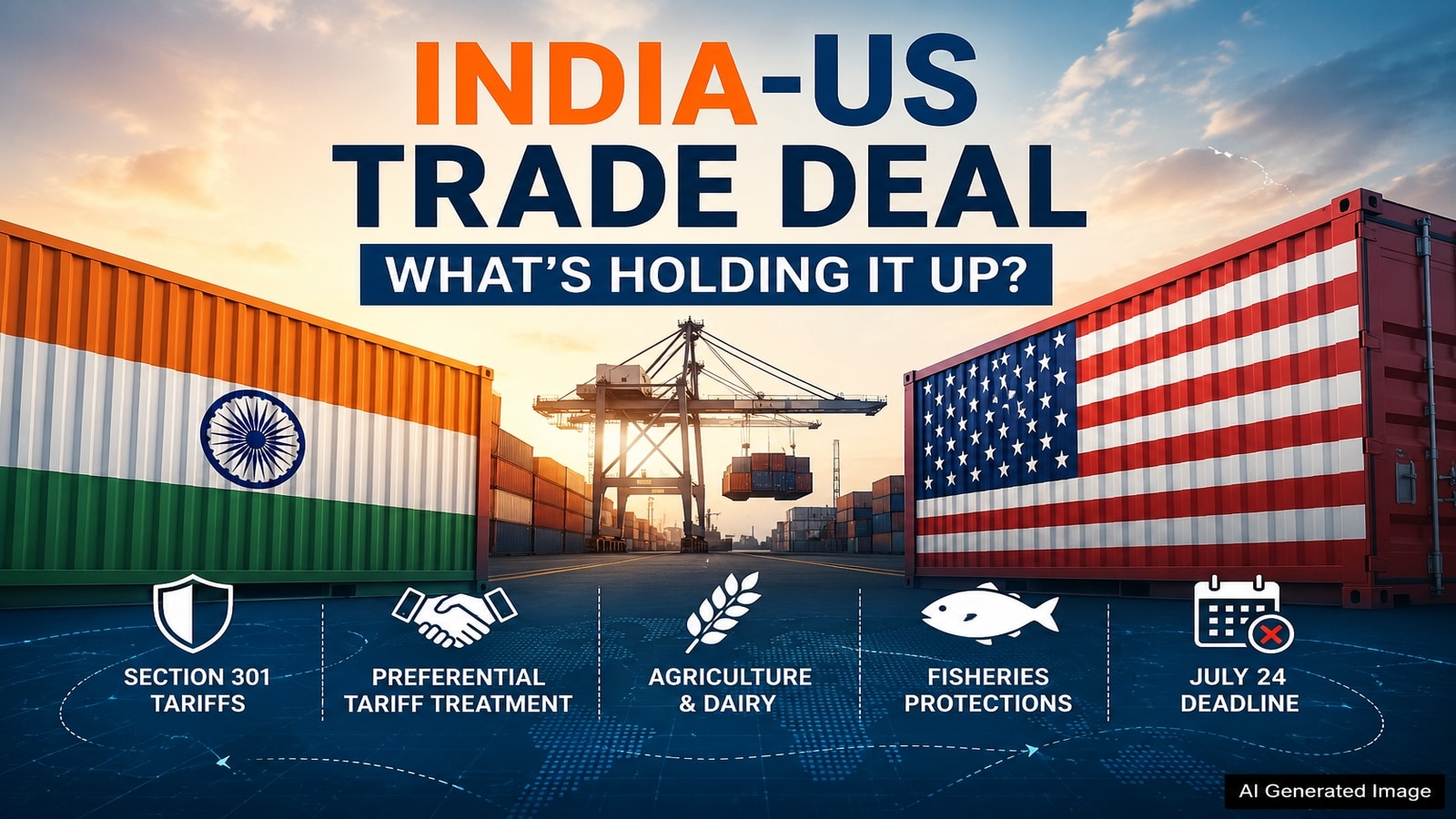
National trade strategies fail when one party mistakes a structural shift in economic leverage for a temporary negotiating posture. The collapse of the interim trade agreement between New Delhi and Washington during U.S. Trade Representative Jamieson Greer’s ministerial visit highlights a fundamental misalignment in risk pricing.
Washington proceeded under the assumption that the threat of impending U.S. import levies would compel India to rapidly cede market access, particularly within its highly protected agricultural sector. Instead, Indian negotiators chose to stall the framework, signaling a structural willingness to absorb short-term tariff exposure rather than accept an asymmetric legal regime.
This strategic holdout is driven by a calculated assessment of domestic industrial resilience, changing legal vulnerabilities within U.S. executive trade enforcement, and an explicit refusal to sign an agreement that fails to guarantee a relative cost advantage over regional export competitors.
The Strategic Asymmetry of the February Framework
The initial negotiating equilibrium was established under acute fiscal and trade pressure. In August 2025, Washington imposed a combined 50% tariff penalty on Indian originating goods—comprising a 25% base reciprocal tariff compounded by a 25% punitive levy explicitly tied to New Delhi’s continued procurement of discounted Russian crude oil. This aggressive penal regime directly threatened nearly 70% of India’s export pipeline to its largest bilateral trading partner.
The bilateral trade framework drafted on February 2, 2026, sought to dismantle this specific oil penalty and establish a normalized baseline, reducing India's blanket tariff exposure down to 18%. However, an internal evaluation of the text reveals an extreme structural imbalance:
- Unilateral Agricultural and Industrial Concessions: India committed to sweeping tariff reductions across critical industrial inputs and a broad spectrum of sensitive agricultural commodities.
- The Residual Tariff Floor: In exchange for opening these domestic markets, India did not secure zero-tariff access. It accepted a fixed 18% reciprocal rate, maintaining a significant cost barrier for Indian manufactured goods entering the U.S. market.
- The Seven-Fold Escalation Paradox: By anchoring the baseline at 18%, India effectively codified an entry duty rate seven times higher than the historical averages observed in July 2025, prior to the trade friction.
This imbalance meant India would permanently dilute its domestic defensive trade barriers while formalizing an adverse tariff regime for its own exporters.
The Legal De-escalation and U.S. Executive Overreach
The primary mechanism that altered New Delhi’s cost-benefit calculation was a sudden shift in the U.S. domestic legal framework. On February 20, 2026, the U.S. Supreme Court issued a landmark 6-3 decision striking down the executive branch's use of the International Emergency Economic Powers Act (IEEPA) to unilaterally levy broad, cross-sector industrial tariffs without explicit Congressional authorization.
This judicial intervention fundamentally neutralized Washington's primary enforcement lever. The ruling invalidated the 50% penalty architecture and forced the White House to pivot to a weaker, temporary 10% global fallback levy.
[Pre-February 20, 2026]
U.S. Exec Tariff Threat: 50% (25% Reciprocal + 25% Russian Oil Penalty)
   ──> High Leverage over India

[Post-February 20, 2026 Supreme Court Ruling]
Striking down of IEEPA Overreach ──> Executive Pivot to 10% Global Fallback Levy
   ──> Collapse of U.S. Leverage Floor
The erosion of this leverage altered India's negotiating position in two distinct ways.
First, the real-world tariff differential narrowed significantly. The delta between the temporary fallback levy (10%) and the proposed interim deal rate (18%) inverted the structural incentive to sign. Entering into the interim deal would actually cause an immediate 8% tariff increase on Indian goods relative to the post-ruling status quo, while forcing India to dismantle its own domestic agricultural protections.
Second, it introduced critical institutional unpredictability. The Supreme Court ruling proved that the current U.S. executive administration's trade policy operates on shaky legal foundations. Indian policy bodies, notably the Global Trade Research Initiative (GTRI), successfully argued that finalizing a long-term trade pact with an administration whose executive powers are actively being constrained by its own judiciary represents an unacceptable systemic risk.
The Friction Vectors: Competitive Edge and Legal Permanence
With the threat of a 50% tariff removed, the Ministry of Commerce and Industry adjusted its baseline requirements. Modern trade negotiations are no longer simple exercises in absolute tariff reduction; they are games of relative margin optimization. Two non-negotiable friction points emerged that ultimately blocked the Greer-Goyal talks:
1. The Relative Margin Requirement
India’s export profile competes directly with alternative emerging manufacturing hubs in South and Southeast Asia. Trade Minister Piyush Goyal explicitly stated that India would refuse to ratify any bilateral trade text unless Washington guaranteed a verified tariff advantage over competing export nations—specifically listing Vietnam, Thailand, Indonesia, Malaysia, the Philippines, China, and Bangladesh.
If India reduces its domestic barriers to U.S. agricultural products but its textile, pharmaceutical, and light-manufacturing sectors face the identical 10% or 18% U.S. tariff lines applied to these regional peers, the agreement yields a net-negative return on domestic manufacturing investments. New Delhi requires an asymmetric margin advantage to justify the disruption of its domestic agricultural sector.
2. Safeguards Against Section 301 Weaponization
The second bottleneck involves long-term policy permanence. Almost immediately following the judicial restriction of its IEEPA powers, the Office of the U.S. Trade Representative (USTR) initiated dual investigations under Section 301 of the Trade Act of 1974. One investigation targets general trade compliance, while the second focuses on structural excess manufacturing capacity across 22 distinct sectors globally. Seven of these targeted overcapacity sectors are located in India, focusing heavily on industrial construction goods.
Because Section 301 grants the USTR broad authority to impose unilateral duties on specific sectors following an investigation, Indian negotiators identified a structural vulnerability. A signed interim trade deal could be rendered useless within months if the USTR simply applies new, targeted Section 301 duties on top of the agreed trade-deal rates.
To counter this vulnerability, India demanded two specific legal mechanisms:
- A structural guarantee preventing the introduction of any new U.S. levies or Section 301 penalties post-ratification.
- An explicit Sunset Clause that would automatically trigger the expiration of the entire trade pact if Washington unilaterally alters its tariff schedules under alternative legal pretexts.
Washington’s refusal to cede its unilateral Section 301 enforcement powers effectively halted the talks.
Macroeconomic Drivers of Indian Negotiating Patience
India’s willingness to walk away from the negotiating table without a deal reflects a major change in its macroeconomic fundamentals. The country's trade vulnerability has decreased due to structural changes in energy pricing, export destinations, and domestic policy priorities.
       [Macroeconomic Buffers Supporting India's Stance]
                          │
     ┌────────────────────┼────────────────────┐
     ▼                    ▼                    ▼
Discounted Crude     Diversified Export    Mission 500
 Urgency Reduced       Baskets Found      Leverage Retained
The primary buffer is the sustained access to discounted crude energy inputs. Despite sustained diplomatic pressure from Western allies, India’s strategic decision to maintain importing Russian oil has protected its domestic manufacturing core from global inflationary shocks. The financial savings generated by purchasing sub-market energy inputs outweigh the marginal costs of the temporary 10% fallback tariff on exports to the U.S..
Furthermore, India's export engine has shown notable geographic flexibility. Over the past 12 months, trade corridors across the Middle East, North Africa, and new bilateral frameworks within East Asia have absorbed volumes that were previously vulnerable to U.S. consumer market fluctuations. This diversification reduces Washington's ability to use market access as leverage.
At the same time, the domestic political alignment behind the "Mission 500" initiative—which targets $500 billion in bilateral trade by 2030—has flipped. New Delhi now views the target not as a mandate for a rushed agreement, but as long-term leverage. The state's calculation is clear: achieving a $500 billion trade volume via an unequal treaty that suppresses domestic manufacturing margins defeats the purpose of the economic initiative.
Strategic Recommendation
New Delhi must maintain its refusal to sign an interim trade agreement until Washington provides a legally binding exemption from future Section 301 actions and codifies a structural tariff advantage over Southeast Asian manufacturing competitors.
Operationally, Indian trade authorities should shift their focus from an all-encompassing interim deal to narrow, sector-specific security and technology agreements. By decoupling technology supply chains—such as critical minerals and semiconductor assembly—from general agricultural and textile tariff schedules, India can protect its sensitive domestic sectors while maintaining deep strategic cooperation with its primary Western security partner. This approach insulates high-value industrial sectors from the volatility of U.S. trade policy.
This video provides an excellent analytical breakdown of how India is leveraging specific exit provisions, like the Sunset Clause, to manage long-term tariff risks and counter unilateral trade maneuvers from Washington.
Analyzing India's Trade Strategy and the Sunset Clause


