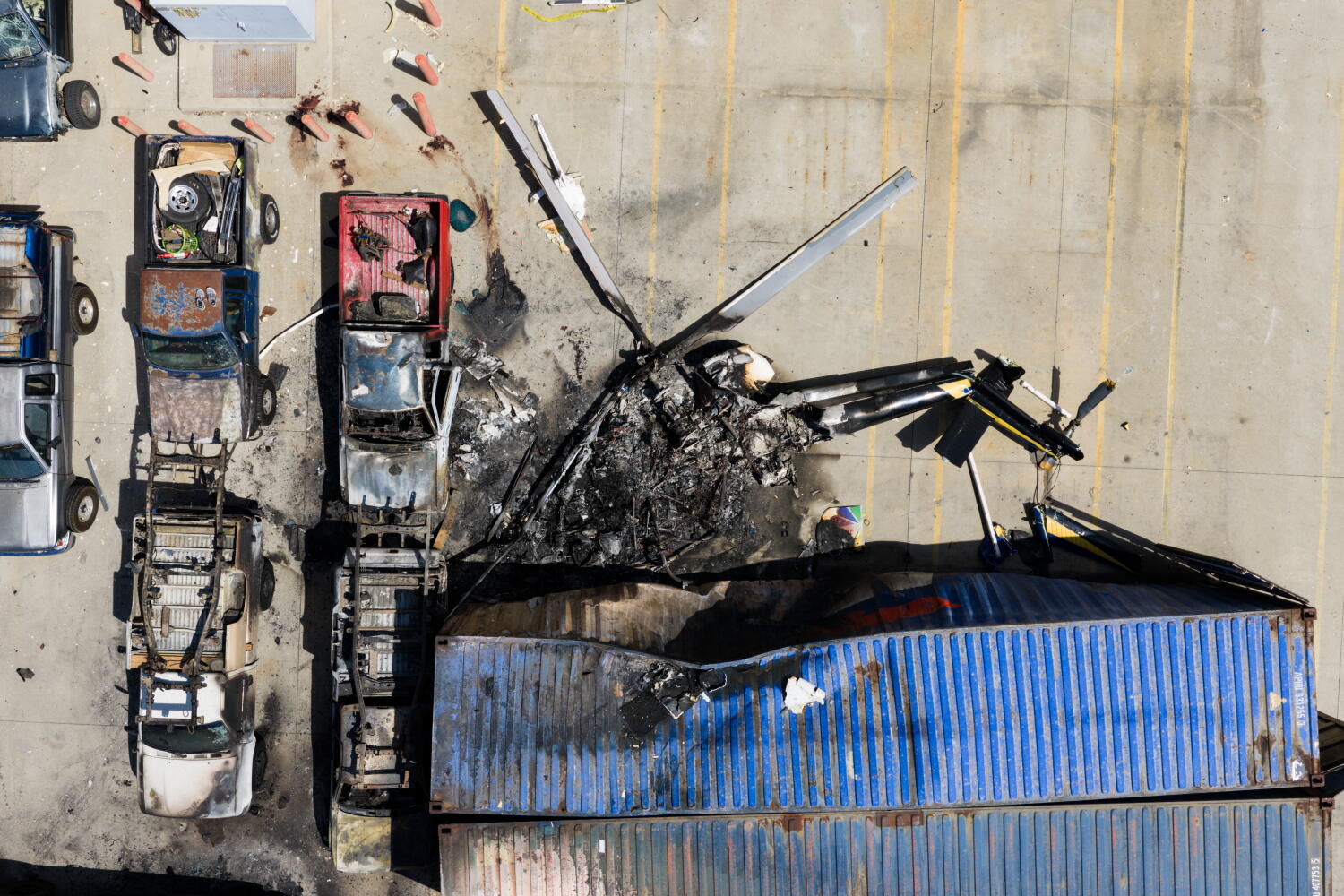
We love a good martyr story in media. When a local news helicopter goes down, taking seasoned veterans with it, the industry rolls out the standard cathedral of sorrow. We hear about the "eyes and ears in the sky," the brave aerial reporters scanning the sprawling asphalt arteries of Southern California, the unblinking sentinels of the commute. It makes for powerful television. It also completely masks an uncomfortable reality.
For the past twenty years, the local news chopper has transformed from an indispensable journalistic tool into an expensive, low-yield vanity project that bleeds station budgets while delivering minimal actual insight.
I have watched news directors sweat over line items, terrified to cut the bird because of what the competition or aging board members might say. They keep the rotor blades turning out of sheer superstition. Let us clear away the sentimentality and look at what aerial traffic and breaking news reporting actually achieved versus what it costs.
The Myth of Aerial Omniscience
The lazy consensus in modern broadcasting insists that you cannot cover a major market like Los Angeles without a multimillion-dollar aircraft hovering three thousand feet above the freeway. The argument relies on a romanticized version of breaking news: traffic jams, high-speed pursuits, and brush fires viewed from a privileged vantage point.
Let us break down the physics and the economics.
A standard news helicopter costs between two and four million dollars to acquire. Operating costs—fuel, insurance, specialized FAA-certified maintenance, hangar fees, and the salaries of dual pilots and photojournalists—easily run into the hundreds of thousands of dollars annually per ship. And what does the viewer get for this staggering capital expenditure?
Most of the time, they get a shaky, wide-angle shot of a white sedan driving fifty miles per hour on the 405 freeway, followed by an anchor in a studio guessing whether the suspect has a blinker on.
When a major brush fire erupts in the Santa Monica Mountains, the chopper gives you a smoke plume from a distance. It rarely gives you tactical truth. Cal Fire and local county departments have long since transitioned to high-definition ground cameras, drone fleets, and real-time GIS mapping that provide incident commanders with infinitely better data than a reporter shouting over the whine of a turbine engine.
The idea that a reporter circling a disaster zone in a helicopter is somehow performing high-altitude investigative journalism is a relic of the 1980s. Today, it is mostly expensive wallpaper.
The Economic Bleed That Nobody Mentions
Let us talk about the trade-offs. Local television stations are fighting a brutal, multi-front war for survival. Digital ad revenue plummeted, cable cord-cutting accelerated, and linear ratings continue an unyielding, generational slide. Station groups are slashing newsroom staff, trimming investigative units, and replacing experienced beat reporters with entry-level general assignment journalists expected to shoot, edit, and write three packages a day.
Yet, millions of dollars are routinely funneled into aviation fuel.
Why? Because of institutional inertia. News executives are terrified of the optics of abandoning the sky. If station X drops its helicopter, the consultants warn, station Y will claim dominance during the next major earthquake or high-speed pursuit. It is a prisoners dilemma played out in the clouds.
No one wants to blink first, even though every financial audit screams that the return on investment for live aerial footage has cratered. With high-definition traffic cameras blanketing every major interchange, dashcams on thousands of commercial trucks, and citizens equipped with 4K smartphones at every street corner, the monopoly on breaking news vantage points has evaporated.
You no longer need a million-dollar rotorcraft to see a pileup on the Ventura Freeway. You just need a well-curated Twitter feed or a Department of Transportation traffic API.
What Real Aerial Coverage Actually Costs Us
The defenders of the status quo will point to tragedies and emergencies, arguing that human lives are saved because a chopper spots a stranded motorist or guides emergency vehicles. That argument sounds noble, but let us look at the actual mechanics of modern emergency response.
First, commercial air traffic control and local law enforcement agencies increasingly view news helicopters not as partners, but as expensive hazards cluttering the airspace during active operations. When multiple news birds crowd a wildfire or a police standoff, they force fire-suppression aircraft to alter flight paths or ground temporarily to avoid a mid-air collision. The safety risk is real, documented, and consistently minimized by station marketing departments.
Second, the fixation on aerial spectacle warps news judgment. Stations will routinely pull production crews off complex municipal investigations, school board accountability reporting, or housing policy deep dives to circle a slow-speed pursuit for forty minutes. It is low-cost, high-adrenaline junk food for the ratings machine. It drains intellectual capital from the newsroom and channels it into a lens pointed downward at asphalt.
The Disruption Blueprint
If we were building a local news operation from scratch today, nobody in their right mind would allocate ten percent of the news budget to a flying glass bubble.
The smart regional players are already dismantling this model quietly. They are partnering with aerial data services, utilizing stationary traffic monitoring networks, and deploying lightweight, tethered drones or ground-based robotic cameras where live vantage points are genuinely required. They are taking those freed-up millions and reinvesting them where it actually moves the needle: investigative reporting units that uncover corruption, data journalists who analyze municipal budgets, and digital producers who reach audiences where they actually consume media.
The nostalgic narrative surrounding veteran aviation crews is understandable, but sentimentality is a terrible business strategy. The sky belongs to automation, data feeds, and nimble, low-cost sensors.
Stop funding the vanity fleet. Put the money back into the newsroom.