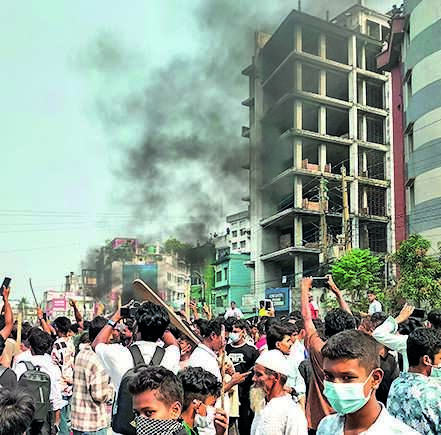
Hundreds of garment factories across Bangladesh are sitting silent right now, and tear gas is hanging over the Dhaka-Tangail Highway. If you only skim the headlines about fresh labour unrest hitting the Bangladesh garment sector, you might think this is just another routine wage dispute that will blow over once a government panel signs off on a pay bump.
You'd be dead wrong.
This week, a government-appointed Minimum Wage Board approved a 36 percent raise for entry-level apparel workers, pushing the monthly floor from 12,500 taka to 17,000 taka—roughly $138. Instead of clearing the streets in Gazipur, Savar, and Ashulia, that announcement poured gasoline on the fire. Around 400 factories remain shut down. Production losses have already blown past $428 million.
To understand why a 36 percent raise triggered riots instead of relief, you have to look past the surface numbers and examine the broken math inside global fashion supply chains.
Why a 36 Percent Wage Hike Failed to Stop the Protests
On paper, a 36 percent jump sounds generous. In almost any Western economy, a one-third pay bump overnight would look like a massive union victory.
In reality, it's the smallest percentage increase Bangladesh's ready-made garment (RMG) workers have seen in over a decade. Look at the recent history of wage revisions in the sector:
- In 2013, the minimum wage rose by 77 percent.
- In 2018, it climbed by 51 percent.
- In 2023, it went up by 56 percent.
Workers didn't walk onto the highways asking for luxury. During negotiations, labour federations initially demanded 30,000 to 32,000 taka ($240 to $260) a month, citing data showing that a basic household budget for a family of four in industrial hubs around Dhaka runs between 45,000 and 60,000 taka. Even after workers' representatives made painful concessions during late-night bargaining—dropping their floor all the way down to 18,000 taka—factory owners held firm at 17,000 taka and pushed the vote through 4-2.
When you're spending nearly everything you earn on rice, rent, and bus fare, a 4,500-taka raise that won't even hit your bank account until January feels like an insult. Sultana Begum, president of the Green Bangla Garments Workers Federation, put it bluntly earlier this month: workers aren't asking for extras, they're demanding the right to live with dignity.
The Street Reality in Gazipur and Ashulia
If you've ever spent time around the industrial belts outside Dhaka, you know how fast frustration turns physical when factories declare sudden "general holidays" under Section 13(1) of the Bangladesh Labour Act. Under that "no work, no pay" rule, factory owners can lock the gates during unrest and legally withhold wages for every closed day.
Workers see locked gates and lose daily pay. They spill onto the N3 and N4 highways. Police and over a hundred platoons of the paramilitary Border Guard Bangladesh move in with batons, sound grenades, and tear gas. Bricks fly. Buses burn. Meanwhile, local political operatives and plainclothes attackers have clashed with demonstrators on the roads, turning an economic survival fight into a volatile street battle.
The Trap Catching Both Factory Owners and Workers
Here's the uncomfortable truth that both labour activists and Western fast-fashion brands often gloss over: hundreds of Bangladeshi factory owners genuinely can't afford higher wages under their current contracts.
That doesn't excuse poverty pay. It explains why the system keeps breaking every few years.
Bangladesh's economy is heavily lopsided. Ready-made garments account for roughly 80.6 percent of the country's total export earnings. When the garment sector sneezes, the entire $500-billion economy catches pneumonia. Yet inside that massive export engine, small and mid-sized tier-two factories operate on razor-thin margins.
Consider what factory owners are juggling right now:
- Surging energy and utility costs that have eaten into operating budgets over the past two years.
- High domestic borrowing rates as state and private banks struggle with liquidity and non-performing loans.
- Flat or falling Free on Board (FOB) prices dictated by Western apparel buyers who still want $8 t-shirts and $18 jeans delivered on tight timelines.
When international brands refuse to raise the price they pay per garment, a sudden 36 percent spike in payroll costs doesn't come out of corporate profits in Stockholm, Madrid, or New York. It comes straight out of the operating cash flow of factories in Gazipur and Narayanganj. Weak factories either default on wages—which is what sparked the initial October walkouts over unpaid September salaries—or shut their doors permanently.
Why Global Buyers Are Already Moving Orders
The financial bleeding isn't hypothetical. According to survey data from the Bangladesh Garment Manufacturers and Exporters Association (BGMEA), just 18 days of recent disruption cost 317 factories an estimated $428 million in lost production. Worse yet, global buyers have already diverted roughly $254 million worth of orders away from Bangladesh to competing hubs like India, Vietnam, and Cambodia.
Once a major fashion brand moves a seasonal knitwear or denim order to a competitor in Tiruppur or Ho Chi Minh City, getting that contract back takes years. You don't just lose a single shipment; you lose long-term vendor allocation.
What Supply Chain Managers and Brands Should Do Right Now
If you source apparel from South Asia, manage retail procurement, or track emerging-market risk, waiting passively for the Dhaka highways to clear is a bad strategy. The December 1 implementation date for the new wage structure won't automatically restore calm, especially since workers won't see a single extra taka in their paychecks until January.
Here is how smart operators are handling the fallout right now:
- Audit your tier-one and tier-two suppliers for wage liquidity. Don't just ask your vendor if their factory is open today. Ask if they have the working capital to absorb the December 1 payroll jump without delaying November overtime or bonuses. Delayed overtime is the number one trigger for wildcat strikes.
- Adjust FOB unit prices for open-costing contracts. If your brand claims to support living wages in its annual sustainability report, prove it on the purchase order. Absorbing even a 3 to 5 percent unit price adjustment on labor-heavy woven garments can keep a mid-sized supplier solvent through Q1 2027.
- Build a 14-to-21-day buffer into spring 2027 shipping schedules. Between highway blockades on the Dhaka-Tangail corridor and port congestion at Chattogram, container lead times are erratic. Air-freighting delayed basics kills retail margins faster than paying slightly more upfront.
- Stop relying on single-country concentration. Even after Bangladesh's exports rebounded slightly in October to nearly $4 billion, structural dependence on one manufacturing hub remains a massive vulnerability. Dual-sourcing core basics across South and Southeast Asia isn't disloyal—it's basic risk management.
Bangladesh built an export powerhouse on the backs of four million garment workers who turned a struggling agricultural nation into one of Asia's fastest-growing economies. Until global apparel buyers stop squeezing factory gate prices while demanding Western compliance standards, the cycle of street protests, police crackdowns, and factory lockouts will keep repeating every time inflation spikes.
Check your Q1 purchase orders today, talk directly to your Dhaka merchandising teams before the December 1 wage rollout hits their books, and price the true cost of labor into your spring shipments.
Watch Bangladesh's 36% Wage Hike Fails to Stop Protests for a closer look at how the newly approved wage structure triggered fresh demonstrations and disrupted factory operations across Bangladesh's garment hubs.