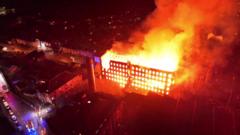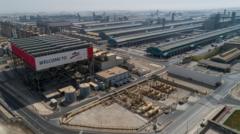
The recent wave of strikes on industrial centers across the Gulf has exposed a terrifying reality that energy markets are still trying to price in. This isn't just about the physical damage to storage tanks or the temporary dip in barrels per day. The true crisis lies in the fundamental failure of modern missile defense systems to protect the specific, hyper-integrated architecture of today's energy giants. For decades, the global economy has relied on the assumption that a handful of strategic chokepoints could be shielded by Western hardware. That assumption is now dead.
While initial reports focus on smoke and sirens, the long-term impact is a massive structural shift in how insurance, logistics, and sovereign wealth are managed in the Middle East. When a multi-million-dollar drone swarm bypasses a billion-dollar defense grid to hit a single, critical desalinization unit or a specific distillation column, it proves that the offense has finally outpaced the defense. The cost of protecting these sites is becoming higher than the value of the commodities they produce.
The Asymmetry of Modern Siege
Modern warfare in the Gulf has moved away from the "tanker wars" of the 1980s. Back then, the goal was to sink ships. Today, the objective is to paralyze the software and specialized hardware that keeps refineries running. Industrial control systems (ICS) are now the primary targets. When a kinetic strike hits a facility, it often serves as a "loud" distraction for a "quiet" cyber-intrusion that attempts to lock down the facility’s internal sensors.
Military analysts have watched as low-cost loitering munitions have evolved. These aren't the high-speed ballistic missiles of the Cold War. They are slow, low-flying, and made of materials that mimic the radar signature of a large bird. By the time a traditional radar array identifies them, they have already reached the terminal phase of their flight.
We are seeing a brutal demonstration of cost-imbalance. A group can manufacture a fleet of twenty suicide drones for the price of a single luxury SUV. To counter them, a defending nation must fire interceptor missiles that cost $2 million each. It is an economic war of attrition that the defenders are currently losing. The math simply does not hold up over a sustained campaign.
Why the Current Defense Shield is Leaking
The Patriot and Terminal High Altitude Area Defense (THAAD) systems were designed to hit large, predictable targets flying at high altitudes. They were never meant to stop a swarm of "lawnmowers with wings" hugging the coastline at fifty feet above sea level. This gap in the "lower-tier" defense is where the current industrial damage is happening.
The Fragmented Grid
Industrial sites in the Gulf are sprawling. A single refinery can cover thousands of acres. Protecting every square inch with short-range, point-defense systems like the C-RAM or the Iron Dome is a logistical nightmare. It requires thousands of personnel and a constant supply of ammunition.
Sensor Overload
In a high-traffic industrial zone, sensors are constantly dealing with "clutter." From flares at gas plants to heavy transport helicopters and maritime traffic, the electronic environment is noisy. Identifying a hostile drone within this mess requires sophisticated AI filtering that, quite frankly, is still prone to false negatives.
The Human Element
We often forget that these sites are staffed by thousands of foreign contractors. Every time a strike hits, the "expat flight" risk increases. If the technical experts who maintain these specialized German and American machines decide the hazard pay isn't worth their lives, the facilities will shut down even if they aren't physically hit. A refinery without engineers is just a very expensive pile of scrap metal.
The Global Price of a Local Fire
The ripple effects extend far beyond the burning site. When a major industrial hub in the Gulf goes offline, the global supply chain for high-end polymers and specialized chemicals breaks. Everyone talks about the price of crude oil, but they overlook the downstream dependencies. The plastic in your medical devices, the lubricants in European car factories, and the fertilizers used in Asian agriculture often trace their origins back to these specific GPS coordinates.
Financial markets have historically treated these attacks as "one-off" geopolitical events. This is a mistake. This is a sustained campaign of industrial sabotage designed to make the region uninvestable.
Consider the insurance markets. Lloyds of London and other major underwriters have already begun raising "War Risk" premiums. These costs are passed directly to the consumer. Even if no oil is lost, the cost of moving that oil increases because the risk of the port being closed or the refinery being hit is now a permanent line item on the balance sheet.
The Failure of Deterrence
For years, the mantra was that "retaliation" would stop these attacks. The idea was simple. If you hit our oil, we hit your launch sites. However, we are now dealing with decentralized actors who don't have traditional "centers of gravity." There is no single palace to strike or a centralized army to defeat. The threat is distributed, mobile, and often hidden among civilian infrastructure.
This creates a vacuum of accountability. When a strike occurs, the finger-pointing lasts longer than the actual fire. This ambiguity is a feature, not a bug, of the new conflict. It prevents a unified international response and allows the aggressors to continue their campaign with relative impunity.
The Engineering Challenge of Resilience
If you cannot stop the missile, you must make the facility capable of taking the hit. This is the new direction of industrial architecture in the region. We are seeing a move toward modularization.
Instead of building one massive, centralized refinery—which acts as a "single point of failure"—companies are looking at smaller, interconnected units. If one is destroyed, the others can continue to operate. This is significantly more expensive to build, but it is the only way to survive in a permanent high-threat environment.
Hardened Infrastructure
We are seeing the return of reinforced concrete bunkers for critical control rooms. The "glass and steel" aesthetic of the early 2000s is being replaced by something that looks more like a military outpost.
Redundant Logistics
Traditional pipelines are being supplemented by massive trucking fleets. While less efficient, trucks are harder to target en masse than a fixed, 500-mile-long pipe that can be seen from space.
The Coming Energy Realignment
The instability in the Gulf is forcing Western powers to rethink their "just-in-time" energy strategies. We are seeing a massive push for domestic refining capacity in North America and Europe, even if it is less "economically efficient" than importing from the Gulf. This is about national security over profit margins.
The irony is that as the world tries to transition to "green" energy, the minerals and components needed for solar panels and EV batteries are often processed in regions that are becoming equally unstable. There is no escape from the reality of geopolitical risk; there is only the choice of which risk you are willing to manage.
The "Golden Age" of cheap, safe energy from the Middle East is closing. What follows is a period of high volatility where the "security premium" will be the most significant part of your energy bill. Governments that fail to secure their own energy independence today will find themselves at the mercy of a drone swarm tomorrow.
Check your local storage capacity and the origin of your refined fuels. If your strategy relies on a stable Gulf, your strategy is built on sand. Move your assets toward hardened, localized production or prepare to pay the "volatility tax" indefinitely.