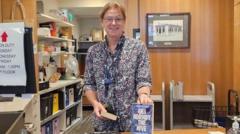
The air in the community hall usually smells of damp wool and floor wax. It is a scent that has defined British local democracy for a century. On Friday afternoons, the heavy oak doors would swing open, and a Member of Parliament would sit behind a folding plastic table, armed with nothing but a notepad, a pen, and a willingness to listen to why the Number 12 bus is always late.
But the doors are staying locked now.
A quiet, clinical notice appeared on a constituency website this week. It didn’t use words like "fear" or "retreat." Instead, it spoke of "incidents." It mentioned "safety protocols." It informed the public that face-to-face surgeries—those intimate, often heated, quintessentially human meetings between the governed and the governors—have been suspended indefinitely.
Just like that, another thread in the social fabric snaps.
To understand why this matters, you have to look past the security briefing. Consider a woman we will call Mary. Mary is seventy-two. She doesn't have an email address, and her grip on the digital world is tenuous at best. For Mary, the MP surgery was the court of last resort. When the pension bureau lost her paperwork, or the damp in her council flat became unbearable, she didn't send a tweet. She put on her best coat and went to see her representative. She looked them in the eye. She waited her turn in a queue of people who were all, in their own way, slightly broken by the system.
There is a profound, almost sacred power in being seen. When a politician sits across from a constituent, they aren't just processing data. They are absorbing the weight of a life. They see the trembling hands, the frayed cuffs, and the genuine desperation that a PDF attachment simply cannot convey.
Now, that physical space is being swallowed by the digital void.
The "incidents" mentioned in the official statements are not vague or trivial. They are the sharp end of a jagged wedge driven into public life. In recent years, the temperature of our national conversation has moved from simmering to a violent boil. We have seen the unthinkable: MPs murdered in the very places they went to serve. We have seen staff cornered in offices by shouting mobs. We have seen the casual, daily vitriol of social media spill over the screen and into the street.
The decision to stop face-to-face meetings is a rational response to an irrational climate. No one should have to risk their life to discuss a planning application. Yet, the rationality of the move doesn't lessen the tragedy of its necessity.
When we move these interactions to Zoom or "secure web-forms," something vital evaporates. The screen is a filter. It strips away the nuance of human presence. It turns a citizen into a "user" and a grievance into a "ticket." On a video call, it is much easier to be rude, much easier to be dismissive, and infinitely harder to find common ground. The screen gives us distance, but distance is the enemy of empathy.
The loss of the face-to-face surgery is the loss of the village square. It is the final retreat into the bunker.
The data supports this grim trajectory. Security spending for parliamentarians has soared into the millions. Protective measures—panic buttons, reinforced glass, bodyguards—are now standard issue. We are witnessing the physical hardening of our democracy. We are building fortresses where there used to be front porches.
Think about the message this sends to the next generation of leaders. If you want to serve your community, you must also be prepared to live like a high-value target. This filters the pool of who steps forward. It favors the thick-skinned, the wealthy, and those who are comfortable living behind a digital or literal barricade. The community leader who just wants to fix the local park might think twice if the price of entry is a credible death threat.
This isn't just about the safety of 650 individuals in Westminster. It is about the health of the millions who need to believe that their voice carries weight. When the MP stops meeting the public, the public stops feeling represented. They feel managed.
The irony is bitter. In an age where we are more "connected" than ever, we are losing the only connection that actually builds trust: the physical presence of one human being standing with another. We have traded the messy, loud, complicated reality of the community hall for the sterile, safe silence of the inbox.
The "incidents" won.
The tragedy isn't just that the doors are locked. The tragedy is that we are slowly forgetting what it felt like when they were open.
Tonight, the community hall will be dark. The floor wax will go unsmelled, and the folding chairs will remain stacked in the corner. Somewhere, a person like Mary is sitting at a kitchen table with a stack of confusing letters, wondering who is left to look her in the eye and tell her they will help. She is looking for a door that is no longer there.
We are all safer now, perhaps. But we are also much more alone.