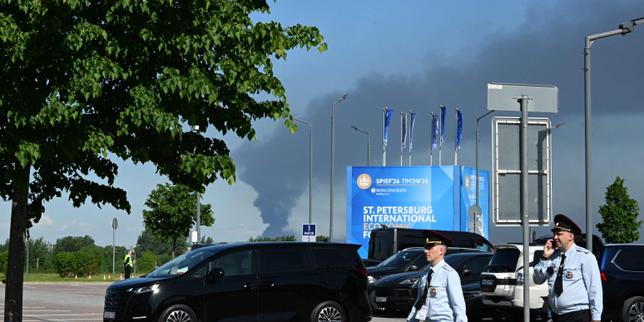
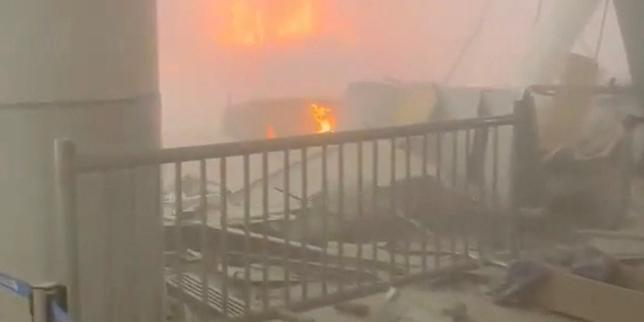
The black smoke billowed directly over the banners of the St. Petersburg International Economic Forum, smudging the opening hours of Vladimir Putin’s premier showcase of economic survival. Kyiv did not just launch an array of one-way attack drones; it systematically dismantled the illusion of rear-area sanctuary that the Kremlin spent four years trying to project. The strike on the Petersburg Oil Terminal on June 3, 2026, alongside attacks on the nearby Kronstadt naval hub and a critical military electronics factory in Tambov, marks a shift in the arithmetic of the war.
This is no longer a localized war of attrition. It is a targeted, tech-driven decapitation of the logistics and luxury that sustain Russia’s political elite. Read more on a connected issue: this related article.
While Kremlin officials rushed to implement the "Kover" security plan at Pulkovo Airport—grounding flights and severing mobile internet access across the city—delegates from the Global South and Western outliers arrived to see the burning infrastructure of Russia’s largest Baltic transshipment hub. The physical damage to the oil tanks is costly, but the collapse of the air defense canopy over Russia’s second-largest city is the true catastrophe for Moscow.
The Broken Shield of Leningrad Oblast
For decades, the air defenses surrounding St. Petersburg were engineered to counter high-altitude NATO threats coming over the Baltic Sea. Massive S-400 missile batteries and early-warning radars look toward the horizon for supersonic signatures. They were never designed to catch a swarm of low-flying, low-radar-cross-section carbon-fiber drones traveling more than 1,000 kilometers from the Ukrainian border. More journalism by TIME highlights comparable perspectives on the subject.
Ukraine’s Unmanned Systems Forces utilized a complex flight path that traced river valleys and exploited gaps between regional radar coverage zones. By flying at altitudes below 50 meters, the drones effectively hid in the ground clutter of Russia’s internal topography. The internal air defense network, overextended by the need to protect assets along the frontline and around Moscow, left the northern industrial hubs exposed.
Russia's Ministry of Defense claimed to have downed 354 drones across 16 administrative regions during the overnight raid. Yet, the failure to stop the small cluster that penetrated the Kirovsky district reveals a critical bottleneck in Russian defense manufacturing. Russia cannot build short-range point defense systems, like the Pantsir-S1, fast enough to protect every refinery, naval base, and economic forum simultaneously.
Every battery deployed to guard a refinery in the Baltic is one less system protecting a supply depot in Rostov or a command post in occupied Crimea.
Economic Showcase Under a Pall of Smoke
The timing of the strike was calculated for maximum political leverage. The St. Petersburg International Economic Forum (SPIEF) has been the Kremlin’s primary tool for demonstrating that Western sanctions have failed to isolate the Russian economy. With Saudi Arabia as the guest of honor, sending a 200-strong delegation alongside officials from China and the UAE, the forum was intended to highlight "Pragmatic Dialogue: the Path to a Stable Future."
Instead, international executives arrived to a city under a state of digital and physical siege. The cutting of mobile data networks, an emergency measure to prevent drones from using local cellular towers for terminal guidance updates, disrupted the very technology panels the forum sought to promote.
Russia’s economic resilience relies heavily on its ability to export refined petroleum products through the Baltic. The Petersburg Oil Terminal handles up to 12.5 million metric tons of fuel annually. By hitting this specific node, Ukraine directly targets the financial engine funding Russia’s military industrial expansion.
The Asymmetric Math of Deep Strikes
The economic calculation of this campaign heavily favors Kyiv. A single long-range Ukrainian strike drone costs between $20,000 and $50,000 to manufacture, utilizing off-the-shelf satellite navigation modules and localized assembly lines. Conversely, the economic fallout of a successful strike includes:
- Millions of dollars in lost oil infrastructure and disrupted supply contracts.
- The deployment of multi-million dollar interceptor missiles that fail to hit the target.
- Secondary industrial damage, such as the simultaneous strike on the Progress factory in Tambov, which produces specialized aviation and missile control components.
The hit on the Kronstadt naval base further complicates the strategic picture. Reports from Ukraine's Unmanned Systems Forces indicate that a Russian missile corvette undergoing repairs was damaged in the harbor. This proves that Russia's naval assets are no safer in their home ports on the Baltic than they are in the Black Sea.
The war has entered a phase where distance is no longer a defense. By striking the Kremlin's flagship event at its moment of maximum visibility, Ukraine demonstrated that the infrastructure supporting Russia's military effort can be reached, observed, and destroyed at will. The smoke over St. Petersburg will clear, but the vulnerability of Russia's deep interior remains permanently exposed.