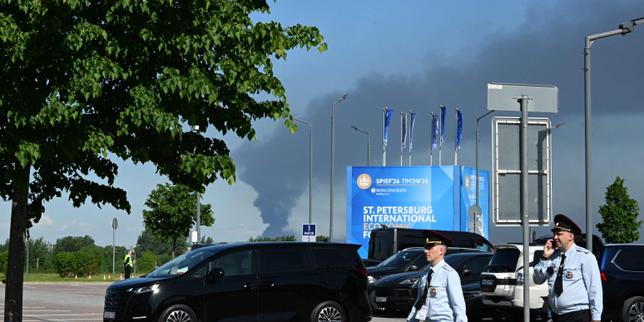
A massive Ukrainian drone strike hit the St. Petersburg Oil Terminal and the Kronstadt naval base early Wednesday morning, sending thick plumes of black smoke directly over the opening session of the St. Petersburg International Economic Forum. The long-range attack, which traveled more than 1,100 kilometers from the Ukrainian border, directly targeted Russia's strategic energy infrastructure and Baltic Fleet assets at the exact moment Vladimir Putin attempted to showcase economic normalcy to foreign delegates.
While the Kremlin's regional governors claimed that air defenses shot down dozens of incoming aircraft, the visible fires at the port terminal told a vastly different story. This operation demonstrates that Ukraine's homegrown drone fleet can bypass dense layered air defenses deep inside Russian territory, shifting the economic weight of the conflict directly onto Moscow's doorstep.
Shattering the Illusion of the Russian Davos
The timing of the strike was calculated for maximum political and economic disruption. The St. Petersburg International Economic Forum, historically referred to as the Russian Davos, is the Kremlin's premier annual event designed to attract foreign capital and project global influence. As delegations from the Global South, Saudi Arabia, and various corporate entities arrived at the Expoforum convention center, they were greeted by darkened skies and the distinct smell of burning petroleum.
The primary target was the JSC St. Petersburg Oil Terminal, the single largest oil-handling complex in northwestern Russia. Spanning 37 hectares and classified as a strategically important enterprise for national security, the facility acts as a crucial arterial hub for Russian energy exports that fund the ongoing invasion. Multiple explosions rocked the port area, igniting large storage tanks holding light and heavy petroleum products.
Simultaneously, long-range drones struck pure military infrastructure at the nearby Kronstadt naval base, home to the Russian Navy’s Baltic Fleet. Early assessments indicate that at least one naval corvette docked at the seaport suffered visible damage. The dual-track assault successfully disrupted local operations, forcing Pulkovo Airport to temporarily suspend all airspace activity and grounding dozens of arriving commercial and private flights.
The Technology Bypassing the S400 Network
Reaching St. Petersburg requires transiting through some of the most heavily fortified airspace on the planet. To achieve this, Ukrainian engineers have abandoned standard commercial drone templates in favor of specialized, low-radar-cross-section composite airframes powered by small, fuel-efficient internal combustion engines.
[Ukraine Border] ---> (Low-Altitude Route bypassing S-400 Radars) ---> [St. Petersburg Port]
                                                                        |---> Oil Terminal (Fire)
                                                                        |---> Kronstadt Base (Corvette Damaged)
These uncrewed aerial vehicles utilize pre-programmed terrain-matching algorithms and autonomous inertial guidance systems. By flying at extremely low altitudes, often skimming just above tree lines, the drones remain beneath the detection horizon of long-range Russian search radars like the S-400 Triumf systems.
- Electronic Warfare Mitigation: The guidance systems do not rely continuously on civilian GPS networks, rendering Russian GPS-spoofing and jamming counter-measures in the Leningrad oblast largely ineffective.
- Mass Saturation Tactics: By launching dozens of aircraft simultaneously alongside cheaper decoy drones, Ukraine forces regional air defense units to deplete their limited ready-to-fire surface-to-air missile stockpiles.
The Russian Ministry of Defense asserted that 354 drones were intercepted across 15 regions during the overnight wave, with Leningrad Governor Alexander Drozdenko claiming 59 downs in his territory alone. However, the sheer volume of successful impacts at high-value nodes proves that saturation tactics are actively overwhelming localized point-defense systems like the Pantsir-S1, which are meant to protect critical infrastructure.
The Attrition Strategy of Long Range Sanctions
Ukrainian President Volodymyr Zelensky characterized the operation as a vital component of Kyiv's "long-range sanctions" strategy. With the frontline geometry largely static due to heavy mining and tactical reconnaissance drones, Ukraine has intentionally transformed the deep rear of the Russian Federation into an active theater of economic warfare.
This is not an isolated incident of harassment. Robert Brovdi, commander of Ukraine's Unmanned Systems Forces, stated that Ukrainian units have successfully struck 20 distinct Russian oil terminals over a recent 33-day campaign. The financial ramifications of these systematic disruptions are severe. A previous series of refinery strikes earlier this year generated an estimated $970 million in lost export revenue and forced domestic fuel restrictions within Russia.
| Targeted Asset | Strategic Value | Operational Impact (June 3) |
|---|---|---|
| Petersburg Oil Terminal | Largest NW energy export hub; 12.5M metric ton capacity | Multiple storage tanks destroyed; export operations halted |
| Kronstadt Naval Base | Main headquarters for the Baltic Fleet | Damage reported to a naval corvette; shipyard infrastructure hit |
| Tambov Progress Plant | Military-industrial weapons production facility | Production lines disrupted via secondary overnight strike |
The economic friction created by these strikes extends far beyond the immediate cost of replacing charred steel storage tanks. Insurance premiums for commercial vessels operating in the Baltic Sea are expected to climb, and the necessity of pulling air defense assets away from the active front lines to protect domestic industrial sites places an additional logistical burden on the Russian military command structure.
Moscow Explores Defensive Limits
The Kremlin's official response has focused on minimizing public alarm while promising retaliation. Presidential spokesman Dmitry Peskov indicated that Russian forces are adjusting their operations to make their deep-defense responses systematic. Yet, the reality on the ground reveals a structural vulnerability that cannot be easily fixed by policy declarations.
Russia possesses a vast geographic expanse, but it does not have an infinite supply of advanced air defense systems. Every Pantsir or Tor system deployed to protect a refinery or a prestige forum in St. Petersburg is a system stripped away from protecting supply depots in Donbas or airfields near Crimea. Ukraine's domestic drone industry has successfully industrialized the production of long-range strike platforms, turning the sheer scale of Russian territory into a liability rather than a shield.