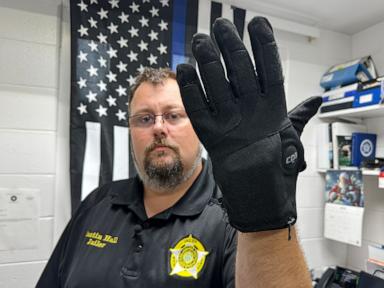
U.S. Immigration and Customs Enforcement recently finalized a $16.7 million contract to acquire 6,000 pairs of specialized gloves capable of delivering painful electric shocks, igniting a ferocious political battle on Capitol Hill and drawing intense scrutiny from civil rights organizations.
The procurement targets the Generated Low Output Voltage Emitter, known as the GLOVE, manufactured by Kentucky-based Compliant Technologies. To the casual observer, they look like standard tactical gear. A discreet button changes that reality instantly. Once pressed, the material transmits a localized electrical charge directly through a subject's skin, designed to break muscular resistance without leaving the distinct burn signatures or contact marks associated with traditional Tasers.
Federal paperwork describes the items as conductive distraction and de-escalation tools meant for crowded detention environments, transport operations, and contentious street arrests. Agency leadership insists the hardware acts as an essential buffer, giving personnel an intermediate compliance option that sits comfortably below lethal firearms on the use-of-force continuum.
Lawmakers disagree sharply. A coalition of sixteen Democratic senators, spearheaded by Nevada's Catherine Cortez Masto, dispatched a formal challenge demanding an immediate cancellation of the order. They argue that deploying shock-delivery mechanisms during routine civil immigration stops invites systemic abuse.
The Anatomy of a Contested Procurement
Federal acquisition logs reveal the transaction bypassed conventional open-market bidding. ICE justified the no-bid arrangement by pointing to an urgent operational requirement. Officers face unprecedented hostility in the field, according to agency defense filings, and require empty-hand compliance instruments that reduce reliance on kinetic brawls or sidearms.
Each pair commands a steep price tag of roughly $2,495. Multiply that across 6,000 units, and the financial commitment becomes substantial for a single accessory class. Critics maintain that spending millions of taxpayer dollars on pain-compliance gear signals a disturbing escalation in enforcement posture, particularly as mass deportation initiatives sweep urban centers across the country.
The friction highlights a deeper philosophical split regarding federal law enforcement oversight. Proponents see a pragmatic upgrade that keeps officers and detainees safer by ending physical struggles quickly. Detractors see a quiet, highly deniable instrument of torture that lacks public visibility. Unlike a firearm discharge, which commands immediate administrative investigation and auditory recognition, a localized electrical pulse applied via an open palm leaves little trace and can easily be omitted from standard use-of-force logs unless internal telemetry is meticulously audited.
Scrutiny Over Safety Claims and Institutional History
Manufacturer guidelines caution that the technology should never serve as a punitive measure or a response to mere verbal disrespect. Warnings explicitly restrict use on vulnerable populations, including pregnant individuals, the elderly, and young children. Yet congressional critics point out that ICE's internal compliance culture has historically struggled with accountability during high-stress operations.
Past deployments of less-lethal options by Department of Homeland Security personnel have occasionally resulted in severe, permanent injuries. Documented incidents involving the GLOVE in local correctional settings further complicate the narrative. In one pending legal challenge originating from a Kentucky detention facility, attorneys allege a detainee sustained dozens of consecutive activations, with individual cycles lasting far beyond manufacturer safety thresholds.
Embeddable microprocessors inside the units store activation logs, a feature ICE points to as an ironclad audit trail. Whether administrative oversight bodies will systematically review those digital logs—or whether they will languish unexamined in digital archives—remains the central anxiety for congressional watchdogs.
The agency maintains that comprehensive training frameworks will govern the rollout before any operational deployment occurs. Field implementation remains months away while policy directives are finalized.
As the first shipments make their way toward federal warehouses, the debate over where security ends and state-sanctioned cruelty begins grows louder, cementing these electrified textiles as the latest flashpoint in America's immigration wars.


