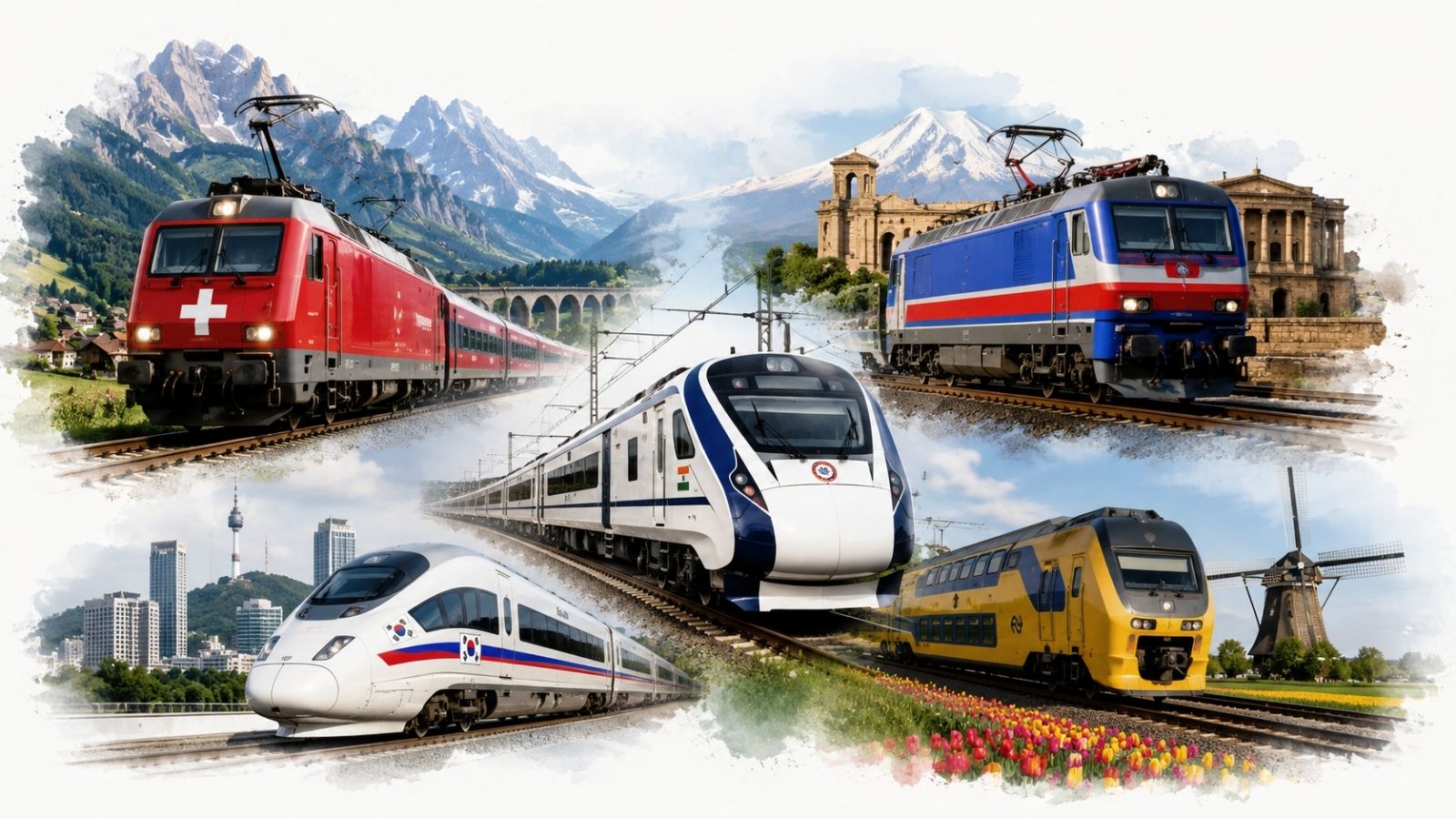
Global logistics are undergoing a quiet, violent reshaping. While politicians argue over carbon credits and electric vehicle subsidies, heavy industry is quietly stringing copper overhead across thousands of miles of tracks.
The primary query driving public curiosity revolves around which nations possess the most electrified railway networks and precisely where India stands on that leaderboard. As of recent disclosures by the International Union of Railways and national transport ministries, India has vaulted near the very top of the global standings, achieving 99.6 percent electrification of its broad-gauge network. It now trails only Switzerland in sheer proportion of network coverage among major systems, while leaving traditional industrial economies trailing in its wake. China sits at roughly 82 percent, Spain at 67 percent, Japan at 64 percent, France at 60 percent, and the United Kingdom languishes around 39 percent.
Yet raw percentages tell only a sanitized fraction of a much harsher story. Behind these numbers lie decades of bureaucratic inertia, staggering capital expenditures, and engineering challenges that break regional economies.
The Engineering Mechanics Behind the Copper Shift
To understand why transitioning a railway from diesel combustion to overhead electric catenary wires is an ordeal, one must look at the physics of tractive effort. Diesel-electric locomotives carry their own heavy power plants, burning fuel to turn generators that drive electric traction motors. They are self-contained, highly inefficient rolling power stations. Electric trains, conversely, draw continuous current from high-voltage overhead lines, boasting energy conversion efficiencies near 95 percent compared to a diesel engine's meager 30 percent.
The math is brutal. But stringing wire over thousands of miles of undulating terrain, aging tunnels, and congested urban bottlenecks requires tearing up operational schedules that have run uninterrupted for over a century.
Consider a hypothetical example. A single trunk corridor spanning one thousand miles cannot simply be shut down for three years while crews erect masts and substations. Freight must move. Commuters must travel. Engineers must execute massive infrastructure overhauls during nightly maintenance windows lasting barely four hours, fighting extreme weather, land acquisition disputes, and supply chain bottlenecks for heavy steel components.
Decoding the Global Standings
Switzerland remains the gold standard because of geographic necessity and complete political consensus. Operating in alpine passes where tunnel ventilation makes diesel exhaust lethal, the Swiss federal system achieved 100 percent electrification decades ago. But scaling that model to a continental landmass is an entirely different battlefield.
India's acceleration provides a fascinating case study in centralized execution. Between the founding decades of its post-independence era and 2014, the pace of railway electrification crawled at a modest historical average. Then came a hard pivot toward mission-mode deployment. Over roughly a dozen years, more than 48,000 route kilometers were brought under wire.
This hyper-focus changed national balance sheets. Diesel consumption for Indian train operations plummeted from nearly 3 billion liters annually down to roughly 1 billion liters. For an oil-importing economy, this substitution saved billions in foreign exchange reserves while shielding freight logistics from international crude oil price shocks.
Meanwhile, western economies stumble. In the United Kingdom, historic projects like the Great Western Main Line electrification suffered from catastrophic budget overruns, poor project management, and chronic delays, eventually resulting in scaled-back ambitions. British rail commuters still contend with aging diesel multiple units rattling down Victorian tracks because the capital cost of retrofitting archaic clearances under low bridges proved politically toxic.
The Hidden Vulnerabilities of Electric Rail
An electrified railway is only as clean as the power plant feeding the grid. This represents the dirty secret of the global rail electrification boom.
If a nation powers its electric locomotives by burning domestic coal or importing liquefied natural gas, the carbon reduction is merely shifted from the locomotive exhaust pipe to a distant smokestack. Progressive networks have recognized this trap, pairing grid expansions with dedicated renewable generation. India, for instance, has integrated over 1,260 megawatts of solar and wind capacity directly to support traction and station loads, though fossil fuels still form the baseline of the national grid.
Another vulnerability is systemic fragility. A diesel locomotive can crawl through a localized blackout. An electric train network paralyzed by a single grid substation failure or extreme weather event stops dead. As climate volatility increases storm frequencies, overhead catenary lines subjected to high winds and ice accumulation become prime points of failure. High-speed lines in Europe and Asia routinely face speed restrictions or total shutdowns when extreme heat warps steel catenary wires or high winds threaten to bring down pantographs.
The Freight Economics Trap
Passenger lines capture the headlines, but freight moves the needle on national productivity. Countries struggle with electrification because heavy freight trains require massive electrical current surges, demanding robust sub-stations spaced closely along heavy-haul industrial corridors.
Nations like the United States chose a different path entirely, relying on private freight rail networks powered by massive, multi-unit diesel locomotives running on cheap domestic shale oil. The American rail network boasts immense cargo volumes, yet its electrification rate remains stubbornly near zero outside of small urban commuter systems. Private Class I railroads in North America have historically calculated that the massive capital expenditure required to erect catenary poles across thousands of miles of empty prairie simply does not yield an acceptable return on investment compared to burning diesel.
The divergence between passenger-dense Asian and European networks and freight-heavy American corridors highlights a fundamental truth. There is no single universal template for modern transit infrastructure. Geography, population density, primary fuel sources, and state capacity dictate winners and losers in the global iron grid race.
As old infrastructure hits the end of its operational lifecycle, nations failing to adapt face structural obsolescence. The copper wires stretching across continents are not merely transport upgrades. They are the new arteries of geopolitical and economic survival.
This short video clip provides a quick overview of India's recent milestone in reaching 99.6 percent railway electrification on its broad-gauge network.
http://googleusercontent.com/youtube_content/1