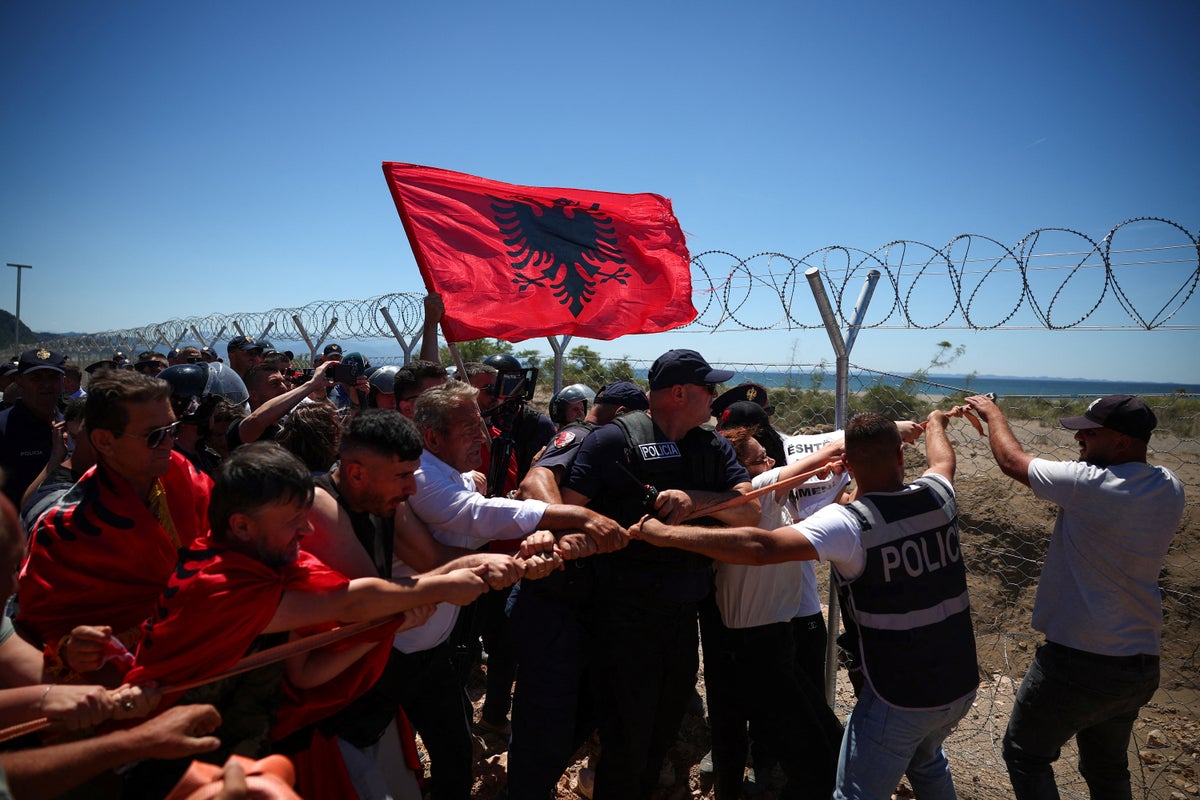
The physical dismantling of security barriers along Albania’s Adriatic coast this weekend was not just an outburst of local vandalism. When 200 villagers in Rrjoll tore down metal and razor wire fences surrounding a luxury development site, they tore through the polished public relations narrative of a multi-billion-dollar Balkan tourism boom. The unrest, which has rapidly escalated from small coastal blockades into a nationwide movement dubbed the Flamingo Revolution, represents a severe structural crisis for international private equity, local sovereignty, and the rule of law. What began as a high-profile real estate play by Jared Kushner and Ivanka Trump has collided with a volatile mixture of ancestral land disputes, environmental degradation, and institutional corruption investigations.
For weeks, the public focus has rested on the star power of the investors and the pristine aesthetics of the Vjosa-Narta nature reserve. Yet the real crisis is institutional. The protests are expanding geometrically because the Albanian government, led by Prime Minister Edi Rama, altered national conservation laws to pave the way for foreign mega-resorts. Now, Albania's state anti-corruption agency, SPAK, is formally investigating the legislative maneuvering behind these land allocations. The fences are coming down because local populations realize that international capital is using state power to overwrite their legal rights and ecological heritage.
The Barefoot Discovery and the Corporate Shield
The official origin story of the project sounds like a luxury travel brochure. Ivanka Trump recounted during a recent media appearance that she and Kushner discovered the location entirely by accident while vacationing on a friend’s yacht. They stopped for a swim, walked up the island of Sazan barefoot, and were instantly captivated by the untouched Mediterranean terrain.
The financial reality is far more calculated. The proposed $1.6 billion development spans two highly sensitive zones: Sazan Island, a former communist military base, and the Pishë Poro-Nartë protected wetland. The plans outline a massive city-scale footprint comprising 10,000 hotel rooms, luxury villas, private apartments, and a deep-water marina.
When public resistance intensified, the corporate structure surrounding the investment began shifting. Affinity Partners, the Miami-based private equity firm founded by Kushner with billions in sovereign wealth funding, has actively sought to distance its primary fund from the immediate fallout. A public relations agency representing the firm stated that Affinity is not directly developing the site, claiming instead that investors are participating solely in their personal capacity through an entity named Sazan Real Estate Development LLC.
This corporate distinction means little to the people living on the ground. To the local farmers and fishermen along the coast, the influx of heavy machinery, the clearing of ancient pine forests, and the destruction of sand dunes are all driven by the same concentrated economic power. The project was rapidly granted "special status investor" privileges by the Albanian government, a designation that effectively immunizes private developers from standard municipal zoning restrictions and fast-tracks the expropriation of territory.
The Systemic Rewriting of Conservation Law
To understand why thousands of protesters are carrying cardboard cutouts of pink flamingos through the capital city of Tirana, one must look at how the legal framework of the Balkan nation was systematically dismantled. Albania contains some of the last undeveloped, non-commercialized coastlines in Europe. This lack of development was an accidental byproduct of decades of isolation under a brutal Stalinist dictatorship, leaving habitats like the Narta Lagoon to become critical ecological sanctuaries for endangered migratory birds and the rare Mediterranean monk seal.
As European tourism demand surged, these protected areas became the most valuable real estate assets in the country. Instead of enforcing conservation mandates, the government chose to alter them.
In 2022, the state redrew the boundaries of the Vjosa-Narta protected area to accommodate the construction of the Vlora airport, an infrastructure project explicitly designed to feed luxury tourism. Then, in early 2024, the parliament passed a sweeping amendment that loosened conservation restrictions entirely. The new law explicitly permitted the construction of five-star luxury hotels inside previously sacrosanct nature reserves, provided the projects carried special strategic economic value.
This legislative pivot bypassed public consultation entirely. Local environmental groups, including PPNEA-BirdLife Albania, argue that building a luxury complex of this magnitude within a wildlife sanctuary destroys the ecosystem permanently. The bulldozers currently cutting tracks through the dunes are not performing minor technical surveys; they are altering the topography of a globally recognized biodiversity hotspot.
Blood, Soil, and the Privatization Mirage
While international headlines focus heavily on environmental conservation, the second front of this crisis is rooted in property ownership. The weekend clash in Rrjoll, situated in northwestern Albania, exposed a systemic flaw in how the state manages land titles.
Unlike the southern Sazan project, the Rrjoll demonstration saw hundreds of villagers clash with police over what they term outright land theft. More than 200 families assert that the land handed over to five-star resort developers was unconstitutionally confiscated from them.
Property rights in post-communist Albania have been chaotic for over three decades. When the regime collapsed in 1991, land redistribution was handled sloppily, leaving thousands of families with legitimate ancestral claims but overlapping or unrecorded titles. The Rama administration has frequently used this legal ambiguity to declare prime coastal land as state-owned, subsequently privatizing it for foreign investment syndicates under the guise of national economic development.
Local landowners feel completely cut off from the wealth being generated on their doorsteps. Investors have repeatedly declined to consult with the local communes, leading to deep structural resentment. The anger is no longer philosophical. It is existential. When private security guards were captured on video dragging an activist away from a coastal cliff, it transformed a regional land dispute into a broader struggle over human rights and civic dignity.
The Geopolitical Stakes and the European Illusion
The escalation of this real estate crisis arrives at a critical geopolitical juncture for the Western Balkans. Prime Minister Rama has aggressively defended the Kushner-linked project, stating bluntly that there is absolutely no chance the investment will be halted as long as he remains in office. Rama frames the mega-resort as an essential catalyst to transform Albania from a historic backwater into a premier luxury destination, a move he claims will accelerate the country’s goal of joining the European Union by 2030.
The European Union itself views the situation through a completely different lens. Albania’s path to EU ascension requires strict compliance with Western environmental standards and rigorous anti-corruption metrics. By rewriting conservation laws to accommodate high-net-worth foreign entities, the Albanian government is actively jeopardizing its European integration prospects. Nearly 100 civil society organizations have petitioned parliament to repeal the 2024 environmental amendments, explicitly warning that the Kushner project sets a dangerous precedent of legal regression.
A haunting precedent already exists just across the border in Serbia. In late 2024, an investment plan backed by Kushner’s circle to transform a historic, bombed-out military headquarters in Belgrade into a luxury commercial hub fell apart amid systemic scandal. Serbian prosecutors charged multiple high-ranking officials, including a government minister, with abuse of office and document falsification related to the project's land transfers. Kushner ultimately withdrew from the Belgrade venture, but the blueprint of aggressive legislative manipulation followed by sudden legal collapse appears to be repeating itself along the Albanian coast.
The ultimate failure of these grand real estate strategies lies in the delusion that local populations will quietly accept displacement if the incoming capital is sufficiently massive. As the metal fences continue to buckle under the weight of public opposition, the financial risk profiles for these projects are shifting from high-reward to liabilities. International developers can secure all the top-down state decrees they desire, but without local social licenses, a resort footprint inside a contested wetland remains nothing more than a highly vulnerable concrete fortress on shifting sand.



..jpg)