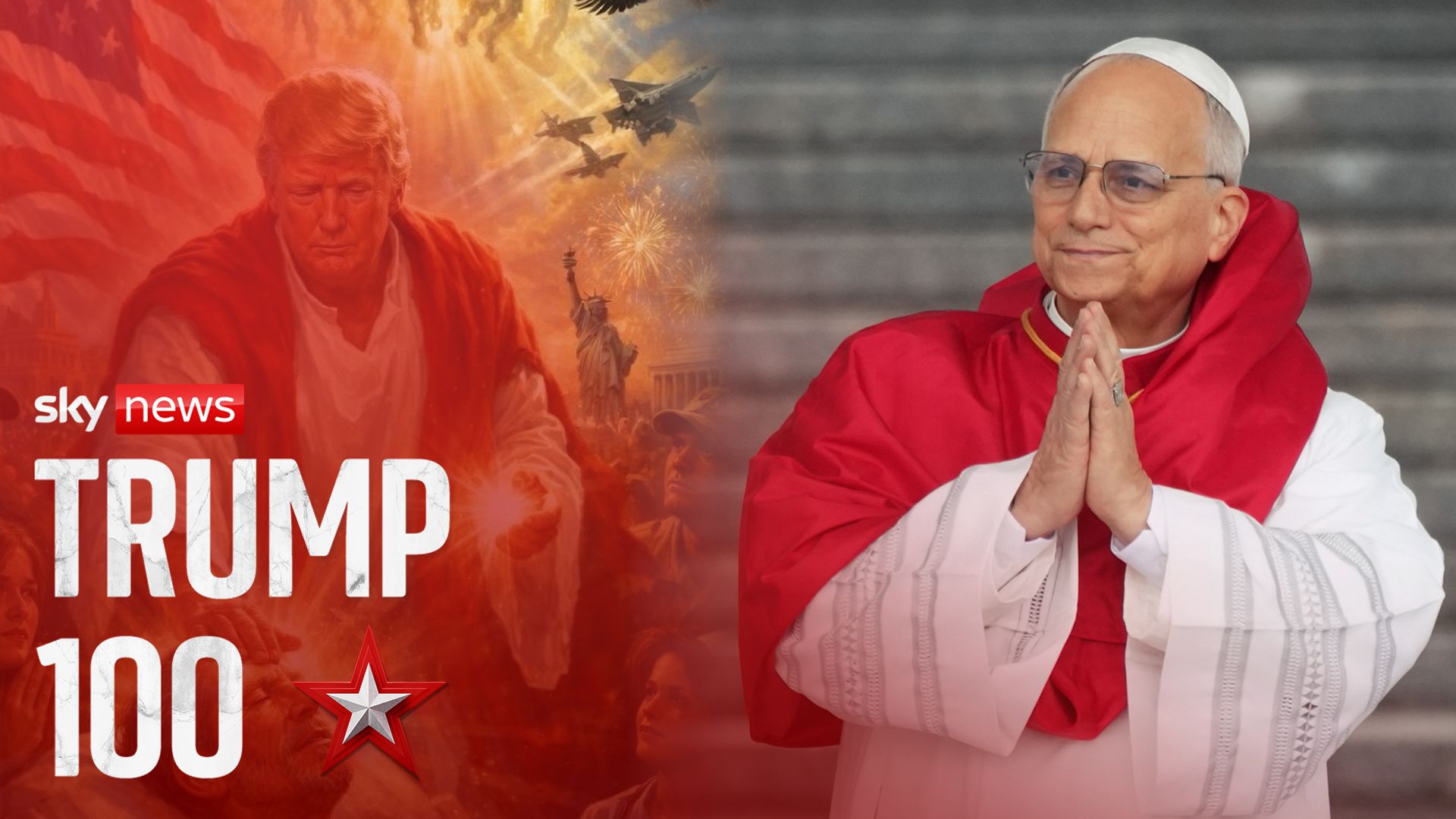
The tension between Donald Trump’s nationalist-populist agenda and Pope Francis’s globalist-humanitarian theology represents more than a personality clash; it is a fundamental collision between two competing systems of sovereignty. While media narratives often reduce this to a series of rhetorical volleys, the conflict is rooted in a structural divergence over the role of the nation-state, the ethics of border security, and the hierarchy of human obligations. This friction is not a peripheral political theater but a stress test for the influence of institutional religion in an era of resurgent nationalism.
The Bifurcation of Sovereign Authority
To understand the friction, one must categorize the two opposing frameworks of authority at play.
The Westphalian Model (Trumpian Statecraft): This framework operates on the absolute priority of the nation-state. Sovereignty is defined by the physical border and the exclusive duty of the executive to the citizen body. In this model, resources are finite, and security is a zero-sum game. The moral imperative is the protection of the polis from external volatility.
The Universalist-Ecclesiastical Model (Franciscan Theology): The Vatican operates on a trans-territorial logic. The Pope’s authority claims a moral jurisdiction that transcends borders, emphasizing the "global common good." Here, sovereignty is secondary to the inherent dignity of the person, regardless of legal status. This model views the world as an interconnected ecosystem where the exclusion of the migrant is not a security measure, but a systemic failure of Christian charity.
The clash occurs because Trump’s policy suite—specifically the construction of physical barriers and restrictive immigration quotas—functions as a direct rejection of the Vatican’s "culture of encounter." When the Pope famously suggested that building walls is "not Christian," he was not merely issuing a moral critique; he was challenging the fundamental legitimacy of the Westphalian security apparatus.
The Economic and Moral Cost Functions of Migration
The disagreement over migration is frequently analyzed as a debate over "values," but it is more accurately described as a dispute over the Cost Function of Social Cohesion.
Trump’s logic dictates that the influx of non-citizens imposes a direct cost on the labor market and public infrastructure. The "wall" serves as a physical manifestation of a protective tariff on national identity and economic stability. The strategy assumes that social trust is a fragile asset that requires a high barrier to entry to maintain.
Conversely, Pope Francis views the cost of exclusion as higher than the cost of integration. His framework suggests that the long-term stability of the West is threatened more by the "globalization of indifference" than by demographic shifts. From a theological perspective, the Vatican views the migrant not as an external variable to be managed, but as a catalyst for moral renewal. This creates a logical impasse: one side sees a liability to be mitigated, while the other sees a moral obligation that supersedes economic calculation.
Structural Divergence in Climate and Energy Policy
Climate change serves as the second theater of this conflict, characterized by a dispute over Temporal Responsibility.
The Trump administration’s withdrawal from the Paris Agreement was a calculated move based on the prioritization of immediate industrial competitiveness. The logic is grounded in the present-day economic cycle: maximizing domestic energy production and reducing regulatory friction to stimulate GDP growth. In this view, international climate accords are a form of soft-power containment by foreign entities.
Pope Francis’s encyclical, Laudato si', provides the counter-framework: "Integral Ecology." This theory posits that environmental degradation and social injustice are the same phenomenon. The Vatican’s logic operates on a multi-generational timeline, arguing that short-term economic gains are irrelevant if they compromise the "common home."
This creates a specific bottleneck in diplomatic relations. Trump’s strategy relies on the disaggregation of issues (treating energy, trade, and security as separate levers), whereas the Vatican insists on the totality of impact (arguing that you cannot have a healthy economy without a healthy environment and a protected lower class).
The Strategic Instrumentalization of Faith
The interaction between these two figures is further complicated by the internal demographics of the American electorate. The U.S. Catholic vote is a non-monolithic, high-variance block that both leaders attempt to influence.
- The Traditionalist Alignment: Trump’s focus on judicial appointments (specifically the overturning of Roe v. Wade) creates a pragmatic alliance with the Catholic hierarchy's conservative wing. This segment prioritizes the "sanctity of life" and religious liberty, often overlooking the administration's divergence from the Pope on migration or the environment.
- The Social Justice Alignment: This segment aligns with Pope Francis’s emphasis on the poor and the marginalized. For these voters, Trump’s rhetoric is a departure from the "seamless garment" of Catholic social teaching.
The "Trump vs. Pope" narrative serves as a tool for both sides to solidify these internal factions. For Trump, challenging the Pope reinforces his "outsider" status and his commitment to putting "America First," even against global moral authorities. For Francis, the critique of Trump serves as a pedagogical moment to pivot the Church away from Eurocentrism and toward the "peripheries" of the Global South.
The Mechanism of Soft Power vs. Hard Power
The conflict highlights the diminishing returns of institutional "soft power" in the face of digital-age populism. Historically, a papal rebuke could destabilize a leader’s standing within a Catholic-heavy constituency. However, the Trump era has demonstrated a shift in how authority is processed.
Through the use of direct-to-consumer communication (social media), Trump bypassed traditional intermediaries, including religious ones. He effectively reframed the Pope’s critiques as the interference of a "globalist elite" rather than the guidance of a spiritual father. This represents a significant pivot in the Geopolitics of Influence: moral authority is increasingly secondary to perceived cultural protection.
The Vatican's response has been to double down on multilateralism. By seeking alliances with other international bodies and faith leaders, the Pope is attempting to create a "moral coalition" that can check the impulses of nationalist leaders. This is a battle between the Unilateral Executive and the Multilateral Institution.
Identifying the Bottlenecks in Reconciliation
Any attempt to find "synergy" between these two platforms fails because the core assumptions are mutually exclusive.
- The Border Bottleneck: You cannot simultaneously maintain a "zero-tolerance" border policy and adhere to a "welcome the stranger" theological mandate. One must eventually yield to the other in practice.
- The Environmental Bottleneck: You cannot prioritize a fossil-fuel-led industrial resurgence while advocating for a radical reduction in global consumption to save the biosphere.
- The Institutional Bottleneck: The Trumpian movement views international institutions (including the UN and the Holy See) as threats to national autonomy. The Vatican views these institutions as the only way to prevent global catastrophe.
The result is a state of perpetual low-level diplomatic friction. The "negotiations" are not about finding common ground, but about managing the optics of disagreement to avoid alienating shared constituents.
The Geopolitical Forecast
The trajectory of this relationship will be dictated by the shift toward a multipolar world. As the United States moves further toward a "fortress" mentality, the Vatican will increasingly look toward the East and the Global South for its strategic partnerships.
The primary risk for the Trumpian strategy is the erosion of moral legitimacy on the international stage, which can lead to diplomatic isolation. The risk for the Franciscan strategy is the loss of influence over the wealthiest and most powerful Catholic nation in the world, leading to a "schism of the heart" among the American laity.
The strategic play for future administrations or the Vatican’s diplomatic corps is not to seek a grand reconciliation—which is logically impossible—but to identify specific, narrow areas of "overlapping interest." This might include the protection of religious minorities in the Middle East or anti-human trafficking initiatives. Outside of these narrow corridors, the two systems will continue to operate in a state of structural antagonism, as each requires the rejection of the other to validate its own existence. The friction is the point; it defines the boundaries of 21st-century power.
Establish a clear distinction between policy-driven critique and fundamental theological disagreement. In the current landscape, the executive who successfully frames their nationalist goals as a form of "cultural preservation" will consistently outperform a global religious authority that lacks a physical enforcement mechanism. The Vatican's only counter-move is the long-game: waiting for the eventual exhaustion of nationalist cycles and positioning itself as the only remaining stable architecture for global cooperation.