The Silence Before the Roar
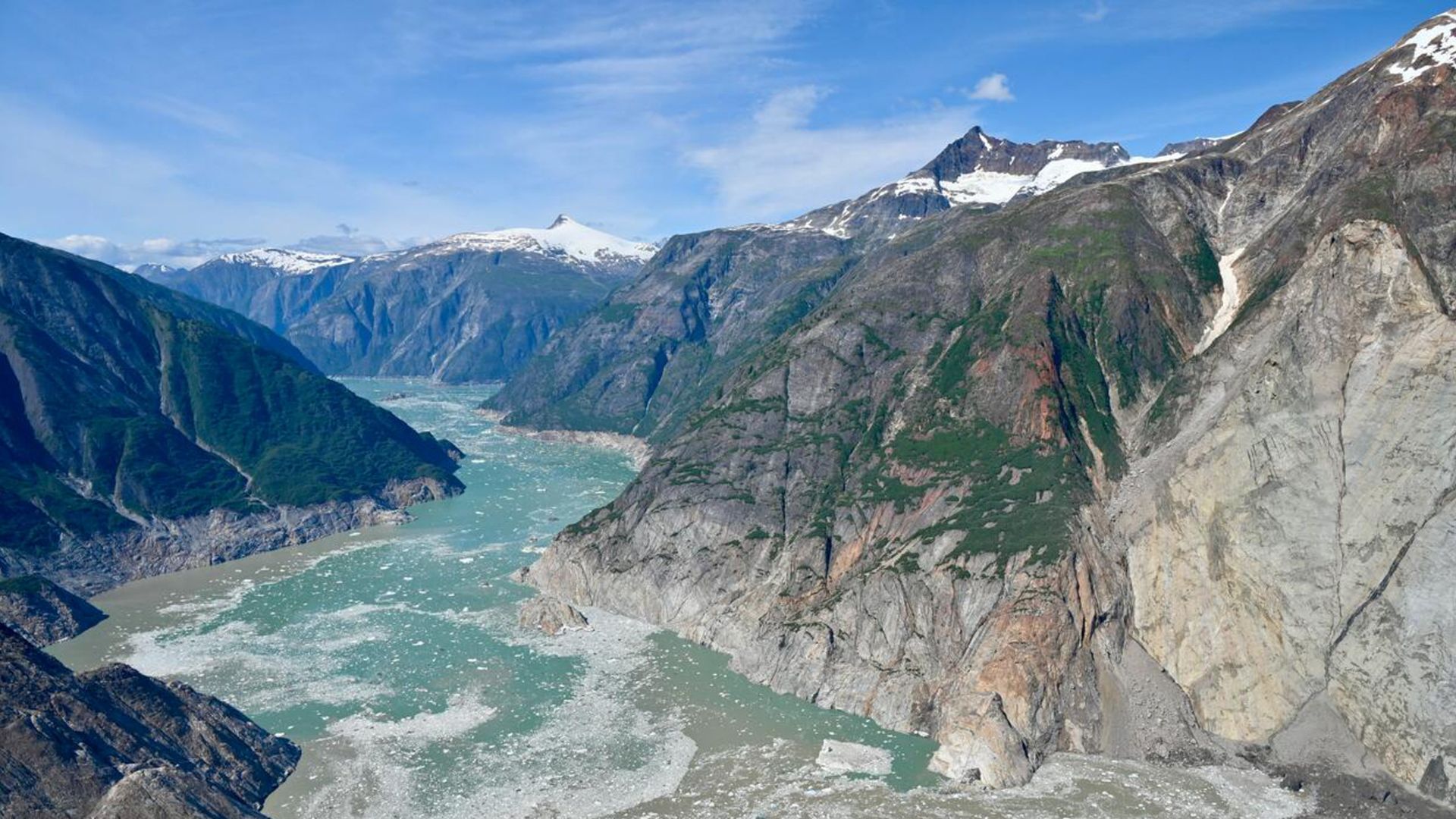
The air in Dickson Fjord is usually brittle. It is a place of absolute, crystalline stillness, tucked away in the jagged reaches of East Greenland. If you stood there on an average September morning, the only sound you might hear would be the groaning of ancient ice or the sharp crack of a glacier calving into the dark, freezing water.
But on September 16, 2023, the silence didn't just break. It vanished.
Somewhere high above the waterline, a mountain peak was dying. For centuries, it had been held together by permafrost—nature’s structural glue. As the planet warmed, that glue turned to water. In an instant, 25 million cubic meters of rock and ice—a mass equivalent to 10,000 Olympic-sized swimming pools—lost its grip on the earth.
It didn't slide. It fell.
When that much mass hits a narrow body of water, the result isn't a splash. It is a displacement of reality. A wave surged upward, reaching a staggering height of 200 meters. For context, that is nearly twice the height of the Statue of Liberty. It was a megatsunami, a prehistoric monster birthed by modern chemistry.
The Ghost in the Machine
For nine days after the initial collapse, the Earth rang like a bell.
In seismic stations from the Arctic to Antarctica, needles danced across paper. Digital sensors spiked. But the signal was wrong. It wasn't the jagged, chaotic scribble of an earthquake. It was a monotonous, rhythmic hum—a "monochromatic" vibration that repeated every 92 seconds.
Scientists were baffled. It was a global hum, a secret frequency being broadcast through the crust of our planet, yet no one could find the source. They called it a USO: an Unidentified Seismic Object.
Consider the perspective of a seismologist sitting in a quiet office in London or Berlin. You see the Earth vibrating. You check for tectonic shifts. Nothing. You check for volcanic activity. Silence. Yet, the planet is singing a low, mournful tune that refuses to stop.
The mystery lasted over a week because we weren't looking for a "seiche."
A seiche is a standing wave in an enclosed or partially enclosed body of water. Think of a child splashing in a bathtub. If they move just right, the water sloshes back and forth, hitting one side, then the other, in a steady, predictable rhythm. In Dickson Fjord, the megatsunami had been trapped. Because the fjord is narrow and winding, the energy had nowhere to go. The water sloshed back and forth, back and forth, for nine days straight.
Every time that wall of water hit the mountain walls, it sent a shockwave through the ground. The mountain was acting as a drumstick, and the Earth was the drum.
The Human Shadow on the Ice
We often talk about climate change as a series of spreadsheets. We discuss $CO_2$ parts per million, Celsius gradients, and carbon credits. These are cold, bloodless things. They don't capture the terror of a wall of water taller than a skyscraper rushing toward an empty research station.
Fortunately, the Ella Island research base was vacant when the wave hit. If it hadn't been, there would be no story to tell—only a list of missing persons. The wave stripped the landscape. It pulverized infrastructure that had stood for decades. It rearranged the map of the fjord in a matter of minutes.
The terrifying reality is that this wasn't a "freak accident." It was a predictable consequence of a thinning world.
As we peel back the icy skin of the Arctic, we are removing the weight and the tension that keeps mountains intact. We are witnessing the literal deconstruction of the landscape. This wasn't just a landslide; it was a symptom of a fever.
The Calculus of Disaster
To understand the scale, we have to move away from the abstract. Imagine a hypothetical hiker, let’s call him Erik, standing on a ridge five miles away. Erik wouldn't have heard the landslide first. Sound travels slow; gravity is fast. He would have seen the mountain face simply dissolve, a grey-white curtain dropping into the navy blue water.
Then, the water would have risen. Not like a wave at the beach, but like the ocean itself was being pushed out of its bed by a giant’s hand.
$E_p = mgh$
The potential energy stored in that rock, held high above the sea for millennia, was converted into kinetic energy in seconds. When that energy hit the water, it created a force so immense it defied the standard models of fluid dynamics used by local authorities.
The "stakes" here aren't just about remote fjords in Greenland. The stakes are the cruise ships that now frequent these once-impenetrable waters. Every year, thousands of tourists travel to these very fjords to witness the "majesty" of the melting ice. They sit in glass-bottomed lounges, sipping cocktails, unaware that the mountains framing their selfies are becoming structurally unstable.
If that landslide had happened two months earlier, or two miles closer to a transit route, we wouldn't be talking about a seismic mystery. We would be talking about a maritime graveyard.
The Rhythmic Warning
The nine-day hum is perhaps the most haunting part of this saga. It represents a transition in how we experience our changing environment. We have moved past the era of "invisible" changes. We are now in an era where the planet is physically screaming.
Researchers from 40 institutions across 15 countries had to collaborate to solve this puzzle. It required satellite imagery, hydrodynamic modeling, and seismic analysis. It took a global village to understand why the Earth wouldn't stop shaking.
This collaboration highlights a growing gap in our survival strategy. Our technology is brilliant at detecting the aftermath—we can tell you exactly why the mountain fell and how the wave moved—but we are still remarkably poor at listening to the mountain while it’s still standing.
The permafrost is melting at depths we aren't monitoring. The internal pressure of the rock is shifting in ways our sensors aren't calibrated to feel. We are flying blind through a canyon of our own making.
Beyond the Measured World
There is a specific kind of grief in watching a mountain fall. It is the loss of the permanent. We rely on the "everlasting hills" to be the backdrop of our lives, the steady anchors in a world of flux. When they start to tumble into the sea, the psychological floor drops out from under us.
The Dickson Fjord event is a harbinger. It tells us that the boundaries between the solid and the liquid are blurring. It tells us that the "remote" world is no longer distant. The seismic waves from that fjord reached the feet of every person on Earth. You felt it, even if you didn't know it. Your floor vibrated with the rhythm of a Greenlandic fjord struggling to find its level.
We are participants in this sloshing bathtub.
The water eventually calmed in Dickson Fjord. The hum faded. The seismic needles returned to their steady, boring lines. But the mountain is still shorter. The water is a little higher. And the glue that holds the rest of the peaks together is thinning under a sun that doesn't care about the sturdiness of mountains.
Next time the Earth rings, it might not be a mystery. It might just be the new sound of the seasons.
Imagine the next collapse. The rock waits. The ice thins. The water sits in the dark, ready to be moved. The mountain doesn't need to give a warning; it only needs to let go.