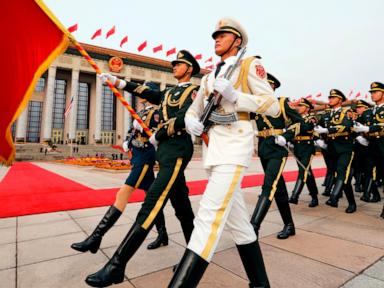
Donald Trump doesn’t care about standard diplomatic dinners or dry policy briefings. He wants the show. He wants the 21-gun salute, the rows of soldiers standing at exactly the same height, and the kind of historical grandeur that makes a politician look like an emperor. Beijing knows this. They’ve known it since 2017 when they invented the "state visit-plus" just for him.
When Trump touches down in Beijing this week for his 2026 visit, the red carpet won't just be a floor covering. It’s a psychological tool. China treats protocol like a chess move. Every flag waved by a schoolchild and every second of a military band’s performance is calculated to set a mood before a single word about trade or Iran is spoken.
The Art of the Imperial Welcome
In 2017, Xi Jinping did something unprecedented. He hosted Trump for a private dinner inside the Forbidden City. No foreign leader had received that honor since the founding of the People's Republic of China in 1949. Trump loved it. He spent years afterward talking about how "beautiful" it was and how much respect he was shown.
This isn’t just about being polite. It’s about "face." In Chinese culture, giving someone face (mianzi) is a way to build a debt of gratitude. If Xi gives Trump the royal treatment, it makes it harder for Trump to be the "bad guy" at the negotiating table the next morning.
This time around, the setting is the Temple of Heaven. It's another heavy-hitter in terms of symbolism. It’s where emperors once prayed for good harvests. By walking Trump through these grounds, Xi isn't just showing off a tourist site. He's placing himself and Trump in a lineage of world-shaping leaders.
Why 2026 is Different
The 2017 trip was a honeymoon of sorts. Today, the world is messier. We have a conflict involving Iran that’s threatening global oil prices and a trade relationship that’s been through a meat grinder of tariffs and Supreme Court battles.
China’s current confidence is higher than it was nine years ago. They’ve watched Trump’s style, they’ve mapped his reactions, and they know his buttons. While the 2017 visit was about "State Visit-Plus," the 2026 version is more of a "Strategic Reset."
Expectations are lower for a reason.
- The Schedule is Leaner: Instead of a long, rambling tour, the itinerary is compressed.
- Missing Figures: Melania Trump isn't on this trip, which changes the social dynamics of the state banquet.
- The Iran Shadow: Beijing’s ties to Tehran mean they have a card to play that they didn't have before.
Protocol as a Signal
If you want to know how the talks are going, don't look at the official press releases. Watch the stairs of Air Force One.
In 2016, when Barack Obama landed in Hangzhou for the G20, there were no rolling stairs. He had to exit from the "belly" of the plane. It was a massive snub. For Trump, the stairs are always there, usually with golden edging.
If China wants to show displeasure this week, they won’t say it. They’ll just send a lower-ranking official to the tarmac. They’ll let the military band play for thirty seconds less. They’ll make the tea a little colder. These "micro-aggressions" in protocol tell the real story of the relationship.
What's Actually on the Table
Trump wants a win he can take back to the voters for the midterms. He needs China to buy more American goods—specifically agriculture. He also wants help with North Korea and a lid on fentanyl precursors.
Xi wants stability. He wants to ensure that the U.S. doesn't go too far with technology controls or tariffs that could destabilize the Chinese economy.
They’re both using the "spectacle" to buy time. For Trump, the photos of him standing with Xi at the Temple of Heaven are gold for his base. They show him as a global titan. For Xi, the photos show a domestic audience that even the "unpredictable" American president shows respect to the Middle Kingdom.
How to Read the Trip
Don't get distracted by the $250 billion figures that usually get thrown around during these trips. Most of those "deals" are just non-binding memorandums that never happen.
Instead, look for these three things:
- Body Language: Do they walk side-by-side or is one slightly ahead?
- The "Surprise": Does Xi offer an unscheduled stroll or a private gift? That's a sign of a "favor" being granted.
- The Language: Does Trump call Xi a "brilliant leader" or a "competitor"?
Protocol isn't just about manners. It's the language of power when the two most powerful men on Earth don't speak the same tongue. Honestly, the theater is often more important than the script.
If you’re following the news this week, ignore the talking heads speculating on trade percentages for a second. Watch the red carpet. Watch who sits where. That’s where the real diplomacy is happening.