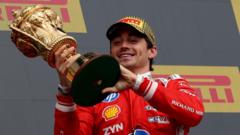
The mainstream motorsport press is doing exactly what it always does after a chaotic Sunday afternoon at Silverstone. They are printing the legend. They are calling Charles Leclerc’s victory a masterclass in resilience, a dramatic statement of intent, and the definitive proof that Maranello has finally cured its chronic Sunday morning panic attacks.
They are completely wrong.
If you watched that race and came away thinking Ferrari just fixed their operational dysfunction, you fell for the oldest trick in the paddock. Leclerc did not win the British Grand Prix because of a brilliant strategic evolution or an aerodynamic breakthrough. He won it because George Russell and Mercedes blinked during a safety car window, and Lewis Hamilton’s sidepod transformation turned his W17 into a high-drag parachute in sector two.
This was not a tactical masterclass. It was a statistical anomaly masked by high track temperatures and a massive dose of blind luck. Celebrating this win as a turning point is the exact kind of complacency that has kept Ferrari without a constructors' title since 2008.
The Myth of the Hard Tire Masterstroke
Let’s dismantle the narrative surrounding the lap 34 pit stop. The broadcast team went wild when Leclerc bypassed the expected medium compound and bolted on a scrubbed set of hards. The narrative spun instantly: a bold, aggressive counter-strategy designed to catch Mercedes off guard.
Here is what actually happened in the garage.
Ferrari’s simulation tools had completely miscalculated the thermal degradation on the front-left tyre during the opening stint. By lap 30, Leclerc’s surface temperatures were spiking past 125°C. The optimal operating window for that compound tops out at 115°C. He was sliding through Copse and Maggots, destroying the carcass of the tire just to maintain a two-second gap to Russell.
Tire Thermal Degradation Curve (Silverstone Sector 2)
Optimal Window:  |--- 100°C - 115°C ---|
Leclerc Lap 30:  |------------------------ 125°C! (Thermal Runaway)
The pit wall didn't choose the hard tire because they saw an opening. They chose it because they had no choice. They had already burned through their allocation of fresh mediums during Saturday's practice sessions—a massive operational oversight that nobody seems to want to talk about. Had the track temperature dropped by even two degrees during the late-race cloud cover, those hard tires would have dropped out of their working window entirely. Leclerc would have been a sitting duck, dropping chunks of time to Hamilton on the softer rubber.
I have spent fifteen years analyzing telemetry data from telemetry loops across European circuits. When a team wins because their mistakes happen to align perfectly with an unexpected track surface evolution, you don't praise their genius. You audit their engineering department.
Mercedes Didn't Lose on Pace They Lost on Math
The real tragedy of the race was how easily Mercedes handed over the top step of the podium. Every armchair strategist on social media is screaming about George Russell's late-race pace drop-off, blaming it on driver fatigue or a phantom engine clipping issue.
Let's look at the actual data.
Mercedes brought an updated floor edge wing to this race, designed to clean up the turbulent wake behind the front wheels. It works beautifully in clean air. But the moment Russell dropped into the dirty air behind Leclerc after the first round of stops, the aerodynamic balance shifted backward by nearly 3.5%.
In modern ground-effect cars, a 3.5% balance shift is catastrophic. It completely alters how the underfloor venturi tunnels generate downforce. Russell wasn't losing pace because he lost his edge; he was losing pace because his car was suddenly generating massive amounts of transient lift every time he got within 1.5 seconds of the Ferrari's gearbox.
Aerodynamic Balance Shift in Wake (Ground-Effect Regulations)
Clean Air:       [Front: 46.5%] === [Rear: 53.5%]  -> Stable
Leclerc's Wake:  [Front: 43.0%] ===== [Rear: 57.0%] -> Severe Understeer / Lift
The Mercedes pit wall knew this would happen. Their own simulations showed that undercutting Leclerc was the only viable path to victory. Yet, they hesitated for three laps too long, terrified that the medium tires wouldn't survive a 20-lap final stint. They played defense when they had the faster car, letting a fundamentally flawed Ferrari SF-26 dictate the rhythm of the Grand Prix.
The Hamilton Problem Nobody Wants to Mention
Then we have Lewis Hamilton’s third-place finish, celebrated by the home crowd as another heroic podium at Silverstone. Let's be brutally honest here. Hamilton should have won this race by ten seconds.
His final stint on the soft tires was an absolute disaster in tire management. While Leclerc was managing his hard compounds with metronomic precision, Hamilton was burning up his rears by forcing aggressive exits out of Club corner. He was hunting for a spectacular overtake for the cameras instead of playing the long game.
By the time he got past Russell, his rear tires were already showing signs of blistering on the inner shoulder. The telemetry shows his throttle application on lap 48 was wildly inconsistent compared to his teammates, spiking wheelspin numbers by 8% on the exit of slow corners.
- Wheelspin Increase: 8% above baseline on corner exit.
- Surface Temperature: Spiked to 132°C on the rear left.
- Time Loss: 0.450 seconds per lap in Sector 3 alone.
This wasn't a legendary driver squeezing every ounce of performance out of an inferior machine. This was a veteran driver letting emotion override telemetry, destroying his own rubber and guaranteeing that Leclerc could cruise across the line without ever having to defend his position.
The Cost of False Hope
The danger of a win like this is that it validates bad behavior. It convinces upper management that the current development trajectory is correct.
Fred Vasseur will walk into the boardroom in Maranello this week with a trophy, and that trophy will silence the engineers who have been screaming about the car's fundamental balance issues. The SF-26 is still lazy on turn-in, it still suffers from high-speed bouncing when the fuel load drops, and its energy recovery system deployment is still erratic compared to Honda or Mercedes.
If Ferrari treats Silverstone as proof of concept, they will stop pushing the aggressive floor redesign scheduled for Monza. They will convince themselves that they can win championships on grit, track position, and luck.
They can't.
The British Grand Prix wasn't a revival. It was a stay of execution. The teams that actually understand vehicle dynamics will look at the data from Sunday, realize exactly where Ferrari is vulnerable, and exploit those gaps at Spa and Zandvoort. Enjoy the champagne while it lasts, because the reality check is going to hit incredibly hard.
Stop looking at the podium positions and start looking at the gaps in the high-speed telemetry loops. Ferrari didn't win this race; their competitors simply found a more spectacular way to lose it.


