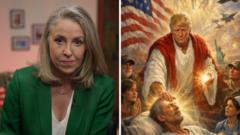
The visual of Donald Trump as a messianic healer, hand outstretched in a red cloak to touch a bowed head, was not merely another provocative social media post. It was a calculated theological hand grenade. By circulating an AI-generated image of himself as a Jesus-like figure, Trump effectively signaled that the boundaries between political loyalty and religious devotion have dissolved. This move comes at a moment of maximum friction with the Vatican, as Pope Leo XIV openly condemns the administration's stance on the war in Iran. The result is a high-stakes fracture in the American religious right, forcing millions of voters to choose between the authority of an ancient church and the magnetism of a modern movement.
The Iconography of Power
The backlash from the April 2026 post was swift, even from within the President’s own base. While his most ardent supporters viewed the image as a metaphor for his "healing" of the nation, a significant portion of the evangelical and Catholic electorate recoiled. For these voters, the image crossed the line from political symbolism into blasphemy.
The strategy, however, was no accident. For years, the rhetoric surrounding Trump has flirted with the divine. His spiritual advisers have long compared his legal and political struggles to the trials of biblical figures. Survival after the 2024 assassination attempt was frequently framed as "divine intervention." By moving from "protected by God" to "portrayed as God," the administration is testing the elasticity of American faith. They are betting that for a modern populist movement, the identity of the leader is more important than the tenets of the creed.
A Collision with the Vatican
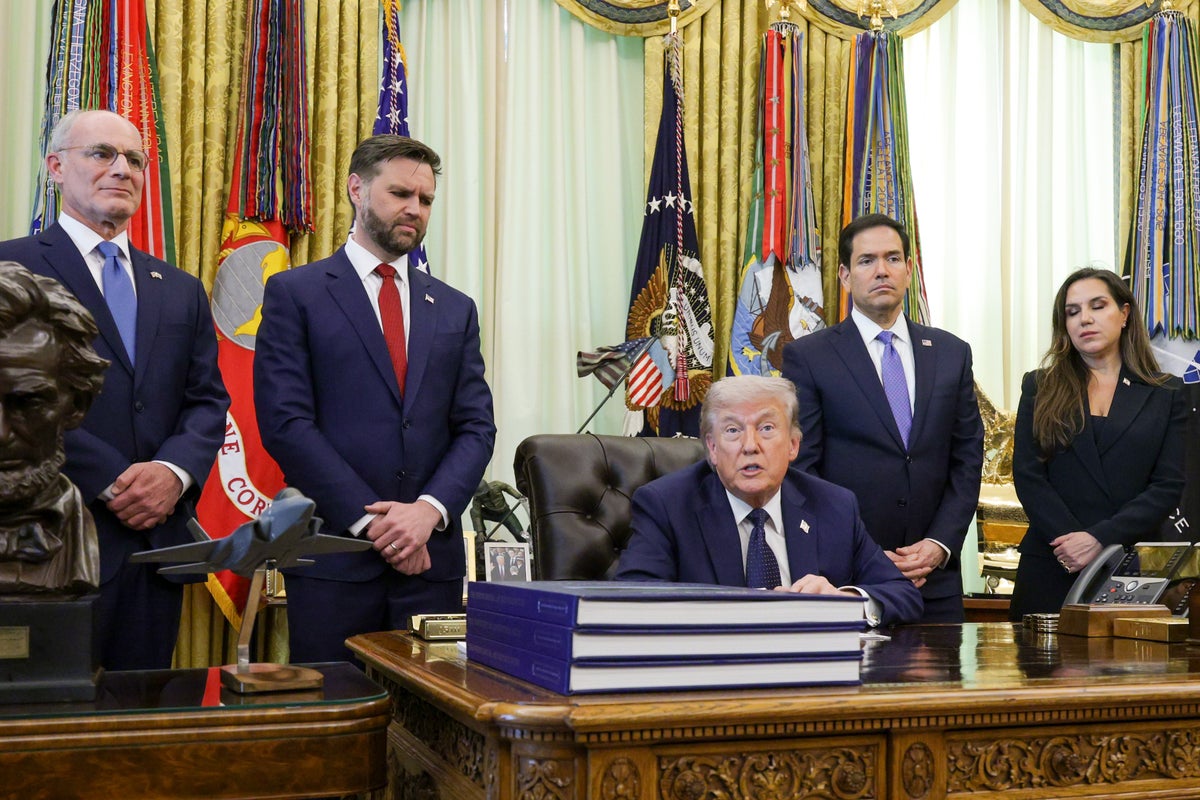
While Trump leaned into messianic imagery, his relationship with the Holy See reached a historic low. Pope Leo XIV, a figure defined by his outspoken stance on global peace and humanitarianism, has emerged as the President’s most formidable ideological opponent. The primary flashpoint is the escalating conflict in Iran.
The Vatican has not been subtle. Pope Leo XIV recently reminded the world that "God does not listen to the prayers of those who wage war." This was a direct rebuke to members of the Trump cabinet who have framed the war as a divinely ordained mission. The tension is a modern revival of a very old American anxiety: can a Catholic be a loyal citizen if their Pope opposes their President?
Unlike the 1960s, when John F. Kennedy had to prove he wouldn't take orders from Rome, today’s conflict is reversed. Conservative Catholics, who have been a cornerstone of the Trump coalition, now find themselves in a theological vice. They are being asked to choose between a Pope who speaks the language of the Gospels and a President who uses the imagery of the Gospels to sell a nationalist agenda.
The Fragile Alliance of the Religious Right
The coalition of evangelicals and conservative Catholics has held for nearly four decades, primarily glued together by shared stances on social issues like abortion and religious freedom. However, that alliance was built on a foundation of "cultural traditionalism" rather than deep theological unity.
The current crisis exposes the cracks in that foundation.
- Theology of War: Evangelicals often lean toward a "just war" or even "prophetic war" framework, while the Vatican under Leo XIV has moved toward a more radical pacifism.
- Identity vs. Doctrine: For many, the movement has become "post-policy." It is no longer about what the leader does, but who the leader is.
- The Medium is the Message: The use of AI-generated religious art reflects a shift toward a digital-first faith where reality is secondary to the emotional resonance of the image.
When the President asks his followers to "backfill" their theology to support his political maneuvers, he is engaging in a form of religious re-engineering. If the base accepts the image of Trump as a Christ-figure, they are essentially accepting that he is the source of moral truth, rather than the Church or the Bible.
The Political Risk of Blasphemy
There is a pragmatic danger in this spiritual escalation. Data from the 2024 election showed Trump winning 56 percent of the Catholic vote. That margin is not guaranteed if the administration continues to mock or marginalize the papacy.
In the days following the post, prominent religious figures began to break rank. Even some of his most loyal evangelical surrogates expressed discomfort, recognizing that once you elevate a man to the level of the divine, there is no room left for the divine itself. The deletion of the post suggests that even within the White House, there is a realization that the "Jesus-like" branding may have overreached.
This is not a simple feud between two powerful men. It is a struggle for the soul of the American conservative movement. If the movement chooses the man over the tradition, it transforms from a political party into something else entirely—a secular religion with its own icons and its own truth.
The standoff between the White House and the Vatican will likely intensify as the 2026 midterms approach. The President’s ability to maintain his grip on the religious base depends on whether he can convince them that he is the true defender of their values, even when the head of the world's largest Christian church says otherwise. For many believers, the choice is no longer about policy; it is about where they place their ultimate trust.