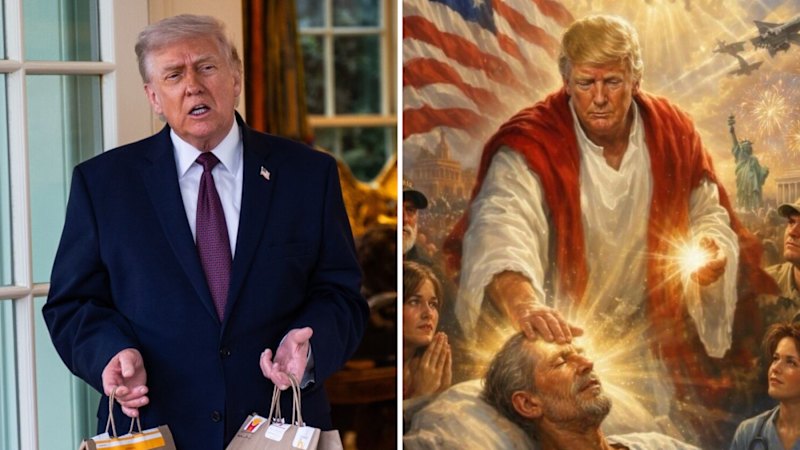
The press is currently hyperventilating over a social media post where Donald Trump shared an AI-generated image of Jesus Christ sitting in a courtroom. They are obsessed with the literalism of it. They are picking apart his claim that he thought the image looked like a "doctor."
They are missing the entire game.
While journalists scramble to fact-check the anatomy of a digital savior or debate the optics of "messianic imagery," they are falling into the same trap that has captured them for a decade. This isn't about theology. It isn't even about a "doctor." This is about the weaponization of absurdity.
The Cognitive Dissonance Engine
Most political analysts treat social media posts like press releases. They analyze the text, look for a policy pivot, and check for consistency. This is a fundamental misunderstanding of how digital influence works in the modern era.
Trump doesn't post to inform. He posts to provoke a specific, reflexive spasm in his opposition.
When he claims he saw a "doctor" in an image that clearly depicts a religious figure, he isn't being "confused." He is testing the elasticity of truth. By forcing the media to spend forty-eight hours arguing about whether a robe and long hair constitute a medical uniform, he has successfully dictated the national conversation.
The media believes they are "exposing" his lack of grip on reality. In reality, they are acting as the unpaid distribution network for his brand.
The Semantic Shift
Let's look at the "doctor" claim with some actual rigor. In the context of political theater, a "doctor" is a healer of a sick system. Whether he believes the pixelated man in the chair is a cardiologist or the Son of Man is irrelevant.
The messaging is about The Cure.
The establishment operates on a logic of incrementalism. They want data, white papers, and consensus. The populist operates on a logic of archetypes. By blending the religious with the professional, the imagery suggests a dual role: the spiritual leader and the technical fixer.
The media’s "lazy consensus" is that this is just another example of a rambling ego. But if you look at the engagement metrics, this "rambling" outperforms every polished policy speech given in the last six months.
I’ve seen campaigns spend $50 million on focus-grouped messaging only to have it wiped out by a single, grainy, nonsensical meme. Why? Because the meme bypasses the critical mind and goes straight to the lizard brain.
The Failure of Fact-Checking Absurdity
"People Also Ask" online: Why does Trump compare himself to Jesus?
The question itself is flawed. He isn't comparing himself to Jesus; he is positioning himself as the target of the same forces that his base believes persecuted Jesus. It is a shared-victimhood narrative.
When a "fact-checker" enters the fray to explain that Donald Trump is not, in fact, a deity, they aren't helping. They are performing a redundant service that only serves to alienate the people who find the imagery resonant.
This is a classic display of the Streisand Effect. By trying to suppress or ridicule the image, the media ensures it stays at the top of every feed for a week. They are the oxygen for the fire they claim to be trying to extinguish.
The "Doctor" Defense as Tactical Nonsense
Why call it a doctor?
Because it creates a "trap door" in the conversation. If he is called out for being sacrilegious, he can pivot to the "doctor" defense. If he is called out for the "doctor" claim being insane, he can pivot to the "it was just a beautiful image" defense.
It is a form of linguistic guerrilla warfare. You cannot pin down a cloud.
The mistake the "intellectual" class makes is assuming that voters demand literal consistency. They don't. They demand a vibe. They demand a fighter who isn't afraid to be weird, loud, and offensive to the people they dislike.
The Professionalism Fallacy
The "lazy consensus" in journalism is that "professionalism" and "decorum" are the ultimate currencies of power.
This is objectively false in the current attention economy.
We live in a post-decorum age. In this world, the person who can generate the most "What did he just say?" headlines wins. Every time a news anchor sighs and looks into the camera with faux-concern over a courtroom-Jesus-doctor post, Trump’s base hears one thing: "We are winning because we are making the elites lose their minds."
Beyond the Meme
The real story isn't the image. It's the total collapse of the media's ability to respond to anything that doesn't fit into a standard "Left vs. Right" policy debate.
They are bringing a knife to a laser-pointer fight.
The image is a Rorschach test. To his followers, it’s a sign of divine or moral alignment. To his detractors, it’s a sign of mental decline or blasphemy. To the man posting it, it’s a 10-cent piece of digital bait that just earned him $100 million in free media coverage.
Stop asking why the post is "wrong." Start asking why you can't stop talking about it.
The media isn't the referee in this game. They are the ball. And they're being kicked exactly where the player wants them to go.
The "doctor" is in, and he’s laughing at you.