The tech press loves a good anxiety narrative. Right now, the favorite storyline running through every silicon valley rag is Mark Zuckerberg’s supposed sleepless nights over compute capacity. The lazy consensus goes like this: Meta is building staggering clusters of H100 and B200 chips, running up astronomical capital expenditures, and now facing a brutal strategic bind over whether to hoard that processing power for proprietary artificial intelligence or monetize it by renting it out to the masses.
It sounds sophisticated. It sounds like a high-stakes corporate thriller. It is also entirely wrong. In other news, read about: ByteDance AI Strategy by the Numbers What the Infrastructure Arms Race Actually Reveals.
I have spent the last decade watching infrastructure budgets get rubber-stamped and slashed in boardrooms across Menlo Park and Redmond. I have seen infrastructure executives panic over electricity baseloads while their PR teams fed reporters stories about existential supply chain constraints.
Zuckerberg is not caught in a dilemma. He is executing a textbook utility play on a multi-billion-dollar scale, and the media is falling for the misdirection hook, line, and sinker. CNET has provided coverage on this critical topic in extensive detail.
The False Choice Between Selling and Keeping
The standard analysis frames Meta's GPU allocation as a zero-sum game. The argument claims that every watt of electricity and every cluster of silicon dedicated to internal model training, like Llama iterations or personalized feed algorithms, represents lost revenue from external cloud customers. Conversely, every GPU rented out via API or cloud partners means less raw compute for Zuckerberg to build his personal digital empire.
This framing relies on a fundamental misunderstanding of how hyperscale infrastructure actually functions.
Meta does not view compute as a fixed pie where they must choose between eating it or selling it. They view compute as an internal currency designed to eliminate third-party tax. When Zuckerberg talks about heavy capital investments, analysts look at the depreciation schedules and clutch their pearls. They assume Meta is building a massive money pit.
They ignore the alternative: what happens if Meta doesn't own the pipes?
For the past fifteen years, social networks lived as tenants in a world built by Apple, Google, and traditional cloud providers. Apple’s App Tracking Transparency policy wiped out billions in ad revenue overnight because Meta did not control the underlying hardware ecosystem or the operating system layer. Zuckerberg learned that lesson with permanent scars.
Owning the silicon capacity isn't about deciding whether to sell cloud instances to startups. It is about vertical integration taken to its logical, terrifying extreme.
The Economics of Infinite Supply
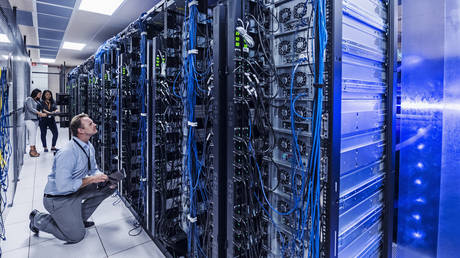
Let us look at the actual mechanics of what Meta is deploying. Data centers from Prineville to Forest City are not standard server farms. They are custom-engineered thermal and electrical monsters designed for dense matrix math.
When outsiders ask whether Meta should sell this capacity or keep it, they assume the marginal cost of running a large language model query is high enough to warrant rationing. It is not. Inference costs have plummeted off a cliff over the past twenty-four months. Through quantization, speculative decoding, and specialized model distillation, running a smart response costs fractions of a cent.
The capacity dilemma is a phantom. Meta has more raw processing headroom coming online than their current application suite can saturate organically. But instead of packaging that excess into a generic AWS competitor to fight Amazon and Microsoft on their own turf—a low-margin, high-headache enterprise game—Meta is giving the core intelligence away for free.
Think about that. They spend tens of billions on silicon, train world-class open-source weights, and then hand them to the developer community for zero dollars.
Why? Because open-sourcing state-of-the-art models destroys the pricing power of companies trying to monetize closed API access. If OpenAI has to charge premium subscription fees to amortize its compute costs while Meta distributes a comparable model for free, OpenAI's business model starts to look remarkably fragile. Zuckerberg isn't worried about what to sell. He is subsidizing the destruction of his competitors' unit economics.
The Real Bottleneck is Not Chips
If you ask industry pundits what is stopping the artificial intelligence boom, they point to silicon manufacturing yields at TSMC or advanced packaging capacity like CoWoS.
They are looking at the wrong end of the supply chain.
The real constraint is not silicon. It is megawatts and transformers. The electrical grid cannot keep pace with the thermodynamic appetite of modern server clusters. When a data center requires three hundred megawatts of continuous power, you aren't just buying graphics cards; you are negotiating with regional transmission organizations, buying up local municipal power authorities, and figuring out how to build dedicated nuclear or geothermal microgrids.
Meta’s capital expenditures are not a temporary spike driven by a sudden urge to buy every chip Jensen Huang can manufacture. They represent a permanent capital shift toward industrial-scale energy accumulation.
When you control the energy generation and the silicon compute, you control the toll booth for digital interaction. Zuckerberg is not building data centers to serve ads slightly faster. He is building the foundation of a sovereign digital state.
Dismantling the Monetization Myth
Every quarterly earnings call brings the same chorus of institutional investors asking the same tired question: "Mark, how are we going to monetize these capital expenditures?"
The question itself is downstream of old-world thinking. It assumes monetization must look like a direct subscription fee or a per-token API charge.
Meta’s monetization strategy has never been about charging for software. It has always been about friction reduction. Every time an open-source model improves, every time a recommendation engine gets sharper through massive compute, user retention climbs. Higher retention means more time on platform. More time on platform means more advertising inventory. And more importantly, it keeps users trapped inside the Meta ecosystem where privacy regulations and platform shifts implemented by third parties cannot touch them.
If you rent your compute to external developers, you capture a software margin. If you use that compute to power an ad-targeting engine that reaches three billion people daily, you capture a rent on global commerce.
Which business would you rather own?
The Uncomfortable Truth About Open Source
There is a naive school of thought that believes Meta champions open-source artificial intelligence out of pure philanthropic benevolence or a commitment to academic science.
This is corporate romanticism at its most embarrassing.
Meta open-sources its models because it is a defensive weapon of mass disruption. By flooding the market with high-tier weights, they commoditize intelligence before closed-source companies can build a permanent moat around it. Every startup that builds on Llama instead of paying for proprietary enterprise tiers weakens the market position of the commercial gatekeepers.
Zuckerberg is playing a game of chicken with the entire software industry. He is saying: We have more cash, more energy, and more patience than anyone else. We will drive the cost of raw intelligence down to zero.
Try building a sustainable high-margin software business when the core component is free.
The Strategic Playbook Ahead
If you are running infrastructure strategy or trying to position your enterprise against this backdrop, stop worrying about whether Meta is going to become a public cloud provider. They aren't. They don't want to deal with enterprise service-level agreements, legacy database integrations, or corporate IT helpdesks.
They want to own the substrate of human communication and computation.
The capital expenditure numbers will keep climbing. The media will keep running breathless pieces about the looming capacity crunch. Analysts will keep manufacturing dilemmas where none exist.
While they write their stories, the hardware keeps spinning, the power plants keep humming, and the models keep getting smarter, entirely free of charge.
Don't look at the balance sheet as a warning sign. Look at it as an eviction notice for everyone else.