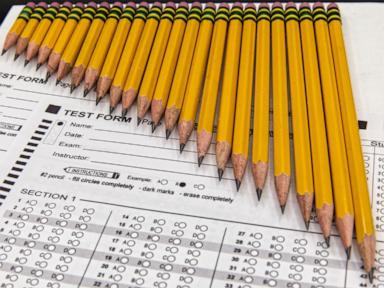
Smell the graphite.
It is a scent born of crushed cedar and baked clay, dredged from the earth and bound into a hexagonal spine. If you close your eyes, you are six years old again, staring down a blank sheet of wide-ruled paper while a yellow painted wood cylinder rolls slowly toward the edge of your desk.
That yellow is not an accident. It is an empire.
The Weight of a Wood Cylinder
We forget how much blood, sweat, and compressed rock we once asked our children to hold between their thumb and forefinger. Every standardized test, every scribbled math proof, every tentative poetry draft of the twentieth century was forged in the exact same shade of cadmium yellow, stamped with a mysterious numerical code that felt less like a classification and more like a military rank.
The No. 2 pencil.
We treat it as background noise. A cheap plastic tub of them sits on a teacher’s podium, chewed at the eraser end, waiting to be sacrificed to the sharpener. But step back. Look at the logistics of it. Billions of these yellow sticks have been manufactured, sharpened, blunted, and thrown away. They outlasted the fountain pen craze. They survived the dawn of the personal computer. Long after the floppy disk went to the graveyard, the yellow pencil remained, stubbornly wedged behind the ears of carpenters, accountants, and poets alike.
Why?
To understand why this specific piece of painted wood conquered a continent, we have to look past the stationery aisle and into the raw, industrial grit of the nineteenth-century American landscape.
When Graphite Was Gold
Before the pencil became a mass-produced American birthright, it was a fragile luxury.
Consider the European craftsmen of the 1700s. They carved pencils out of solid chunks of pure graphite mined from Borrowdale, England. That English graphite was so pure, so densely packed, that thieves broke into mines and guards were posted with muskets. But mines run dry. By the time supplies dwindled, clever chemists like Nicolas-Jacques Conté realized they could mix powdered graphite with clay, bake it in a kiln, and control the hardness. More clay meant a lighter, harder line. Less clay meant a dark, soft stroke.
Suddenly, grading systems mattered. European makers stamped their leads with numbers and letters. H for hard. B for black.
Then came the American industrial machine, hungry, standardized, and impatient.
By the late nineteenth century, American classrooms were swelling with the children of immigrants. Public education was exploding from a localized luxury into a massive, centralized engine. Teachers needed a tool that was uniform. A tool that could mark a standardized test bubble with enough carbon to trigger an early optical scanning machine, yet cheap enough to hand to a room of forty restless children without bankrupting a school district.
Enter the Eberhard Faber Pencil Company, and later, the Dixon Ticonderoga. They did not just manufacture a writing utensil. They engineered a national reflex.
The Chemistry of the Everyday
(Hypothetical scenario: Imagine a young clerk in a 1920s railroad office in Chicago, squinting under a harsh gas lamp, ledger open, moving a freshly sharpened yellow stick across endless columns of figures. One mistake means hours of erasing, tearing paper, starting over.)
The genius of the No. 2 pencil lies precisely in its compromise.
If a pencil is too hard, a No. 4 say, it leaves a faint, ghostly scratch that tears through thin paper when the writer presses too hard. If it is too soft, a No. 1, it smudges into a dark smear, coating the palm in gray dust and wearing down to a stub in minutes.
The No. 2—roughly equivalent to the European HB—is the Goldilocks zone of carbon. It yields easily to rubber. It leaves a mark dark enough to read, yet hard enough to survive being shoved into a canvas bookbag alongside a bruised apple.
And then there was the color.
Early American pencils were often left unpainted, showing off the natural grain of cedar. But in the late 1800s, the best graphite in the world came from mines in China and Japan. American pencil makers wanted to signal to the market that their product was of exotic, imperial quality. What did they do? They painted their pencils bright yellow—a color historically associated with Chinese royalty—and stamped them with Chinese-inspired brand names like Ticonderoga.
It was pure marketing genius wrapped in yellow lacquer. A stolen aesthetic turned into an indigenous American icon.
The Indestructible Relic
We live now in a world of glass and light. Our thumbs swipe across infinite feeds of glowing pixels. We dictate notes to invisible servers hovering in data centers across deserts.
Yet, when an astronaut goes to space, NASA does not hand them an iPad. (The old urban legend about million-dollar space pens versus Russian pencils is a myth, but the truth remains: graphite is reliable in zero gravity.) When a carpenter framing a house on a rain-slicked roof needs to mark a stud, they do not pull out a stylus. They grab a pencil. When a child learns how to spell their own name for the very first time, they do not tap keys on a mechanical keyboard.
They grip. They press. They erase. They try again.
The No. 2 pencil survived because it requires no battery, no Wi-Fi, and no software update. It is democratic technology in its purest form. It writes on cheap newsprint and expensive parchment with equal grace. It breaks when dropped, but it forgives mistakes with a pink rubber nub that wears down faster than the lead itself, a poetic little reminder that to err is human, and to correct is built into the design.
Look down at your desk right now.
Somewhere in a drawer, beneath the receipts and the rubber bands, there is one. The paint is chipped near the ferrule. The eraser is worn flat at an angle. It is waiting for the moment the power cuts out, the screen goes dark, and you need to leave a mark that will still be legible long after the servers have gone cold.