When leaders of global superpowers meet behind closed doors, the official communiques rarely tell the whole story. Back when President Donald Trump hosted Chinese President Xi Jinping at the White House, Western critics were quick to dismiss the pageantry as mere "diplotainment". They pointed to the lack of sweeping breakthroughs on thorny tech restrictions or long-term trade disputes. But looking at the event through a purely transactional lens misses the entire point of modern great power competition.
Inside mainland China, the optics of the summit told a vastly different story. State media and public discourse framed the Washington visit less as a scramble for concessions and more as a visual validation of China's ascension to peer status with the United States. If you want to understand how geopolitics actually works today, you have to look past the policy scorecards and examine how superpower theater shapes domestic morale and international alignment. Recently making news in related news: Inside the Occupied South Ukraine Humanitarian Crisis And Why Traditional Aid Is Failing.
The Power of Equal Footing
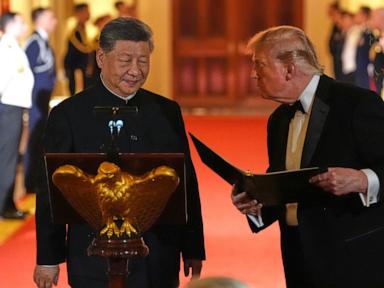
For decades, diplomatic protocols favored an implicit hierarchy where visiting foreign leaders traveled to Washington to align with an American-led global order. Xi's arrival in Washington disrupted that traditional narrative. By commanding an elaborate state welcome, complete with military honors and a high-profile state dinner in the East Room, the summit projected an image of co-equality.
In Beijing and Shanghai, ordinary citizens and political analysts viewed the red-carpet treatment through a nationalist lens. When a rising power sits across the table from an established hegemon without showing deference, domestic audiences take notice. It reinforces a narrative that China has successfully navigated decades of economic pressure, trade crackdowns, and technological containment to secure a permanent seat at the top table. More details on this are detailed by Reuters.
Substance Versus Symbolism in Modern Diplomacy
Critics in Washington argued that the 90-minute bilateral meeting yielded few binding agreements on critical issues like artificial intelligence guardrails or industrial overcapacity. They noted that agreements to extend tariff pauses or commit to modest agricultural and energy purchases—such as importing millions of metric tons of U.S. coal—barely scratch the surface of structural economic tensions.
Yet, expecting a single summit to resolve decades of systemic rivalry is naive. Leaders like Xi and Trump do not operate in a vacuum. They use high-level summits to manage friction points rather than eliminate them. For China, avoiding escalation while projecting strength is a win in itself. The meeting bought Beijing valuable breathing room to stabilize its domestic economy while signaling to regional neighbors in Asia that Washington and Beijing are managing their rivalry through direct dialogue rather than military confrontation.
Decoding the Domestic Narrative in China
Public reaction on Chinese social media and street interviews following the summit revealed a pragmatic consensus. Citizens frequently noted that talking is objectively better than cutting off communication. In a global climate defined by fragmentation and conflict, the mere existence of a face-to-face summit communicates stability.
State messaging cleverly leveraged this desire for stability. By emphasizing mutual respect and the avoidance of the infamous "Thucydides Trap"—the historical tendency for a rising power to spark war with an established one—Beijing positioned itself as a responsible stakeholder. This framing resonates deeply at home, where the middle class craves economic predictability alongside national pride.
What the West Keeps Missing About Beijing Strategy
Western foreign policy establishments often trap themselves in short-term accounting. They want immediate concessions on intellectual property, supply chains, or geopolitical alignments. When those concessions do not materialize, they label the summit a failure.
China plays a much longer game. Every handshake on the South Lawn, every state dinner toast, and every broadcast of Xi walking alongside his American counterpart serves as visual evidence of national rejuvenation. It tells the domestic populace and the wider developing world that China's rise is irreversible.
The Xi-Trump summit wasn't about signing away core national interests. It was an exercise in projection. By claiming equal billing in the heart of American power, Beijing achieved its primary objective without firing a shot or yielding an inch of strategic leverage.