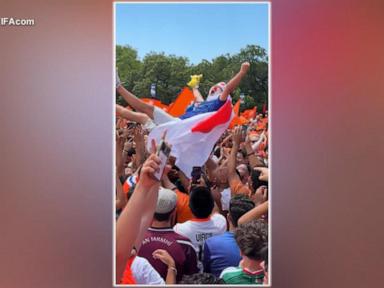
The cameras are panning across crowded fan zones. Local news anchors are beaming. The official narrative is locked in: the FIFA World Cup is a golden ticket, a tourist-fueled economic engine lighting up host cities across the United States.
It is a beautiful illusion. It is also completely wrong. Meanwhile, you can explore related stories here: The Accidental Mirrors in the Bleachers.
Every major sporting event spawns a predictable wave of civic euphoria. Mayors boast about projected billions in revenue. Hoteliers jack up prices. Restaurant owners prepare for an unprecedented windfall. They buy into the lazy consensus that a massive influx of international soccer fans automatically translates into broad local prosperity.
But if you look past the jersey-clad crowds and analyze the actual mechanics of sports tourism economics, the reality is starkly different. The massive economic windfall promised to American cities is a mathematical mirage. To explore the full picture, check out the detailed article by FOX Sports.
The Displacement Illusion: Who Are You Actually Attracting?
The foundational flaw in the "tourists are saving the city" argument lies in a phenomenon economists call the displacement effect.
Promoters love to count every single fan wearing a federation scarf as a net-new economic contributor. They tally up the hotel rooms, the restaurant tabs, and the Uber rides as if that spending occurred in a vacuum. What they willfully ignore is who is not in the city because of the tournament.
Imagine a scenario where a mid-sized US host city welcomes 50,000 international soccer fans for a match week. At the exact same time, thousands of business travelers, convention attendees, and traditional vacationers look at the skyrocketing hotel rates, the gridlocked traffic, and the packed restaurants—and they book their trips somewhere else.
The Reality Check: You are replacing high-spending corporate travelers and regular tourists with sports fans who spend money inside a highly restricted, FIFA-monitored radius.
Decades of independent economic research back this up. Professor Victor Matheson, a leading sports economist at the College of the Holy Cross, has repeatedly demonstrated that major sporting events rarely produce the net economic gains touted by organizers. When London hosted the 2012 Olympics, the city actually saw fewer total visitors during the games than it did during the same period in previous years. The regular tourists simply fled.
The economic activity isn't multiplying. It is merely substituting.
The Extractive Economy of the FIFA Machine
To understand why local businesses often lose out during a World Cup, you have to follow the money trail.
A naive observer looks at a stadium packed with 70,000 fans and assumes the local economy is winning. But who actually captures that revenue?
- Ticket Sales: Every single dollar spent on match tickets goes straight into FIFA’s coffers, completely tax-exempt thanks to the aggressive concessions demanded of host governments.
- Stadium Spending: Concessions and merchandise sales inside the venue are heavily controlled. Corporate partners hold monopolies on everything from the beer served to the credit cards accepted. Local vendors are systematically shut out.
- The Fan Zone Monopolies: Even outside the stadium, official FIFA Fan Festivals funnel spending toward global conglomerates. If a local pub is located three blocks away, they might see a minor spillover effect, but they are competing against a massive, corporate-sponsored entertainment apparatus designed to keep dollars inside the perimeter.
I have spent years analyzing municipal budgets and corporate sponsorships. The pattern is always the same: local taxpayers fund the security, the transit overhauls, the stadium retrofits, and the sanitation crews. Meanwhile, a Swiss-based sports governing body and a handful of multinational corporate sponsors extract the profits and fly them out of the country.
The Hotel Math That Doesn't Add Up
"But look at the hotel occupancy rates!" the optimists cry.
Yes, hotel rooms in host cities are booking out at 3x or 4x their standard seasonal rates. On paper, it looks like a jackpot. In practice, it is a localized extraction of wealth.
When a hotel room in downtown Miami or Los Angeles goes from $200 a night to $800 a night during a tournament, that extra $600 does not magically filter down into the local economy. It does not go into the wages of the housekeepers, the front desk staff, or the valets. Their hourly pay remains exactly the same, despite their workload doubling.
Instead, those surging revenues flow directly to corporate headquarters in Bethesda, Chicago, or international holding companies. The wealth generated by local real estate during the tournament is immediately exported to institutional shareholders.
Furthermore, this artificial price hiking creates a severe post-event hangover. The massive spike in hotel room rates can cause a multi-year chilling effect on the local convention business. Event planners look at a city’s recent historical hotel data, see inflated averages, and take their 10,000-person corporate summit to a city that didn't host a soccer match.
The Real Winners vs. The Perceived Winners
To see the stark divide between tournament mythology and economic reality, look at where the capital actually flows:
| Industry Sector | Perceived Outcome | Economic Reality |
|---|---|---|
| Boutique Hotels & Airbnbs | Unprecedented windfall for local property owners. | Massive platform fees; short-term gains canceled out by long-term corporate travel displacement. |
| Main Street Restaurants | Packed tables and record-breaking nightly receipts. | Regular local clientele stays home to avoid traffic; fans eat at official venues or fast-casual chains. |
| Municipal Governments | Massive tax revenue injection to fund public services. | Sky-high overtime costs for police and transit; strict tax exemptions for event organizers erase projected gains. |
| Ride-Share Drivers | Surge pricing creates massive payday opportunities. | Gridlock dramatically reduces the total number of trips a driver can complete per hour, eroding margins. |
Dismantling the "Global Branding" Myth
When the raw financial data fails to support the hype, proponents always pivot to the ultimate intangible defense: "The global media exposure is priceless advertising for our city."
This is the ultimate grift.
Does anyone honestly believe that cities like New York, Los Angeles, Miami, or San Francisco need a soccer tournament to put them on the global map? These are already alpha-grade global brands. A two-hour broadcast featuring sweeping drone shots of the skyline does not suddenly convince a manufacturing company to relocate its headquarters or a foreign investor to build a factory there.
Even for lesser-known host cities, the branding argument falls flat. Think back to previous tournaments. Can you pinpoint a measurable, sustained rise in long-term tourism for cities like Manaus, Brazil, or Rustenburg, South Africa, directly attributable to the World Cup? No. The world moves on to the next news cycle within 48 hours of the final whistle.
The premise of the question we are asking is fundamentally broken. We shouldn't be asking, "How much money are tourists bringing to the US during the World Cup?"
We should be asking, "How much public money are we spending to act as a pro-bono stage for a multi-billion-dollar private entity, and why are we celebrating the crumbs left behind?"
The Actionable Alternative for Local Businesses
If you are a local business owner in a host city, stop waiting for the World Cup savior matrix to make you rich. The system is rigged to bypass you. If you want to survive and actually profit during the tournament, you have to pivot completely away from the official fan traffic.
First, stop trying to compete with the official fan zones. You cannot out-market or out-deliver a multi-million-dollar FIFA activation zone.
Instead, market directly to the locals who are actively avoiding the chaos. Create "Soccer-Free Zones." Offer discounts, quiet atmospheres, and seamless parking for residents who want to escape the jersey-wearing crowds. While your competitors are dealing with rowdy, low-tipping tourist crowds who buy one beer and sit at a table for four hours to watch a match, you can capture the stable, high-margin local demographic that has been completely abandoned by the rest of the city.
Second, if you own a hospitality business, do not overhire or overexpand based on tournament projections. The demand is a spike, not a plateau. The moment the teams fly out, the demand drops off a cliff, leaving over-leveraged businesses holding an expensive inventory and labor hangover.
The tourists might be lighting up stadiums across the country, but local municipalities and small businesses need to realize that when you play with fireworks, you are usually the one left cleaning up the ash.


GR_SOL_TOP__FCO_X_200_ML.jpg)