The Pacific Ocean is rarely quiet, despite its name. If you sit on the black volcanic sands of Efate Island in Vanuatu, the water speaks in a constant, heavy rumble. It is the sound of deep water moving against fragile coral. For generations, this sound meant isolation. It meant an island nation could look out at the blue horizon and feel entirely alone, insulated by thousands of miles of open sea.
But geography is a cruel master. In the modern geopolitical theater, isolation is a luxury that expires quickly.
For years, a quiet anxiety drifted through the palm-fringed streets of Port Vila. It wasn't something spoken about loudly over cups of kava or at the bustling open-air markets where women sell massive hands of bananas. It was a theoretical threat, a shadow cast from thousands of miles away. Rumors drifted through the region like smoke: whispers of deep-pocketed foreign developers eyeing the deep-water ports, hushed conversations about infrastructure loans that felt a bit too generous, and the chilling architectural reality of dual-use docks that could hold a cruise ship today and a guided-missile destroyer tomorrow.
The shadow had a name, and that name was Beijing.
Then came the pen stroke that changed the map.
The Weight of a Fountain Pen
To understand why a security pact between Australia and Vanuatu matters, you have to look past the dry press releases issued by bureaucratic offices in Canberra. You have to stand in the humidity.
Imagine a hypothetical local fisherman named Alatoi. For thirty years, Alatoi has taken his wooden outrigger out past the reef, steering by the stars and the subtle shift in the swell. His grandfather did the same. To Alatoi, the ocean is a highway of life. Now, imagine Alatoi looking up from his nets to see the gray, slab-sided hull of a foreign military vessel blotting out the sunset. This is not a metaphor for an abstract political concept. It is the literal transformation of a homeland into a forward-operating base.
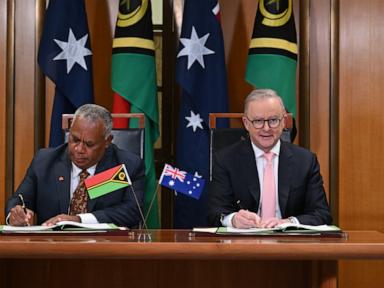
When the governments of Australia and Vanuatu finally signed their comprehensive bilateral security agreement, it wasn't just a bureaucratic milestone. It was a defensive wall built out of legal text.
The core of the agreement is deceptively simple, yet monumentally heavy. It covers everything from disaster relief and cyber security to maritime safety. But the real teeth of the document lie in what it prevents. By formalizing this deep security alliance, Vanuatu effectively closed the door on the possibility of allowing a permanent foreign military presence—specifically a Chinese military base—on its soil.
The strategy behind this is ancient. It is the concept of strategic denial. Australia looked at the map, realized its eastern flank was exposed, and decided that the best way to win a battle in the Pacific was to ensure the terrain could never be used by an adversary in the first place.
The Anatomy of a Velvet Trap
It is easy to judge smaller nations for flirting with superpowers. From a air-conditioned office in Washington or Sydney, accepting billions in infrastructure loans from China looks like a obvious mistake. It looks like a surrender of sovereignty.
But look closer.
Consider the reality of a developing island nation. Cyclones tear through the archipelago with terrifying regularity, flattening schools and washing away roads in a single afternoon. The climate is changing, the tides are rising, and the treasury is perennially thin. When a foreign power arrives with a checkbook, promising to build state-of-the-art wharves, smooth highways, and grand convention centers, it doesn't feel like a geopolitical trap. It feels like a lifeline.
This is the velvet trap of checkbook diplomacy. The cash arrives easily, but the strings are woven from steel.
We have seen the playbook executed elsewhere. A port is built, the debt becomes unpayable, and suddenly the lender requests a long-term lease to recoup the losses. The commercial harbor transforms. Gray paint replaces the colorful hulls of cargo ships. Security fences go up. The locals, who were promised economic prosperity, find themselves locked out of their own waterfront.
Australia watched this pattern unfold across the global south with growing alarm. The realization hit Canberra like a physical blow: if a hostile superpower established a naval footprint in Vanuatu, less than twelve hundred miles from the Queensland coast, the strategic balance of the Southern Hemisphere would flip overnight. The shipping lanes that feed Australia would be under the literal binocular gaze of a competitor.
The treaty was born out of that pure, existential panic.
The Invisible Stakes of the Coral Sea
The negotiation of this pact was not a smooth journey. It was a agonizing dance of sovereignty versus survival.
Vanuatu has long prided itself on a foreign policy of "non-alignment." The nation’s founding fathers fought hard to throw off the bizarre, joint colonial rule of the British and the French—a system so convoluted the locals called it the "Pandemonium." Having finally won their independence in 1980, the people of Vanuatu are fiercely protective of their right to choose their own destiny. They have no desire to become pawns in a new Cold War between Washington and Beijing.
The tension during the drafting of the pact was palpable. How does Australia offer security without looking like a colonial master returning to claim a backyard? How does Vanuatu accept protection without signing away its freedom?
The solution required a shift in perspective. Australia had to stop treating the Pacific as a blue buffer zone and start treating it as a neighborhood. The funds shifted from grand, empty architectural monuments to practical, resilient human needs. The pact succeeds because it doesn't just talk about missiles and radar; it talks about policing, maritime surveillance, and the ability to rebuild after the next Category 5 storm hits the coast.
It is an expensive investment for Australia, totaling hundreds of millions of dollars in sustained aid and partnership. But in the grand calculus of geopolitics, the price of a treaty is a bargain compared to the price of a militarized horizon.
The Ripples Across the Water
The signing of the agreement sent a shockwave through the diplomatic corps in Beijing. For years, the strategic assumption was that the Pacific was wide open for economic acquisition. The assumption was that Western powers had grown lazy, distracted by conflicts in the Middle East and Europe, leaving the island nations forgotten.
That assumption was wrong.
The treaty serves as a blueprint for the region. It signals to other Pacific nations—from the Solomon Islands to Fiji—that there is a viable alternative to the debt-heavy infrastructure models offered by distant empires. It proves that regional security can be maintained through mutual respect rather than economic coercion.
Yet, the victory is fragile. A piece of paper is only as strong as the ink used to sign it and the political will used to enforce it. Governments change. Economic pressures mount. The temptation of easy capital never truly disappears.
If you return to that beach on Efate Island, the physical world looks completely unchanged. The outrigger canoes still bob in the shallows. The coconut palms still lean precariously over the water, silhouetted against an orange sky. There are no naval patrols steaming past the reef today, and no concrete bunkers breaking up the pristine coastline.
The horizon remains clear. For now, the only thing dominating the landscape is the infinite, uninterrupted blue of the open sea, protected not by cannons or steel walls, but by the quiet authority of a shared promise.