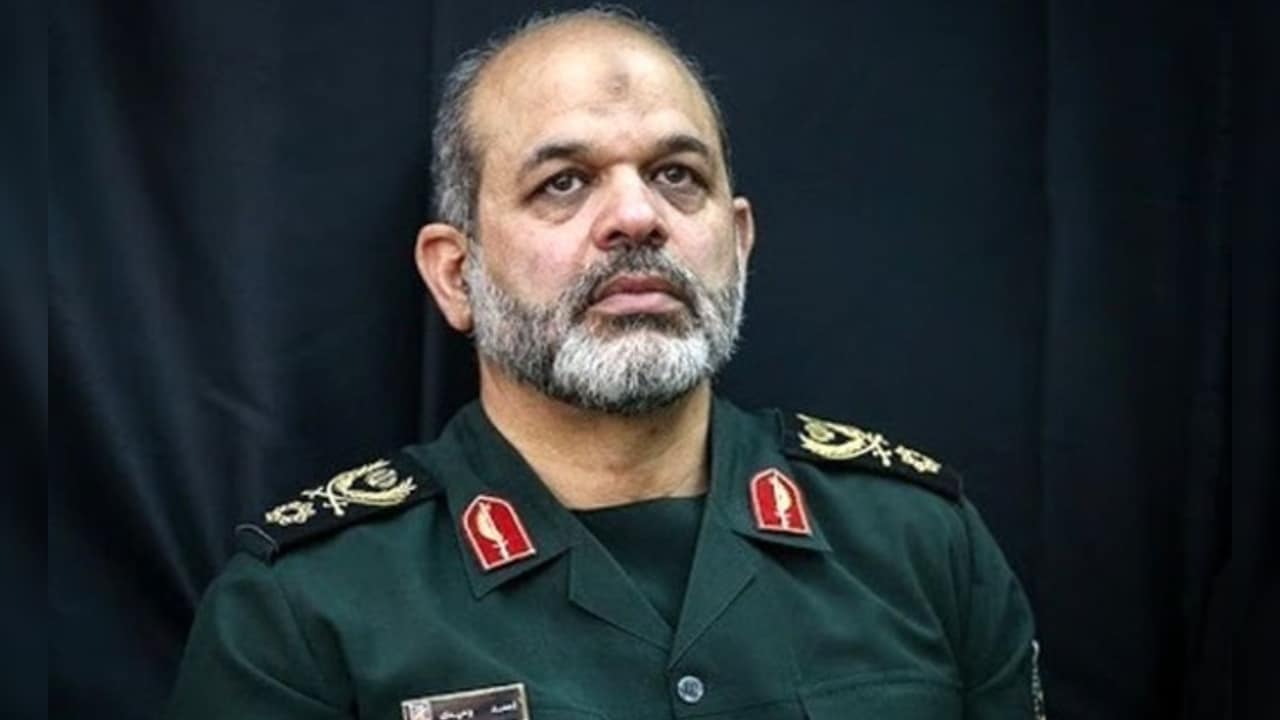
Mainstream media profiles want you to believe a comforting fairy tale about Iranian power. They paint a picture of a clean political hierarchy in Tehran: a moderate, elected president trying to broker peace with the West, routinely blocked by a cartoonish, shadow-dwelling military villain. The latest focus of this lazy narrative is Ahmad Vahidi, the Commander-in-Chief of the Islamic Revolutionary Guard Corps (IRGC).
When the international press looks at Vahidi overruling President Masoud Pezeshkian or driving a hard line in backchannel negotiations with Washington, they see a rogue commander hijacking the state. They claim Vahidi is single-handedly driving Tehran's war stance.
They are fundamentally misreading the entire mechanics of Iranian governance.
Vahidi is not an unguided missile disrupting an otherwise functional diplomatic machine. He is the machine itself. The conventional wisdom that separates Iran's "diplomats" from its "militants" is a myth designed for Western consumers who desperately want a moderate savior in Tehran to negotiate with.
I have spent decades watching analysts fall for this exact trap. By focusing on Vahidi as an aggressive individual actor, the foreign policy establishment is asking the wrong question entirely. They ask how to bypass him, instead of realizing that he represents the structural reality of the Islamic Republic during wartime.
The Myth of the Rogue Commander
The conventional press focuses heavily on recent leaks showing that Vahidi blocked President Pezeshkian's choice for intelligence minister and overrode attempts by Foreign Minister Abbas Araghchi to secure a fast-track diplomatic exit from blockaded shipping lanes. To a Western observer trained in civil-military separation, this looks like a military coup in slow motion.
It is nothing of the sort.
The IRGC is not a traditional military that sits subordinate to a civilian executive branch. It is a parallel ideological state structure that holds a constitutional mandate to safeguard the Islamic Revolution, both domestically and abroad. When Vahidi asserts authority over wartime economics or dictates the bounds of nuclear and ballistic missile negotiations, he is not stepping out of line. He is fulfilling the exact design of the regime’s power structure.
Consider the institutional pedigree Vahidi brings to the table. He was the first commander of the Quds Force in the late 1980s and 1990s. He served as Minister of Defense under Mahmoud Ahmadinejad, and Minister of Interior under Ebrahim Raisi. He ran the Supreme National Defense University. This is not a thuggish warlord running a militia out of a cave; he is a highly educated institutional bureaucrat with a doctorate in strategic studies who has spent forty years constructing the very security apparatus he now commands.
When he overrules a president, he does so with the explicit backing of the deep ideological core of the state, including Supreme Leader Mojtaba Khamenei's inner circle. The president exists to manage the bureaucracy and take the blame when the economy collapses under the weight of sanctions. The IRGC exists to ensure the regime survives the war. Believing that Pezeshkian could simply choose to ignore Vahidi if he just had more international support is a dangerous delusion.
Why Negotiating Around the IRGC Fails
The biggest mistake Western diplomats make is trying to cultivate "moderate" factions within Tehran to cut deals, hoping to cut out hardliners like Vahidi. This strategy assumes that the diplomatic track and the military track operate in separate silos.
Imagine a scenario where a Western delegation successfully signs a deal with Iran's foreign ministry to reopen regional shipping routes in exchange for a partial freeze on uranium enrichment. What happens next? The diplomats return home to celebrate a breakthrough, while the IRGC—which controls the actual anti-ship ballistic missiles, the fast attack craft in the Strait of Hormuz, and the domestic logistics networks—simply ignores the agreement.
This is not a theoretical risk. We have seen versions of this play out for decades. The IRGC operates the leverage that makes Iran relevant on the global stage. They control the drone production facilities, the ballistic missile stockpiles, and the regional proxy architecture. A diplomat cannot trade away assets they do not physically control.
By establishing the Shahid Beheshti School of Governance—an institution exclusively designed to train military personnel to run state civilian infrastructure—Vahidi spent years ensuring that the lines between civil administration and military strategy were permanently erased. The IRGC does not just fight the wars; it manages the borders, controls major sectors of the economy, and runs the internal security forces that suppress domestic dissent.
The Real Vulnerability of the Vahidi Strategy
If the mainstream view of Vahidi as an omnipotent, rogue dictator is wrong, the hyper-fixation on his strength also misses his most glaring weakness.
The contrarian truth that hawks refuse to admit is that Vahidi's aggressive centralizing of power is born out of acute systemic fragility, not absolute strength. The IRGC has taken massive blows to its leadership cadre over the last year. Vahidi took the top spot only after successive commanders, including Hossein Salami and Mohammad Pakpour, were eliminated in rapid succession during intense regional strikes.
Vahidi is currently forced to run a flattened, highly centralized command structure because he cannot fully trust the integrity of his own network. When a state security apparatus suffers heavy decapitation strikes, internal paranoia spikes. Vahidi's refusal to allow Pezeshkian to appoint a new intelligence minister isn't just a flexing of political muscle; it is a desperate defensive measure to prevent counter-intelligence failures during an active war.
Furthermore, this extreme centralization creates a massive bottleneck. By forcing all critical wartime economic decisions, intelligence appointments, and diplomatic redlines through a small cadre of trusted IRGC veterans, the regime loses its ability to adapt quickly. They are running a mid-20th-century command-and-control model against modern, decentralized threats.
Stop Misreading the Playbook
If you want to understand where Tehran's war negotiations are actually going, stop looking for signs of a rift between the politicians and the generals. There is no rift; there is only a division of labor.
Vahidi’s role is to ensure that Iran’s core strategic assets—its missile program, its regional deterrence posture, and its internal security grip—are never put on the negotiating table. The politicians are permitted to negotiate only within the narrow box that the IRGC constructs for them.
Accepting this reality means abandoning the comfortable illusion that a change in presidential tone equals a change in state policy. It means realizing that any deal not explicitly signed off on by the IRGC command structure is not worth the paper it is written on. Vahidi isn't hijacking the negotiations; he is setting the price of admission. Western strategy needs to stop chasing the ghost of Iranian moderation and start dealing with the hardline architecture that actually runs the country.