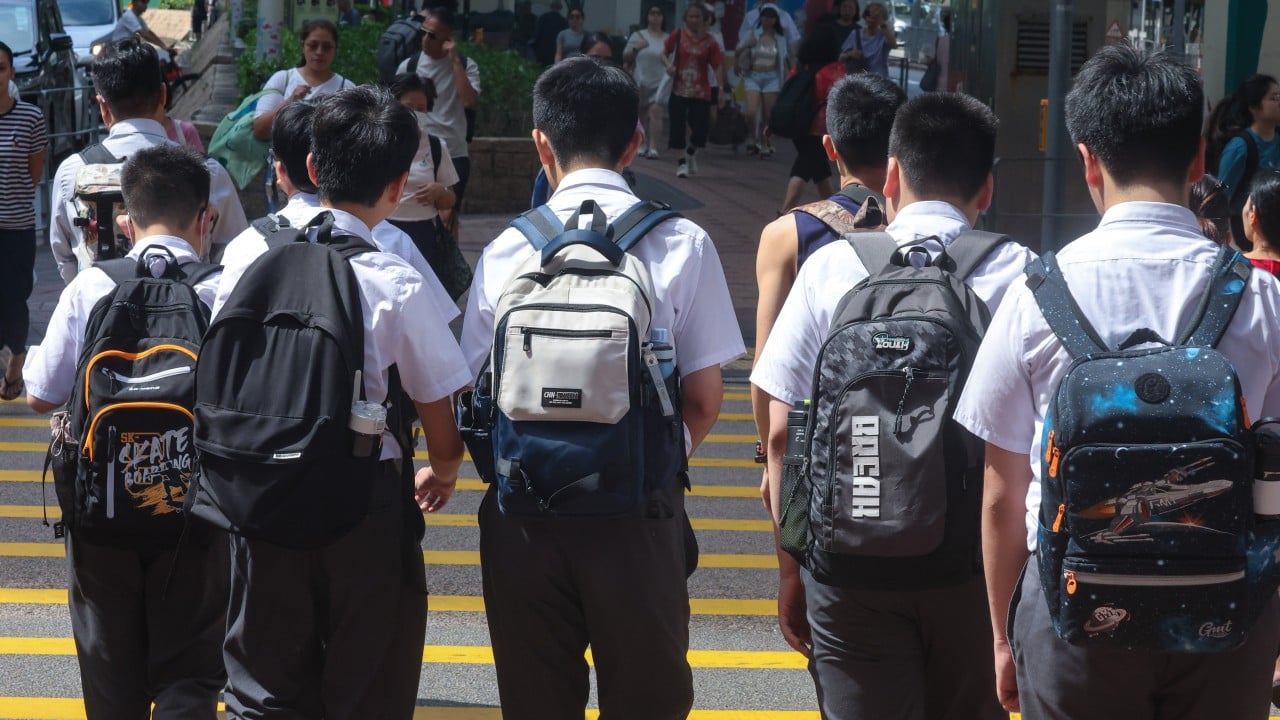
The uniform sits folded on the chair, crisp and dark, every crease ironed with an anxious precision that belongs to a different century. Beside it lies the school bag, heavy enough to tilt a spine, bulging with textbooks, past papers, correction fluid, and the quiet, crushing accumulation of expectations.
In a city that never stops moving, children are learning how to stand still while the ground dissolves beneath them.
We look at the statistics when they arrive in the morning papers, cold and clinical lines on a digital screen. We register the digits, nod with a collective gravity, and then we board the crowded MTR, sliding back into our own private turbulences. The number that lingers, the one that refuses to dissolve into the morning rush hour, is the age. Fifteen or below. Children who have barely learned the cadence of their own voices, let alone the endurance required to survive the steep, vertiginous cliffs of modern adolescence.
Sixty percent. That is the proportion of suspected student suicides in Hong Kong involving children who have not yet reached their sixteenth year.
Pause on that. Let the sentence strip away its bureaucratic armor. These are not university students staring down the terrifying ambiguity of an adult labor market. These are children who still skin their knees, who collect stationery sets, who hide under their bedsheets with comic books and flashlights long after the apartment has gone dark. Or at least, they used to.
To understand what is happening inside the concrete canyons of this city, you have to abandon the spreadsheets. You have to step into the fluorescent glare of a secondary school classroom during test week, where the air smells of old paper and suppressed panic.
Consider a hypothetical student, though every teacher in the territory will recognize her face instantly. Let us call her Chloe. She is fourteen. Her hair is tied back in a strict, regulation ponytail. Her grades are not bad—they are eighty-two percent, eighty-four percent, eighty-six percent. In any rational universe, these are the marks of a diligent, capable mind. But in the arithmetic of modern achievement, eighty-five is a failure if the top student scores ninety-eight.
Chloe does not cry when she gets her physics paper back. She simply stops breathing properly. Her chest tightens. A small, cold knot forms beneath her ribs, a physical weight that does not go away when she eats dinner or when she sits through piano practice. It stays with her through the four hours of evening cram school, through the silent bus ride home while neon signs smear red and green across the window glass, and into the dark hours of midnight when she stares at her ceiling trying to remember what happiness feels like.
We built a machine of pure velocity and placed it around our children.
Hong Kong is a city forged by immigrants and survivors, a place where people learned to outrun poverty through sheer, bone-deep labor. The cultural DNA of the city is stamped with the gospel of upward mobility. Education was the ladder. The only ladder. If you studied hard enough, memorized deeply enough, and outlasted the competition, you could buy your ticket out of the subdivided flats and into stability.
But somewhere along the way, the ladder turned into a treadmill that accelerates every time you catch your breath.
The pressure is not a sudden blow. It is a slow accretion. It is the teacher’s sigh when a grade dips two points. It is the parent’s silent glance at a cousin’s report card posted in a family chat group. It is the omnipresent hum of comparison, amplified a thousandfold by social media algorithms that feed insecurity back to teenagers in a loop of curated perfection.
When a child at fifteen or younger decides that the distance between who they are and who they are supposed to be is unbridgeable, we search frantically for a single trigger. Was it a failed exam? Was it a fight with a friend? Was it a stern word from a father who only wanted a better life for his progeny?
The truth is more unsettling. There is rarely a single cause. There is only the accumulation of silence.
Children are remarkably adept at hiding their quiet disintegrations. They do not want to add to their parents' burdens. They see the exhausted faces of mothers and fathers who work twelve-hour shifts in logistics, finance, or retail just to pay rent in one of the most expensive housing markets on earth. The child looks at that sacrifice and translates it into an internal currency of guilt: They are working themselves to the bone for me. The least I can do is get an A.
When an A feels like the baseline entry fee for existing, failure becomes terrifying. Not failure as a setback, but failure as an existential betrayal of the people who love them most.
We must talk about the architecture of isolation. In high-density apartment blocks where thousands live stacked vertically in the sky, it is entirely possible to feel completely invisible. A child can walk through a school of two thousand students every single day and speak to no one about what actually matters. Conversations are transactional. Did you finish the math homework? What did you get for question four?
We have optimized our schools for performance and left empathy to fend for itself.
Public health experts and psychologists have pointed repeatedly to structural interventions. More counselors in schools. Smaller class sizes. A fundamental overhaul of public examination systems that treat human minds like computer processors to be benchmarked and sorted. These measures are essential. They are the scaffolding we must erect if we want to stop the bleeding.
Yet, scaffolding alone will not change the climate.
To shift the trajectory of these numbers, we have to look inward at our own definitions of success. We have to be brave enough to tell our children something that sounds heretical in a competitive meritocracy: You are not your grades.
We have to model resilience by showing our own vulnerability. Adults in this city are masters of endurance, but terrible at admitting despair. We smile through the exhaustion, hide our financial anxieties, and project an unshakeable facade of competence. Children absorb this emotional subtext instantly. They learn that pain must be concealed, that struggling is a weakness, and that asking for help is an admission of defeat.
What if we inverted the narrative?
Imagine a home where a low grade is met not with a scowling silence or a lecture on future earnings, but with a cup of tea and a question about what is happening behind the eyes. Imagine a school system that measures its worth not merely by university entrance rates, but by the emotional baseline of its graduates.
These are not soft ideals. They are matters of survival.
The sixty percent statistic is not just a data point to be analyzed by policy committees and forgotten by next Tuesday. It is an urgent, flashing warning light on the dashboard of our society. It tells us that the current path is unsustainable, that our children are paying the interest on our collective ambition with their lives.
When a fourteen-year-old looks at the horizon and sees only a wall of demands, the tragedy belongs to all of us. It is a failure of imagination, a failure of community, and a failure of love that forgot how to listen before it started teaching.
The uniform still hangs on the chair. The school bag waits by the door.
Dawn will break over the harbor soon enough, painting the skyscrapers in gold and grey. Millions of children will pick up their bags, step out into the rushing current of the city, and put on their brave faces once more. Whether they walk alone in the silence or feel the steady, unconditional warmth of a hand that asks for nothing in return is the only choice that remains.