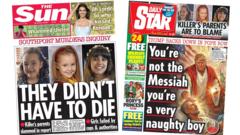
The ink stays on your fingers long after the coffee has gone cold. For those who still reach for the physical weight of a newspaper, there is a specific, tactile ritual to the morning. You unfold the broadsheet, the paper crisp and resistant, and suddenly the chaos of the world is laid out in a grid of black and white. But lately, the headlines haven't just been reporting the news. They have been screaming about things that shouldn't have happened.
The front pages today aren't just collections of data points or policy shifts. They are a gallery of avoidable grief. When a headline reads "They didn't have to die," it isn't just a critique of a system or a political jab. It is a haunting indictment of the gap between what we know and what we do.
Consider a crowded hospital corridor. It’s a hypothetical space, but one grounded in the very real crisis currently gripping the healthcare system. There is a woman named Sarah—let’s call her that—who has been sitting on a plastic chair for fourteen hours. She isn't a statistic. She is a daughter waiting for a doctor to tell her why her father’s breath is coming in ragged, shallow gasps. When the system fails Sarah, it isn't because of a lack of medical science. We have the pills. We have the machines. We have the brilliant minds. The failure is in the plumbing of society—the logistics, the funding, the sheer, crushing weight of demand meeting a hollowed-out supply.
The tragedy of the "avoidable" is that it requires a villain, but often finds only a vacuum. We want to point a finger at a single person, a single "Messiah" who can fix the wreckage. But the headlines are equally clear on that front: No one is coming to save us with a magic wand.
The Myth of the Singular Savior
We have a cultural obsession with the hero arc. We see it in our movies, our boardrooms, and most dangerously, our politics. We wait for the one leader, the one CEO, or the one visionary who will step onto the stage and resolve the structural rot with a single, sweeping gesture.
But the "Messiah" complex is a trap. It allows the rest of us to remain passive. If we believe a savior is coming, we don't have to worry about the leaking pipes in our own communities. We don't have to look at the granular, boring, difficult work of local policy or systemic reform. The newspapers today are a cold splash of water to the face. They remind us that placing our faith in a single figurehead is a recipe for heartbreak. When that figure inevitably fails—because they are human, because the problems are too vast—the disillusionment that follows is more toxic than the original problem.
It’s a cycle of adoration and execution. We build them up, we wait for the miracle, and when the hospital wait times stay long and the cost of living keeps climbing, we tear them down and look for the next miracle worker.
The truth is messier. It is less cinematic. The solutions to the problems that cause people to die "when they didn't have to" are found in the unglamorous work of redundancy, safety nets, and boring, consistent investment. It is the work of many, not the whim of one.
The Invisible Stakes of Silence
Why does it take a headline to make us notice the fraying edges of our safety?
Humans are wired to ignore slow-motion disasters. We notice the lightning strike, but we ignore the termites. The "avoidable" deaths mentioned in the morning papers are the result of termites. They are the result of years of "efficiency" drives that were actually just cuts. They are the result of assuming that because things worked yesterday, they will work today with 10% less.
Think about the way we view our public institutions. We treat them like a smartphone battery. We only care when the red bar appears and the percentage hits 1%. But a healthcare system, a transport network, or a social safety net isn't a battery you can just plug into a wall for an hour. It’s an ecosystem. Once it collapses, you aren't just looking at a "system failure." You are looking at Sarah, still sitting in that plastic chair, realizing that the help her father needs is stuck behind a wall of bureaucracy and understaffed wards.
The emotional core of this isn't anger. It's exhaustion. It is the weary realization that the "Messiah" we were promised was just a distraction from the fact that we stopped maintaining the foundations.
The Mirror in the Paper
When we read these stories, we are looking into a mirror. The headlines reflect our collective choices. We choose the narratives we follow. We choose whether to demand long-term stability or settle for short-term charismatic promises.
The "Messiah" narrative is an easy sell. It’s a story we know how to read. The story of "incremental systemic improvement through sustained public pressure and nuanced policy" doesn't sell many papers. It doesn't get many clicks. But it is the only story that ends with fewer people dying who didn't have to.
The stakes are invisible until they are agonizingly personal. We move through our lives assuming the floor will hold. We assume that if we dial those three digits, someone will come. We assume that the "authorities" have a plan. The papers are telling us, in no uncertain terms, that the plan is failing because we expected a person to do the job of a society.
There is a specific kind of silence that follows the reading of a particularly heavy news day. It’s the sound of a realization sinking in. We cannot wait for a Messiah because the Messiah is a myth used to sell us our own powerlessness.
Instead, there is only the work. The grueling, daily, collective insistence that "avoidable" must actually mean "prevented."
As the sun climbs higher and the morning ritual ends, you fold the paper back up. The ink is still there, dark and stubborn on your skin. You can wash it off, but the stories don't disappear quite as easily. They stay in the back of the mind, a reminder that the world is built by hand, and it can only be fixed the same way—one unglamorous, necessary step at a time, long after the cameras have stopped looking for a savior.
The man in the hospital bed is still breathing, for now. Sarah is still waiting. The Messiah isn't coming, but the nurse just started her double shift, and she is exhausted, and she is the only thing standing between the headline and the truth.
The paper hits the recycling bin with a dull thud. Outside, the world is already moving, loud and indifferent, waiting for us to decide what we are willing to save.