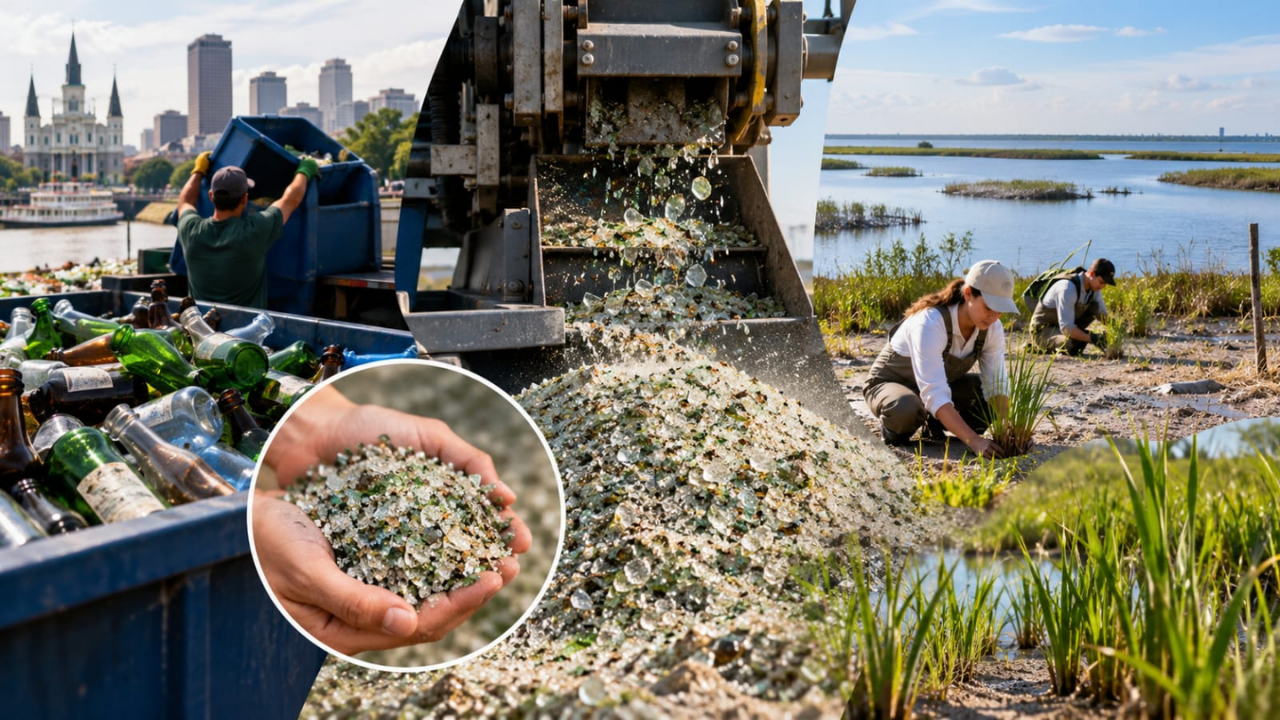
The empty bottle feels weightless in the hand. It is a modern convenience so effortless we rarely pause to consider its departure. You pour the wine, you crack open the cold beverage at a humid backyard barbecue, you toss the green or amber glass into a curbside bin, and you forget it. Out of sight. Out of mind.
Except glass does not disappear. It does not decompose. It is an ancient material—molten sand, soda ash, and limestone fused by fire—that stubbornly persists for millennia, lying in wait beneath the surface of the earth.
Walk down any street in New Orleans after a humid evening, listen to the brass band echoing down a brick-paved alleyway, and look closely at the gutters. You will see the casualties of celebration. Shards catching the amber glow of old streetlamps. A broken Heineken bottle. A discarded wine flask from a porch gathering. We live in a city built on rhythm, moisture, and excess, and for generations, our celebration carried a quiet, permanent footprint.
Then came 2020. A year when the world seemed to fracture, a local initiative began quietly doing what large municipal systems often fail to do. It started collecting the ghosts of last night's dinner parties and turning them back into the earth.
Twelve million pounds.
Let that number settle for a moment. Twelve million pounds of glass diverted from landfills, crushed, pulverized, and reborn. Not shipped across oceans to ambiguous recycling plants, but transformed right here, used to rebuild the very coast that protects us and the infrastructure beneath our feet.
To understand why this matters, you have to understand the existential geography of Louisiana. This is a place where the land is literally sinking while the sea is rising. We live on a fragile ribbon of silt, a delta shaped by the wild Mississippi River before humans caged it with levees. Every year, coastal erosion eats away at the marshes, the natural sponges that cushion New Orleans from the fury of incoming hurricanes.
Sand is currency here. Clean, heavy sand is what engineers use to rebuild barrier islands, restore marshland, and armor the fragile edges of our home. And yet, for decades, we were burying mountains of glass in local landfills—heavy, dense, silica-rich material that could easily be converted into local aggregate.
Consider a hypothetical resident named Marcus, who runs a neighborhood restaurant in the Marigny. Every week, Marcus breaks down cardboard boxes and wheels out heavy crates filled with wine bottles, gin bottles, and beer bottles left behind by patrons listening to late-night jazz. In the past, watching those heavy bins get dumped into a traditional garbage truck felt like a quiet defeat. It was throwing away raw earth. Now, Marcus knows that the bottles from his Friday night rush are destined for a different ledger. They are headed toward a local recycling hub where heavy industrial crushers reduce jagged shards into smooth, usable sand.
Glass is essentially silica. Ground down correctly, it loses its dangerous edges, turning into a benign, workable substitute for river sand. It does not leach toxins. It does not degrade. It simply fills a desperate void.
When glass becomes sand, the transformation is almost poetic, but the logistics are brutally practical. The initiative we are talking about—Glass Half Full, founded by young entrepreneurs who looked at the state’s coastal crisis and refused to wait for slow-moving bureaucracy—began with a bucket, a backyard, and a rented concrete mixer. It was grassroots ingenuity born out of pure stubborn affection for a vulnerable city.
People brought their empties. Neighbors dropped off bins in the trunk of sedans. The founders didn't have a massive corporate endowment; they had grit, blisters, and an urgent realization. They understood that if you want to save a coastline, you do not start in Washington, DC. You start with the recycling bin on your front porch.
The process itself is loud. The deafening roar of industrial machinery grinding glass against glass, stripping away paper labels, and sorting the fragments by color until they emerge as fine, greyish sand or gravel-like cullet. That finished product is then loaded onto trucks and barges. Some of it goes toward coastal restoration projects, creating nesting grounds for wildlife or shoring up eroding wetlands. Some of it goes into local construction projects, paving paths and mixing into eco-friendly concrete.
Twelve million pounds is a difficult metric to visualize. It is not just a statistic on a corporate sustainability report.
Imagine six hundred full-size elephants piled high. Imagine a mountain of amber and emerald bottles stretching higher than the roof of a French Quarter townhouse, completely pulverized into a protective shield for the marshlands. That is what twelve million pounds looks like when you translate bureaucratic tonnage into physical reality.
Critics will point out the obvious: recycling glass is energy-intensive. Transporting heavy bottles takes fuel. True. But the alternative—digging up natural riverbeds for virgin sand while our landfills groan under the weight of permanent waste—is an ecological shell game we can no longer afford to play. Localized glass recycling closes the loop. It keeps the weight here, where the problem lives.
There is a deeper psychological shift that happens when a community starts participating in a project like this. You stop seeing a bottle as trash. You begin to see it as a temporary container for an experience, one that deserves a second life. When you hand your glass over to a community drop-off site, you are engaging in a micro-act of stewardship. You are voting for the physical persistence of the ground you walk on.
New Orleans has always been a city of reinvention. We take battered traditions, floodwaters, humidity, and heartbreak, and we turn them into art, music, and resilience. We throw beads in the air and sweep them up at dawn. We patch our roofs, paint our shutters, and rebuild after the storm clears.
Transforming millions of pounds of discarded glass into coastal sand is just another variation of that old, stubborn Louisiana magic. It is the art of refusing to let anything go to waste, especially the ground beneath our feet.
The next time you hear the sharp, satisfying clink of glass bottles being sorted into a bin, listen closer. Underneath the noise of the city, beneath the trumpets and the chatter of the avenue, you are hearing the sound of a coastline fighting back, one bottle at a time.


