Silence.
That is the first thing you notice after the concussion wave passes, before the dust even settles into the back of your throat and before your ears begin their high, metallic ringing. Anyone who has stood near the aftermath of an artillery barrage or a ballistic missile impact knows that strange, vacuum-sealed quiet. For three or four seconds, the world seems to hold its breath, as if physics itself is calculating the cost of what just occurred.
Then comes the sound of shifting concrete.
When a Russian strike hit a humanitarian aid distribution site in Ukraine, killing 31 people and leaving dozens more buried beneath twisted rebar and pulverized masonry, the global news cycle processed the event with its usual, practiced efficiency. A headline flashed across millions of glowing screens. A number was updated from twenty-four to twenty-eight, and finally to thirty-one. People scrolled past it over morning coffee, sighed at the tragedy of a protracted war, and moved on to weather reports or stock tickers.
Numbers are merciful like that. They insulate us. Thirty-one is a statistic you can hold in your head without breaking; thirty-one individual mornings, thirty-one half-drunk cups of tea left on kitchen tables, and thirty-one pairs of shoes waiting by front doors are not.
The Architecture of a Tuesday Morning
To understand what actually happens when an aid center becomes a crater, you have to stop looking at satellite maps and start looking at a cardboard box.
Consider a hypothetical composite of the people who gather at these sites—let us call her Olena, a sixty-eight-year-old retired schoolteacher living twenty kilometers from the shifting front line. In a town where the municipal water pipes ruptured two winters ago and the local grocery store is now a scorched shell, a humanitarian aid hub is not a charity. It is the entire circulatory system of the community.
Olena does not wake up thinking about geopolitics or territorial concessions. She wakes up thinking about insulin, five-liter jugs of potable water, buckwheat, and batteries for a flashlight. She puts on her heaviest coat—not because it is freezing, though the damp chill of eastern Ukraine settles deep into the marrow, but because you never know how long you will have to stand in line.
By 8:30 in the morning, the courtyard outside the distribution center—usually a former cultural center, a school gymnasium, or a municipal warehouse—is alive with a low, rhythmic murmur. People bring folding stools. They trade rumors about pension disbursements and which roads are still passable after the overnight shelling. Volunteers in high-visibility vests move between pallets stacked with flour and hygiene kits, clipboards in hand, checking off names with stubby pencils because the cellular network went down three days ago.
There are no armored vehicles parked outside. There are no radar arrays on the roof, no ammunition crates hidden beneath the tarps. Just sacks of potatoes, diapers, and thermal blankets.
And yet, in the cold calculus of modern attrition warfare, a crowd of civilians waiting for bread is treated no differently than a staging ground for infantry.
Why Civilian Infrastructure Becomes a Target
People often ask, with genuine bewilderment, how a strike of this magnitude happens. Is it a stray missile? Bad intelligence? An accident?
I used to ask those same questions when I first began covering conflict zones, clinging to the comforting illusion that war still operated under some unspoken code of honor, or at least basic military pragmatism. After all, wasting an expensive, precision-guided munition on a warehouse full of canned beans makes zero tactical sense if your goal is simply to defeat an opposing army.
Unless the army is not the only target.
To grasp the logic behind striking an aid site, think of a siege in the medieval sense, updated for the twenty-first century. When an invading force struggles to break through entrenched defensive lines, it shifts its focus toward breaking the will and the physical capacity of the population behind those lines to survive. If you destroy the power grid, people freeze. If you bomb the hospitals, the wounded die of simple infections. And if you strike the humanitarian aid distribution centers, you sever the final thread keeping the elderly, the disabled, and the impoverished anchored to their homes.
You weaponize terror to force a mass exodus. Empty towns cannot resist. Ghost cities do not harbor partisan networks or supply lines.
Military analysts and international law monitors have documented this pattern across multiple theaters over the past decade, from the bombed bakeries of Aleppo to the shattered grain silos and aid hubs of Donetsk and Kharkiv. Under the Geneva Conventions, deliberately targeting civilians and humanitarian workers is a clear war crime. The legal definition is unambiguous. The reality on the ground, however, is written in dust and blood long before any tribunal convenes in The Hague.
The Invisible Clock of the Rescue
When the strike hits, a second, quieter race begins—one that rarely makes the evening broadcast.
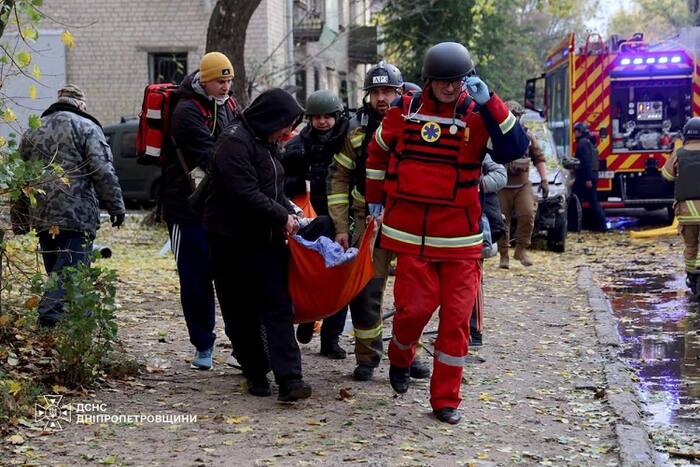
In the immediate aftermath of the blast that killed 31 people, emergency responders from Ukraine’s State Emergency Service arrived within minutes. If you have ever watched these crews work, you realize quickly that rescue operations in an active war zone bear little resemblance to the orderly scenes we see after earthquakes or building collapses in peacetime.
First, there is the threat of the "double-tap"—a brutal tactic in which a second strike is launched at the exact same coordinates twenty to forty minutes after the first, timed specifically to kill the paramedics, firefighters, and neighbors who rushed in to pull survivors from the rubble. Every rescue worker digging through broken concrete with bare hands or hydraulic cutters is listening with one ear to the ground for faint tapping, and with the other to the sky for the whistle of incoming ordnance.
Second, there is the sheer physics of collapsed Soviet-era concrete. Heavy prefabricated panels do not crumble cleanly; they pancake, trapping pockets of air that can keep a human being alive for days while simultaneously crushing limbs and pinning chests so tightly that a person cannot draw a full breath.
Dozens were reported missing immediately following the attack. In the lexicon of disaster reporting, "missing" is a mercifully ambiguous word. For families standing behind the yellow police tape, it is torture.
Imagine standing across the street from a mountain of smoking rubble, clutching a photograph on a cracked phone screen, waiting for a man in a soot-stained helmet to walk over and shake his head. You hope your mother was late that morning. You hope she stopped to talk to a neighbor, or forgot her glasses and turned back toward her apartment, or decided the line was too long and went home. You bargain with time, trying to rewind the clock by ten minutes, five minutes, sixty seconds.
Meanwhile, inside the debris pile, heavy cranes have to lift slabs weighing several tons without causing a secondary collapse that would suffocate anyone still breathing below. Dogs trained to detect human scent are led over jagged rebar, their paws bleeding, pausing occasionally to whine at a gap too narrow for a human shoulder.
The Ripple Effect Nobody Counts
Even when the final body is recovered and the official death toll stops climbing, the true casualty count of an attack on an aid site is only beginning to compound.
Consider what happens the following week in that town, and in twenty other towns just like it along the front.
International non-governmental organizations—groups that operate on strict insurance mandates and donor accountability—are forced to suspend operations. You cannot ask a twenty-four-year-old logistics coordinator from Kyiv or Warsaw to stand in an open courtyard handing out cooking oil when that exact courtyard has just been zeroed in by Russian artillery. Convoys are rerouted. Warehouses are decentralized, broken down into smaller, hidden basements, which slows the distribution of food from thousands of families a day to a few hundred.
And what about the survivors?
Let us return to our hypothetical teacher, Olena. Suppose she survived because she was standing behind a thick load-bearing brick wall when the shockwave hit. She walks away with a mild concussion, a perforated eardrum, and bruises across her ribs. Physically, she is not among the 31 dead, nor is she among the dozens missing. She will not appear in any statistical table.
Yet the next time an aid truck pulls into town, Olena stays inside her dark apartment. The fear of gathering in a crowd—of becoming an easy coordinate on someone’s targeting screen—outweighs her hunger. She rations a single bag of dried peas over two weeks. Her blood pressure spikes from chronic stress and a lack of medication. Three months later, she suffers a stroke alone in her kitchen.
No missile hit her house. No shrapnel touched her skin. Still, the strike killed her just as surely as if she had been standing at ground zero.
What the Rest of Us Refuse to See
There is an uncomfortable truth that those of us living in safe, well-lit cities prefer to avoid: we have grown accustomed to the aesthetics of distant suffering. We know how to look at a photograph of a crater, feel a brief, sharp pang of moral outrage, and then close the browser tab.
Part of that numbness comes from exhaustion. When a conflict drags on year after year, the human brain instinctively builds calluses to protect itself from constant grief. We begin to view atrocities through the lens of inevitability—as though missiles falling on food lines were a natural disaster, like a hurricane or a volcanic eruption, rather than the deliberate result of human decisions made in brightly lit command bunkers hundreds of miles away.
I admit that even after years of witnessing these scenes, I still struggle to reconcile the mundane humanity of an aid site with the clinical violence used to erase it. There is no grand philosophical framework that makes sense of a shattered wheelchair lying next to a spilled bag of rice. Trying to intellectualize it feels like an insult to the people who were simply trying to get through a Tuesday.
What keeps me from turning away is remembering that the fragility we see in eastern Ukraine is not unique to that geography. Modern civilization is astonishingly thin. Every one of us relies on invisible chains of supply, trust, and basic human decency to keep our refrigerators full and our roofs intact. When those chains are deliberately severed anywhere in the world—and when the international community treats the destruction of a humanitarian hub as just another routine news update—the precedent quietly erodes the safety of civilians everywhere.
The Unclaimed Parcels
Two days after the rubble was cleared at the site, local volunteers returned to salvage whatever supplies had survived the blast.
Beneath a collapsed corrugated tin roof, spared by a fluke of geometry where two concrete beams had wedged together in an inverted V, they found several dozen intact cardboard boxes. Inside were loaves of dense rye bread, jars of pickled vegetables, packets of tea, and small bars of soap wrapped in wax paper.
Written across the top of each box in thick black marker was a surname and a number corresponding to the morning’s registry.
The volunteers loaded the surviving boxes onto the back of a battered van and drove from street to street, knocking on doors to deliver them by hand. At house after house, neighbors stepped out onto their porches, took the parcels in silence, and nodded toward the houses down the block where the shutters were closed and the gates were locked.
At the end of the afternoon, the van returned to the edge of the crater. In the back, resting on the metal floor, sat thirty-one boxes whose names had already been crossed off the list.