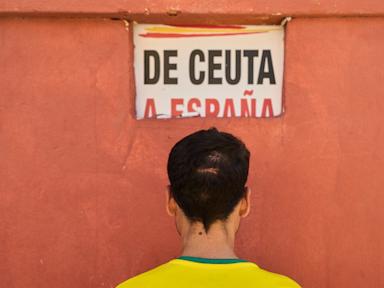
Canvas does not hold warmth well when the Mediterranean wind turns sharp. At night, the fabric of the tents in Ceuta breathes in and out with the coastal gale, a slow, metallic shudder that keeps thousands of people awake.
I remember the sound of that wind. It does not knock; it presses. It forces itself through the smallest gaps in the zippers, carrying the damp salt of the ocean and the unmistakable scent of cold earth. Inside one of these temporary shelters, a young man named Ibrahim sits on the edge of a narrow cot, rolling a cigarette with fingers that have grown stiff from the chill. He is thousands of miles from the kitchen tables of his childhood, yet his mind is caught in a rigid, agonizing geometry.
Justice. Safety. Returning home.
These are not abstract terms found in policy briefs or diplomatic communiqués. In Ceuta—that jagged Spanish enclave clinging stubbornly to the northern coast of Africa—these three words represent a grueling daily trial. They are the coordinates of a human soul suspended between what was lost and what refuses to begin.
To understand why thousands find themselves here, trapped on a scrap of European soil surrounded by high fences and deep water, we must first look at the geography of desperation. Ceuta is a paradox. It is Europe, yet it is Africa. It is a portal, yet it is a dead end. When people cross the border—whether by scaling the formidable barrier topped with razor wire or by swimming the freezing currents around the Tarajal breakwater—they believe they are stepping onto the floor of a sanctuary.
They expect a system designed to listen. Instead, they find a waiting room with no exit doors.
Consider what happens next. The initial adrenaline of survival fades, replaced by the crushing silence of bureaucratic limbo. Weeks turn into months. The tents, pitched hastily on uneven ground, transform from emergency shelters into micro-societies. Clothes lines stretch between tent poles. Makeshift tea stations hum with the low chatter of men and women sharing rumors gleaned from glitchy smartphone screens.
Yet beneath the daily routine lies a profound moral fracture.
Every person in this camp carries an internal scale. On one side sits the memory of home—the political instability, the economic ruin, or the direct threats that made staying an act of self-destruction. On the other side sits the reality of the European borderlands: overcrowded facilities, restricted legal status, and the constant, gnawing humiliation of dependency.
"If I go back, I am a failure," Ibrahim tells me, his eyes fixed on the flickering ember of his cigarette. He doesn't say he is afraid of dying; he says he is afraid of disappearing. In his hometown, everyone knows his face. If he returns empty-handed, having spent the family's pooled savings only to be spat out by the edge of Europe, he becomes a ghost haunting his own past.
That is the hidden cost of the journey. It extracts a toll long before the border is ever crossed.
Statistically, the numbers are stark. Thousands arrive at Spain's southern borders annually, driven by the volatile intersections of climate stress, regional conflict, and post-pandemic economic collapse. Yet, behind the macro-data provided by agencies like UNHCR or local NGOs, the individual narrative is stubbornly nonlinear.
Some migrants weigh the scales and decide that the cost of waiting is higher than the cost of retreat. They choose to return. Voluntary repatriation programs, often viewed with deep suspicion by those still holding onto the dream of asylum, offer a bitter ticket home. It is a profound psychological defeat—an admission that the fortress could not be scaled, or that the prize within its walls was not worth the price of admission.
Others choose to stay, enduring the biting cold of the tent camps not out of stubbornness, but because the alternative is unthinkable. To return home without resources is to invite social ostracization. It is to face the questions of neighbors who only see the empty chair at the dinner table and the debt left behind in the marketplace.
Safety, therefore, becomes a moving target.
Is a person safe when they are sleeping under canvas in a secure European enclave, but denied the right to work, move freely, or build a future? Or is safety found back home, where the economic soil is poisoned, but the familiar roof keeps out the rain?
These are the questions that hang heavy in the air of the Ceuta camps long after the sun goes down. The policymakers in Brussels and Madrid debate migration quotas as if they are adjusting dials on a machine. They speak of border management, security frameworks, and humane repatriation. But their language lacks the texture of salt and canvas. They do not hear the wind rattle the poles at three in the morning. They do not feel the paralyzing weight of a choice where every available option leads to a form of loss.
We must be honest about the mechanics of migration. It is not a clean river flowing from areas of high pressure to areas of low pressure. It is a chaotic, deeply human collision between the instinct to survive and the artificial rigidity of international borders. When nations build walls higher, they do not stop the flow of human desperation; they merely redirect it into narrower, more dangerous channels, turning places like Ceuta into pressure cookers of human potential.
Ibrahim puts out his cigarette against the heel of his shoe. The tiny red glow dies instantly in the damp air. Outside, a guard's boot crunching on gravel breaks the quiet of the night.
He stands up, stretches his long frame inside the cramped confines of the tent, and looks out toward the invisible horizon where the Mediterranean meets the Atlantic. He has not made his choice yet. The scales are still tipping, back and forth, hour by agonizing hour, caught somewhere between the justice he was promised and the reality he was given.