Every time Washington lights up a target in the Persian Gulf, the television pundits crawl out of the woodwork to chatter about escalation ladders, deterrence theory, and regional firestorms. When the latest headlines blare about strikes on Larak Island and Tehran’s predictable chorus of hollow vows for "response and punishment," the foreign policy establishment treats it like another step on a predictable staircase to total war.
They are wrong. Dead wrong. For an alternative look, consider: this related article.
I have spent decades watching defense intellectuals mistake theatrical chest-beating for actual strategic momentum. The conventional narrative insists that kinetic strikes on minor Iranian outposts change the calculus of the regime. It treats every missile impact as a heavy blow against an axis of resistance. This is an illusion designed to comfort cable news viewers and justify bloated defense budgets.
Let us look past the pyrotechnics. Larak Island is not a strategic pivot point. It is a speed bump. Tehran knows it, the Pentagon knows it, and yet we keep running the same tired script because admitting the futility of it requires a complete rewrite of modern naval strategy. Further reporting on the subject has been provided by USA Today.
The Geography of Theater
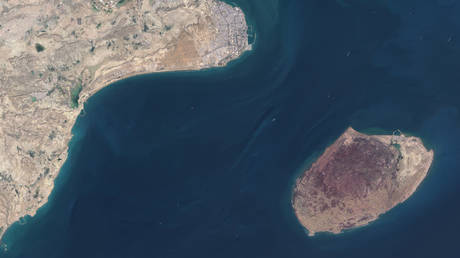
To understand why bombing Larak Island accomplishes next to nothing, you have to look at a nautical chart without the fog of war propaganda. Larak sits near the Strait of Hormuz, an administrative and geographical choke point where roughly a fifth of the world's petroleum passes. For decades, military planners have obsessed over securing this ditch.
The lazy consensus holds that if you degrade radar sites or supply depots on islands like Larak, you secure the shipping lanes. This assumes Iran fights like a 20th-century conventional superpower with centralized logistics and rigid naval formations. That assumption is an expensive fantasy.
Iran does not need fixed installations on Larak Island to disrupt oil flows. Their entire naval doctrine is built on distributed, asymmetric swarming. Fast attack craft darting out from hidden coves along the mainland coast, shore-based anti-ship cruise missiles mounted on mobile truck beds, and sea mines deployed from commercial dhows render fixed island infrastructure largely redundant.
When a strike hits a concrete bunker on Larak, the strategic reality on the water shifts by precisely zero percent. The Islamic Revolutionary Guard Corps Navy simply shifts its asymmetric assets five miles down the coast. We spent millions of dollars on precision ordnance to destroy empty real estate while the actual threat vector remains completely untouched.
The Economics of Exhaustion
Look at the cost imbalance. This is the detail the think-tank crowd conveniently ignores while drafting their white papers.
A single Tomahawk land-attack missile or precision-guided munition costs upward of two million dollars. To launch it, you require a multi-billion-dollar surface combatant or carrier strike group operating in hostile littoral waters, backed by a staggering tail of logistics, intelligence, and aerial refueling.
What is Tehran spending to replace a shattered communications shack or a prefabricated barracks on a barren rock? A fraction of a rounding error in their asymmetric budget.
Imagine a scenario where a corporate CEO spends two million dollars to smash a competitor's storage shed while the competitor owns the entire underlying patent network and supply chain. That CEO would be fired before the end of the quarter. Yet in the defense sector, we call this a successful operation and pin medals on the architects.
This is an asymmetric war of attrition fought on balance sheets, and Washington is currently playing the role of the bankrupt spendthrift. Tehran welcomes these kinetic exchanges. Every time we launch a multi-million-dollar response to a localized provocation, we drain our own stockpiles of high-end interceptors and precision munitions—stockpiles that take years to replenish—while teaching our adversaries exactly how our command-and-control networks react under stress.
The Performance of Retaliation
Let us talk about Tehran's vows of "response and punishment." They are as scripted as a professional wrestling promo.
When state-controlled media in Iran broadcasts fiery warnings of impending vengeance, Western intelligence agencies scramble, threat levels rise, and embassies hunker down. We treat these threats as imminent existential dangers. We panic, we posture, and we prepare for the big one.
Then, nothing happens. Or worse, a proxy group fires a rusted rocket that lands harmlessly in an empty patch of desert two hundred miles away, allowing both sides to claim victory for domestic consumption.
The regime in Tehran does not need to launch a massive direct counter-strike to win. Their victory condition is simply survival and the steady erosion of American staying power. Every cycle of strike and counter-threat normalizes a higher baseline of regional instability, driving up insurance rates for commercial shipping, spooking global energy markets, and slowly convincing our regional allies that Washington's security umbrella is more trouble than it is worth.
We are reacting to symptoms while the disease metastasizes. The real power centers in Tehran—the underground centrifuge halls, the cyber warfare units, the financial networks moving illicit oil through ghost fleets—are miles away from Larak Island. They do not lose a wink of sleep over a smoking ruin on the Persian Gulf coastline.
Breaking the Cycle
If we want to change the dynamic, we have to stop playing the game by rules written thirty years ago.
First, stop treating tactical pinpricks as strategic victories. If a kinetic strike does not fundamentally degrade an adversary's ability to wage asymmetric warfare or alter their core decision-making calculus, it is an expensive form of political theater. Do not do it.
Second, shift the battlefield from the kinetic to the financial. Iran’s network relies on a sprawling shadow economy—illicit oil transfers in international waters, shell companies in opaque jurisdictions, and digital asset channels bypassing Western sanctions. Dismantling those networks requires quiet, methodical forensic accounting, law enforcement coordination, and maritime interdiction that targets revenue streams rather than concrete bunkers. It is less photogenic than a missile launch, but it actually works.
Third, recognize that deterrence in the 21st century is not about proving you can break things. It is about proving you can deny objectives without bankrupting yourself in the process. When your adversary can absorb your blows faster than you can afford to strike, you do not have deterrence. You have a treadmill.
Step off the treadmill. Stop bombing rocks. Let the empty threats ring out into the empty air, and start targeting the lifeblood of the network instead of its shadow.