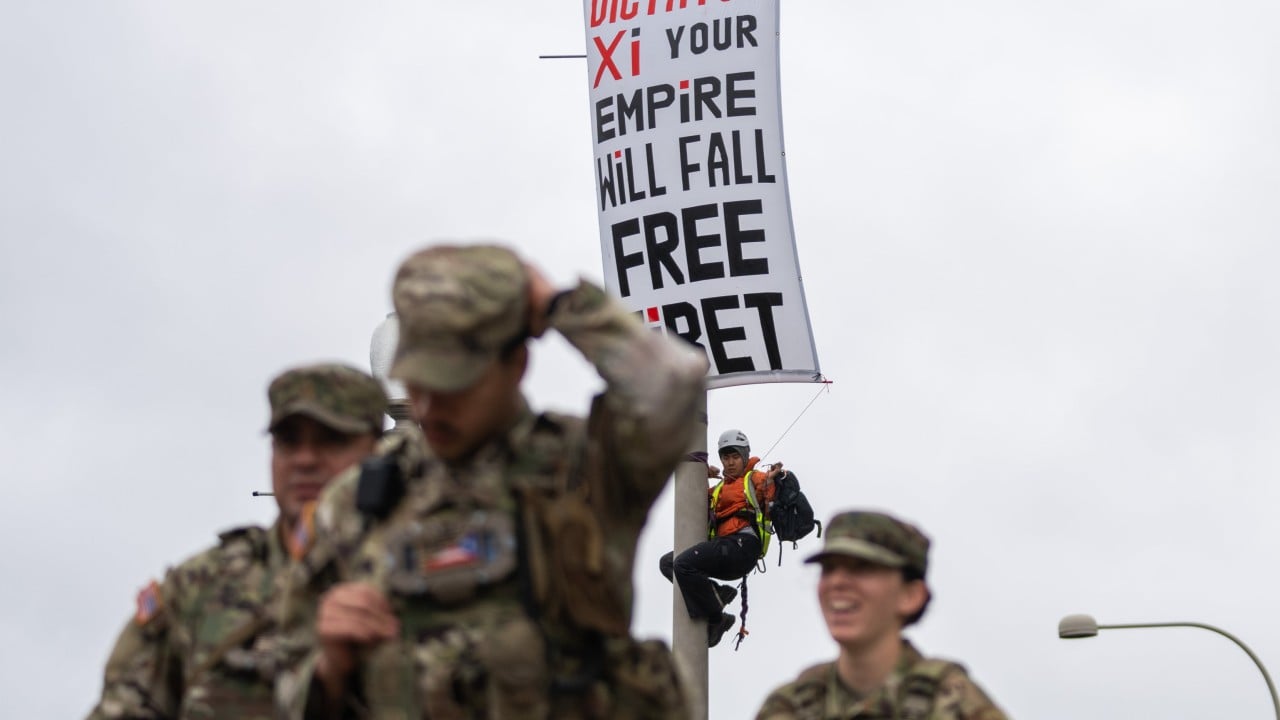
When a foreign head of state arrives on American soil, the federal government does not merely extend diplomatic courtesies. It erects an invisible fortress. Secret Service agents, municipal police departments, and federal intelligence agencies coordinate massive lockdowns to shield visiting dignitaries from converging waves of welcome committees and furious protesters. High-stakes diplomacy requires absolute spatial control. Yet, managing these visits goes far beyond closing city blocks or checking identification credentials. It exposes the fragile friction points where foreign political struggles spill directly onto domestic streets, turning American intersections into arenas of intense ideological combat.
Security perimeters stretch for miles. Barricades line concrete avenues. Federal officials prepare for months.
Every state visit involving high-profile leaders like Chinese President Xi Jinping brings an intricate operational nightmare for domestic security forces. The challenge is multi-layered. Law enforcement agencies must balance the protection of foreign officials under international obligations against the constitutional rights of domestic and immigrant populations who wish to express dissent. When world leaders touch down, they are accompanied by state-backed delegations, intelligence officers, and meticulously organized diaspora groups eager to demonstrate allegiance. Simultaneously, human rights advocates, Tibetan activists, Uyghur survivors, Hong Kong dissidents, and pro-democracy organizations mobilize their own networks. The result is a combustible mix of opposing crowds shouting across police lines, creating a logistical puzzle that tests the limits of urban crowd management.
The Iron Ring Around Diplomacy
Planning begins long before the motorcade rolls. Months of classified briefings precede any major summit.
Federal authorities designate specific zones as National Special Security Events or implement equivalent protective protocols. Metal detectors appear at designated checkpoints. Bomb-sniffing dogs sweep every square inch of asphalt where foreign dignitaries are scheduled to walk. Intelligence analysts pore over social media chatter, intercepting coordination efforts from both foreign consulate-affiliated groups and dissident networks. Every route is mapped with redundancy. Every threat vector is modeled by computer simulations and human intelligence handlers.
Communication breakdowns frequently occur between federal agencies and local police. Local officers often find themselves caught between federal mandates to secure a sterile bubble and local ordinances protecting public assembly. During previous high-level summits, such as the Asia-Pacific Economic Cooperation gathering in San Francisco, local precincts faced intense scrutiny over whether they maintained neutrality or inadvertently shielded aggressive counter-protesters. Federal agencies operate with an abundance of caution, sometimes establishing exclusion zones that alienate local businesses and residents. Commuters face sudden gridlock. Subway stations near meeting sites undergo unexpected closures. The city transforms into an armed camp, designed entirely around the fragile ego and security demands of visiting autocrats and democratic leaders alike.
Furthermore, jurisdictional disputes plague these operations from inception to conclusion. Local law enforcement commanders answer to mayors and city councils accountable to tax-paying residents whose daily lives are upended by security theater. Federal commanders answer to executive branch directives focused entirely on diplomatic stability and bilateral relations. This structural divergence creates operational friction on the ground. When federal agents demand the immediate clearance of a public park or sidewalk to accommodate an incoming motorcade, local police officers are left to manage the immediate fury of citizens whose constitutional rights of movement and assembly are abruptly curtailed.
Anatomy of a Controlled Environment
Control is the ultimate currency of summit security. Without it, catastrophe looms.
The physical architecture of a summit zone follows a strict geometry of exclusion. Concrete jersey barriers block vehicular traffic. Bike racks lashed together with heavy-duty zip ties form pedestrian channels. Police officers stand shoulder-to-shoulder, wearing riot gear beneath high-visibility vests. Behind these lines, credentialed journalists, accredited diplomats, and vetted administrative staff move through sterile corridors. Outside these lines, the public seethes.
This segregation is not accidental. It is the product of historical lessons learned from past security failures. Assassination attempts, violent riots, and embarrassing security breaches during previous decades forced law enforcement to adopt zero-tolerance postures. Yet, this absolute physical control creates severe democratic paradoxes. When citizens are pushed blocks away from the actual locus of power, the First Amendment is relegated to designated free speech zones where sound does not reach the ears of the leaders inside.
Furthermore, foreign delegations bring their own internal security personnel who routinely clash with American protocols. Incidents involving foreign security details attempting to restrict the movement of American press pools or local journalists are well-documented. During recent high-level diplomatic engagements, foreign press handlers and security attachés have argued fiercely with Secret Service agents over camera positions, access corridors, and the carrying of firearms within restricted zones. These simmering disputes highlight a profound tension: American soil is ostensibly governed by American law, yet visiting states demand operational concessions that test sovereignty limits.
Transnational Friction on American Pavement
Protests are rarely spontaneous. They are organized movements backed by deeply entrenched grievances.
The demonstrations greeting a visiting Chinese delegation represent a sprawling coalition of communities persecuted by state policies. Tibetans chant slogans demanding religious freedom. Uyghurs bear witness to mass detention campaigns in Xinjiang. Pro-democracy advocates from Hong Kong wave banned flags and distribute literature detailing the dismantling of civil liberties. These individuals are not distant observers; many are American citizens or lawful permanent residents who live under the persistent shadow of transnational repression. They know that speaking out carries personal risks, including retaliation against family members remaining abroad.
Opposing them are organized welcoming parties. These groups often mobilize through encrypted messaging applications, coordinated via local Chinese community centers, cultural associations, and consulate-sponsored networks. While many participants genuinely revere their home country's rise on the global stage, intelligence reports have repeatedly highlighted how these mobilization efforts receive direct logistical support, financial backing, and tactical instructions from overseas missions. Busses are chartered. Uniform red flags and matching hats are distributed en masse.
When these two worlds collide at a police barricade, the atmosphere turns volatile. Shouting matches escalate into physical shoving matches. Megaphones drown out opposing chants. Pro-democracy demonstrators frequently report being physically intimidated, followed, or assaulted by counter-protesters attempting to block their signs with oversized national flags. Local law enforcement officers, overwhelmed by the volume of people and acoustic chaos, sometimes struggle to distinguish between legitimate counter-protest and organized intimidation tactics directed by foreign state actors.
Intelligence Gaps and Operational Blind Spots
Law enforcement operates in the dark regarding foreign influence operations. The threat is insidious.
Counterintelligence divisions within federal agencies understand that foreign intelligence services utilize diaspora organizations as proxies. These proxy networks monitor dissident activities, photograph protesters, and report dissenters back to home ministries. During summit weeks, this surveillance intensifies. Plainclothes agents from visiting nations mingle near protest zones, documenting the faces and license plates of critics.
American counterintelligence efforts attempt to map these illicit operations, but their hands are often tied by diplomatic immunity and the sheer volume of civilian traffic. When foreign nationals engage in harassment or physical assault on American streets, identifying the masterminds behind the actors is extraordinarily difficult. Local police departments lack the counterintelligence training required to spot sophisticated foreign influence campaigns. Consequently, street-level skirmishes are treated as routine municipal disturbances rather than what they often are: coordinated foreign interference operations targeting the free speech rights of individuals on United States territory.
The financial and operational strain placed on host cities is immense. Overtime budgets for municipal police departments balloon into the millions. Taxpayers foot the bill for security operations designed to facilitate brief diplomatic communiqués that rarely yield long-term geopolitical breakthroughs. Police chiefs must pull personnel away from neighborhood patrols to staff perimeter checkpoints, leaving urban centers vulnerable to normal crime spikes while massive police resources are diverted to protect a single boulevard.
Diplomatic Fallout of Domestic Dissent
Diplomacy requires optics. Protests disrupt the narrative of absolute harmony.
For visiting leaders who rule through tightly controlled domestic media environments, encountering thousands of angry protesters chanting slogans against their regime is a profound public relations embarrassment. State media back home edits out the dissent, painting the overseas reception as an overwhelming display of affection and respect. Yet, behind closed doors, the optics matter immensely. The presence of vocal opposition reminds visiting delegations that their actions face moral and political accountability abroad.
Security measures will continue to escalate as geopolitical tensions mount. Governments will purchase more surveillance technology, deploy heavier barriers, and restrict public access zones even further. Every summit becomes a fortress, sealing leaders inside ivory towers while citizens shout against the walls.
The heavy hand of state security will not silence the dissent. It merely drives the conflict deeper into the streets.


