The kitchen smells faintly of toasted sourdough and damp wool from a Tuesday morning rain. On the counter, the kettle clicks off. Downstairs, the refrigerator compressor hums. Every quiet appliance in the modern home is quietly drinking current from the grid, pulling invisible strings of coal, gas, and wind into the copper veins of the walls.
For decades, generating electricity meant compromise. You either bought into a sprawling suburban roof array costing the price of a second-hand sedan, or you surrendered to the monthly utility bill, watching the numbers climb like a fever chart.
Then came the balcony module.
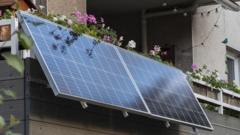
Picture Elena, living on the third floor of a brick apartment block built in the late nineteen-seventies. Her balcony is roughly the size of a billiard table. It catches the afternoon sun, a golden slice of thermodynamic wealth that used to bake the concrete and do nothing else.
Elena is not an engineer. She is an archivist who spends her days cataloging crumbling municipal records. Yet last Tuesday, she carried a flat, rectangular aluminum frame up the stairwell, leaned it against her balcony railing, secured it with industrial-grade zip ties, and plugged a single cord straight into an outdoor wall outlet.
No electrician. No permits. No structural calculations for timber rafters.
Within thirty seconds, the silver-backed panel began converting sunlight into alternating current, pushing electrons backward through her apartment’s own wiring. The coffee maker drew power not from the distant coal plant across the valley, but from the aluminum rectangle five feet outside her double-paned glass door.
This is plug-in solar. It is clumsy, radical, and spreading like wild ivy across urban neighborhoods from Berlin to Seattle.
The Physics of the Everyday Circuit
To understand why this simple household appliance has utility regulators waking up in a cold sweat, we have to look backward at how electricity was designed to flow.
For a century, power moved in a strict hierarchy. Generation happened at the top, miles away from human habitation. Transmission lines carried high-voltage fury across counties. Distribution transformers stepped it down before it entered your home through a meter box designed exclusively to measure consumption, not contribution.
When you plug a standard appliance into a wall, power flows inward. A toaster demands; the grid supplies.
Plug-in solar breaks this unidirectional rule.
(Note: In this hypothetical scenario, we are looking at micro-inverter systems capped safely around eight hundred watts, designed to match the safety thresholds of standard household copper wiring.)
When Elena’s panel generates three hundred watts of electricity during peak afternoon glare, that energy enters the apartment outlet. It doesn't travel back through the main utility meter to power her neighbor's television; electricity is lazy, taking the path of least resistance. It flows to the nearest active load inside Elena's home.
If her refrigerator is pulling one hundred and fifty watts, the solar panel feeds the refrigerator directly. The meter outside slows down. Sometimes, it stops entirely, hovering in a weird, digital stillness.
Physics does not care about corporate utility monopolies. Electrons move toward the nearest demand.
The Bureaucratic Friction
Change rarely arrives without an argument.
When these modular systems first appeared in hardware store aisles, packaged in cardboard boxes alongside garden hoses and lawn chairs, municipal authorities blinked in confusion. Old fire safety codes were dusted off. Bureaucrats pointed to overloaded circuits, thermal loads, and the terrifying phantom of the overloaded fuse box.
They warned of backyard installations turning ordinary apartments into hazardous electrical experiments.
Yet reality told a different story. Millions of these systems operate across Europe with an incident rate so statistically negligible it rounds to zero. Why? Because the engineering is remarkably pedestrian. Most micro-inverters are hardwired to shut down within milliseconds if the grid drops, preventing any stray voltage from leaking into the street lines where a utility lineworker might be repairing a downed cable.
The resistance was never truly about safety. It was about architecture.
For a hundred years, the power grid was a centralized castle with a very tall gate. Plug-in solar hands every apartment dweller with a sunny balcony a small set of keys to the front door.
The Economics of the Small Scale
Let us talk about money, because revolutions rarely survive without a ledger.
A standard rooftop solar installation requires five figures of upfront capital, months of contractor availability, and a homeowners association willing to debate the aesthetic purity of silicon wafers against asphalt shingles. If you rent your home, you might as well be asking permission to remodel the Taj Mahal.
Plug-in solar bypasses the landlord entirely.
An eight-hundred-watt kit costs less than a decent flat-screen television. It can be unboxed, mounted, and plugged in during a lunch break. If Elena decides to move apartments next year, she unplugs the cord, cuts the zip ties, loads the panels into the back of a hatchback, and takes her personal power plant with her.
The payback period shrinks when the installation cost is zero. Without contractor markup or engineering fees, the panels pay for themselves through shaved utility bills in roughly three to five years, depending on local electricity tariffs and latitude.
Every kilowatt-hour generated at the plug is a kilowatt-hour not purchased from a corporation burning fossil fuels at midnight.
The Quiet Shift
There is a psychological transformation that occurs when you watch your electric meter pause in the middle of a sunny afternoon.
We have spent generations as passive consumers of infrastructure. Water comes out of a tap we do not maintain; electricity arrives from wires we cannot see; heat radiates from vents in the floor managed by hidden boilers. We are tenants in our own ecological footprint.
When you adjust the angle of a balcony panel to catch the autumn equinox sun lower in the sky, your relationship with the weather changes. A cloudy morning is no longer just a gloomy inconvenience; it is a drop in production. A bright, freezing January noon becomes an unexpected gift of clean watts.
You start noticing the shadow cast by the oak tree across the street. You begin calculating the angle of incidence. You become an amateur thermodynamicist in a two-bedroom flat.
The grid of tomorrow will not be built solely by massive wind farms anchored in remote ocean trenches or deserts paved with photovoltaic glass. It will be stitched together from millions of tiny, stubborn, individual decisions made on balconies, fire escapes, and south-facing windowsills.
Elena pulls a mug from the cupboard, pours boiling water over loose tea leaves, and watches the steam curl toward the ceiling. Outside her window, the aluminum panel hums its silent, invisible song, turning sunlight into the quiet machinery of daily life.