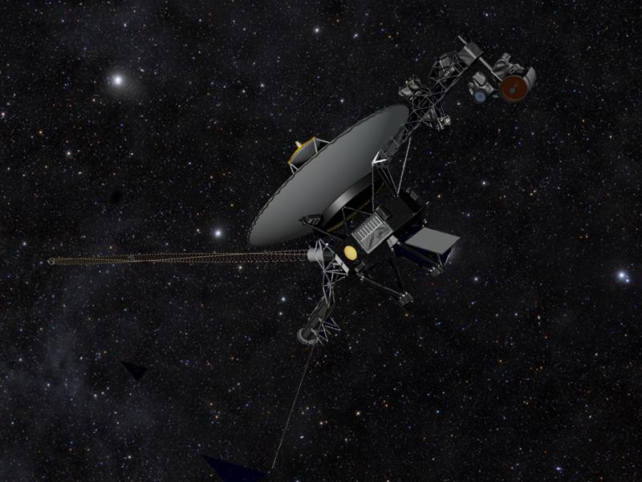
Crossing the threshold of one light-day—approximately 25.9 billion kilometers from Earth—transforms NASA’s Voyager 1 from a legacy planetary probe into a live stress test of deep-space communication physics, radioactive decay mechanics, and autonomous fault tolerance. Most coverage treats this milestone as a romantic astronomical trivia point. From a systems engineering perspective, reaching a 24-hour one-way light-time (OWLT) delay represents a fundamental operational phase shift: real-time troubleshooting becomes mathematically impossible, pushing ground control into a 48-hour minimum command-and-response loop while the spacecraft’s available electrical power approaches the absolute floor required to keep its primary oscillator warm.
To understand what one light-day actually means for mission architecture, we must strip away the novelty of distance and examine the physical bottlenecks governing a 1977-era spacecraft operating in the interstellar medium. The milestone is defined by four interlocking constraints: relativistic signal latency, inverse-square link budget degradation, radioisotope thermal decay, and propellant-valve erosion.
The Physics of a 48-Hour Command Loop
At one light-day, electromagnetic radiation traveling at $c \approx 299,792,458$ meters per second requires exactly 86,400 seconds to traverse the gap between Earth’s Deep Space Network (DSN) antennas and Voyager 1’s 3.7-meter high-gain parabolic dish.
This latency alters the operational calculus of flight control. During the planetary flybys of Jupiter (1979) and Saturn (1980), round-trip light time (RTLT) measured in tens of minutes to under three hours. An anomaly detected in telemetry could be diagnosed, simulated on ground testbeds, and corrected within a single engineering shift. At one light-day, the RTLT hits 48 hours.
This two-day lag creates a severe state-estimation problem for ground teams at the Jet Propulsion Laboratory (JPL):
- Temporal Decoupling of Telemetry: Any downlink packet received by the DSN reflects the physical state of the spacecraft 24 hours in the past. Ground engineers are never looking at Voyager 1 as it is; they are performing forensic analysis on yesterday's hardware state.
- Blind Command Execution: When an uplink command is transmitted, engineers must wait two full days before receiving confirmation that the spacecraft’s Command Computer Subsystem (CCS) registered the instruction and executed the routine. If a command triggers an unintended state transition, the spacecraft must survive on its own internal fault-protection logic for at least 48 hours before human intervention can arrive.
- DSN Scheduling Friction: Because transmission and reception windows are separated by a full planetary rotation, the DSN station that transmits a command is never the station that receives the reply. Uplink might originate from Goldstone in California, while the resulting telemetry confirmation lands at Canberra in Australia or Madrid in Spain two days later.
The 2023–2024 Flight Data Subsystem (FDS) memory corruption incident demonstrated the fragility of this loop. When a single chip in the FDS failed, turning telemetry into unintelligible binary noise, engineers spent months diagnosing the fault because every memory-read test required a multi-day turnaround. At one light-day and beyond, every software patch becomes a high-stakes, slow-motion surgical procedure.
Inverse-Square Attenuation and the Link Budget Floor
Distance degrades radio communications according to the inverse-square law: signal power density drops proportionally to $1/r^2$, where $r$ is the distance from the transmitter. Voyager 1 transmits on the S-band (2.3 GHz) for engineering telemetry and the X-band (8.4 GHz) for high-rate data, utilizing a traveling-wave tube amplifier (TWTA) that outputs roughly 22.4 watts of radio-frequency power—comparable to a standard refrigerator light bulb.
By the time that 22.4-watt beam expands across 25.9 billion kilometers, the signal arriving at Earth carries a power level on the order of $10^{-16}$ watts (attowatts). Capturing this whisper requires extreme ground-side engineering:
- Antenna Arraying: Single 34-meter DSN dishes can no longer reliably lock onto Voyager 1’s carrier signal under suboptimal atmospheric conditions. NASA must routinely rely on the 70-meter dishes at Goldstone, Madrid, and Canberra, or electronically array multiple 34-meter antennas to synthesize a larger effective aperture.
- Cryogenic Amplification: DSN receivers cool their front-end low-noise amplifiers to roughly 4 Kelvin using liquid helium. This suppresses internal thermal noise within the receiver electronics so it does not drown out the cosmic background noise and the faint X-band carrier.
- Bit-Rate Compression: Because the Signal-to-Noise Ratio (SNR) shrinks continuously as $r$ increases, Voyager 1’s downlink data rate has been stepped down from its peak of 115.2 kilobits per second at Jupiter to a baseline of 160 bits per second—and occasionally as low as 40 bits per second for certain engineering modes.
The operational limit here is not the transmitter failing outright, but the bit-error rate (BER) climbing past the threshold where error-correcting codes (specifically Voyager’s Golay and convolutional coding schemes) can reconstruct valid data packets. Once the SNR drops below the receiver's phase-locked loop threshold, the spacecraft effectively vanishes even if its transmitter remains active.
The Power Decay Curve and Thermal Management
Voyager 1 does not rely on solar panels, which would be useless at more than 170 Astronomical Units (AU) from the Sun. Instead, it draws electrical power from three MHW-RTGs (Multihundred-Watt Radioisotope Thermoelectric Generators) fueled by Plutonium-238.
Pu-238 decays via alpha emission with a half-life of 87.7 years. As the isotope decays, thermal output drops. Simultaneously, the silicon-germanium thermocouples that convert heat into electricity degrade due to prolonged exposure to radiation and high temperatures. At launch in 1977, the three RTGs generated approximately 470 watts of electrical power. Today, the system loses roughly 4 watts per year, leaving the spacecraft with well under half its original electrical budget.
This steady attrition forces JPL engineers into a zero-sum game of power allocation:
- Instrument Shedding: Science instruments have been systematically turned off over the decades. The imaging cameras were powered down in 1990 after the Pale Blue Dot portrait; the Ultraviolet Spectrometer, Infrared Interferometer Spectrometer, and Photopolarimeter followed. Only a handful of fields-and-particles instruments—such as the Magnetometer (MAG), Cosmic Ray Subsystem (CRS), Low-Energy Charged Particles (LECP), and Plasma Wave Subsystem (PWS)—remain active to sample the interstellar medium.
- Heater Elimination: The hidden danger of turning off instruments is thermal contraction. In the deep interstellar void, ambient temperatures hover near 2.7 Kelvin. Active electronics generate waste heat that keeps adjacent propellant lines and structural joints above freezing. When NASA shuts down a science instrument to save 5 watts, the surrounding chassis cools down, forcing engineers to weigh whether to turn off survival heaters as well.
- Hydrazine Freezing Risk: Voyager 1 uses hydrazine monopropellant for attitude control. Hydrazine freezes at 2 degrees Celsius. If power drops too low to keep the propellant lines above this threshold, the fuel will freeze, expand, and rupture the plumbing—or simply fail to reach the thrusters, causing the high-gain antenna to drift off its Earth-pointing axis.
Pointing accuracy is non-negotiable. Voyager 1’s X-band beam has a narrow half-power beamwidth of roughly 0.5 degrees. If the spacecraft loses attitude control and drifts by more than a fraction of a degree, the X-band signal misses Earth entirely, severing all contact permanently.
Propellant Valve Degradation and Thruster Redundancy
Keeping that 3.7-meter dish locked onto Earth requires firing tiny hydrazine thrusters in millisecond pulses dozens of times per day. Over nearly five decades, the primary attitude-control thrusters suffered severe degradation in their internal heater beds and propellant valves, causing the pulses to weaken and requiring more frequent firings.
In 2017, engineers executed a bold workaround: they fired up a set of Trajectory Correction Maneuver (TCM) thrusters that had sat dormant in the cold vacuum of space since November 1980. Remarkably, the thrusters ignited after 37 years of hibernation, extending the mission's life. However, this was not a permanent fix.
By the mid-2020s, residue from hydrazine fuel-tank bladders began clogging the narrow fuel-inlet tubes of the active thrusters, forcing JPL to switch back to previously retired thruster branches whose heaters could only be turned on after shutting down more non-essential spacecraft systems. Every thruster swap carries two severe risks:
- Thermal Shock: Powering on a cold thruster catalyst bed requires pre-heating for several hours. Because electrical margins are razor-thin, engineers must temporarily cut power to other subsystems, risking a voltage drop that could trigger a spacecraft reset.
- Valve Sticking: If an aging solenoid valve sticks open during a firing pulse, the spacecraft will spin uncontrollably and exhaust its remaining hydrazine supply within hours. If it sticks closed, that thruster branch is dead.
Interstellar Plasma and the Boundary Dynamics
While the hardware struggles against entropy, the scientific value of Voyager 1 at one light-day lies in its position well beyond the heliopause—the theoretical boundary where the Sun’s solar wind is stopped by the interstellar medium, which Voyager 1 crossed in August 2012 at roughly 121 AU.
At one light-day (roughly 173 AU), Voyager 1 is operating in the Very Local Interstellar Medium (VLISM), completely outside the protective magnetic bubble of the Sun. Contrary to early models that assumed the interstellar medium outside the heliopause would be calm and uniform, Voyager 1’s Plasma Wave Subsystem and Magnetometer have revealed a dynamic, compressed environment:
- Magnetic Field Draping: The interstellar magnetic field does not run randomly; it drapes around the nose of the heliosphere, maintaining a surprisingly consistent orientation with the internal solar magnetic field just inside the boundary.
- Density Gradients: As Voyager 1 moves deeper into interstellar space, electron plasma density has steadily increased—from roughly 0.05 electrons per cubic centimeter near the heliopause to over 0.12 electrons per cubic centimeter further out—indicating a pile-up of interstellar material pushed ahead of the moving heliosphere, analogous to the bow wave of a ship.
- Pressure Fronts: Voyager 1 continues to detect weak shock waves propagating outward from massive solar coronal mass ejections. Even though the solar wind itself stops at the heliopause, the pressure pulses from solar storms transmit across the boundary, compressing the interstellar plasma and causing the ambient magnetic field to ring like a bell.
These measurements are irreplaceable because no other active spacecraft possesses the velocity or trajectory to reach this region within the next several decades. New Horizons, currently traversing the Kuiper Belt, is moving slower than Voyager 1 and lacks a functioning plasma instrument capable of matching Voyager’s interstellar dataset.
Separating Confirmed Engineering Metrics from Mission Projections
When evaluating reports on Voyager 1’s longevity at one light-day, analysts must separate hard telemetry facts from probabilistic engineering forecasts:
Confirmed Facts:
- Distance and Velocity: Voyager 1 is receding from the Sun at approximately 17 kilometers per second (roughly 3.6 AU per year). The crossing of the 25.9 billion kilometer mark (one light-day) is a deterministic certainty governed by Newtonian orbital mechanics.
- Hardware Architecture: The spacecraft runs on three redundant computer systems (CCS, FDS, and Attitude and Articulation Control Subsystem) using 1970s CMOS and plated-wire memory technologies, with roughly 69.63 kilobytes of total memory across all systems.
- Power Decay Rate: The RTG output declines at a predictable, measurable rate dictated by the nuclear physics of Pu-238 decay and thermocouple degradation.
Educated Hypotheses and Projections:
- Exact End-of-Mission Date: Projections that Voyager 1 will lose science capability around 2025–2027 and cease engineering transmissions entirely by the early 2030s are estimates, not hard deadlines. They assume nominal decay rates and no sudden single-point hardware failures.
- Interstellar Medium Uniformity: Scientists hypothesize that Voyager 1 will eventually exit the region influenced by the heliosphere's bow wave and enter undisturbed galactic space, but the exact distance where solar influence drops to zero remains unverified until the spacecraft actually crosses it.
Operational Imperatives for Deep-Space Mission Design
Voyager 1’s survival at one light-day exposes the flaw in modern spacecraft design trends that prioritize software complexity over hardware transparency. Modern deep-space probes rely on dense, multi-layered operating systems and complex autonomous fault-protection routines that can become opaque when edge-case failures occur far from Earth.
Voyager survived because its architecture is radically simple, deterministic, and exposed. Engineers in the 2020s were able to rewrite code on a 50-year-old computer from 25 billion kilometers away only because the memory architecture was completely documented, bit-addressable, and free of black-box abstractions.
For future interstellar precursor missions—such as proposed Interstellar Probe concepts targeting 500 to 1,000 AU—aerospace architects must enforce three design rules validated by Voyager 1’s one light-day milestone:
- Design for Multi-Day Latency: Autonomous fault protection must be capable of isolating hardware failures, shedding non-essential loads, and maintaining antenna pointing for a minimum of 72 to 120 hours without ground intervention.
- Maintain Bit-Level Transparency: Flight software architectures must allow ground teams to inspect, patch, and bypass individual memory registers directly, avoiding opaque middleware that cannot be debugged across multi-day light-time gaps.
- Over-Engineer Thermal-Electrical Coupling: Power distribution buses must be designed so that waste heat from core avionics and RTGs is routed directly to propellant lines and mechanical actuators via passive heat pipes, eliminating the reliance on active electrical survival heaters during the late stages of isotope decay.


