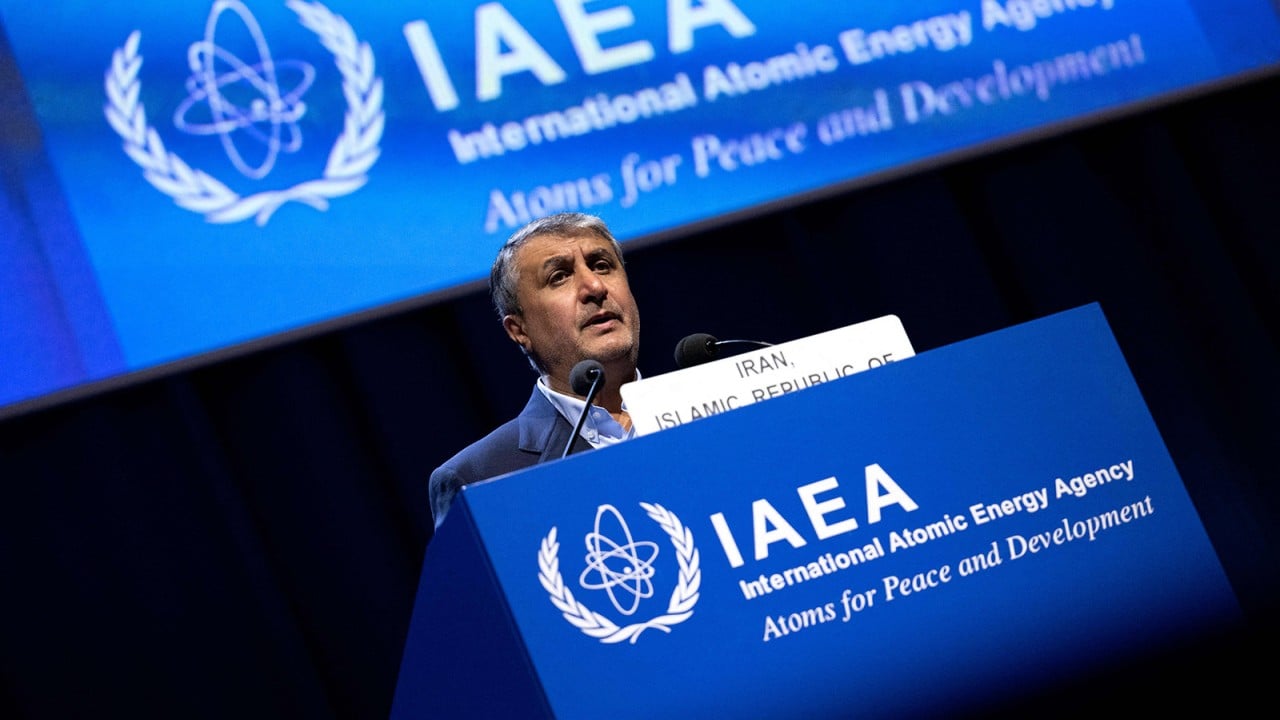
Diplomacy rarely dies in a blinding flash of artillery or a sudden declaration of war. More often, it suffocates in the quiet corridors of bureaucratic exclusion, starved of oxygen by governments that find the very act of talking to an adversary politically toxic.
When Washington successfully pressured international mechanisms to block Mohammad Eslami, the head of the Atomic Energy Organization of Iran, from entering Vienna for the annual International Atomic Energy Agency gathering, it was presented as a routine enforcement of sanctions. It was nothing of the sort. It was a calculated tactical maneuver designed to slam shut the remaining doors of institutional communication, ensuring that the bitter standoff over atomic safeguards remains locked in an escalatory spiral.
The mechanics of the exclusion reveal a strange and brittle legalistic choreography. Austria, trapped awkwardly in its role as the host nation for the UN watchdog, attempted to secure a travel ban exemption through the United Nations Security Council committee for Eslami. Washington flatly objected. The exemption failed, leaving Vienna legally bound to deny entry to a high-ranking state official of a member nation.
Tehran reacted with predictable fury, denouncing the move as a direct violation of sovereign rights and international norms. Russia’s envoy to the agency joined the chorus, accusing Western capitals of weaponizing visa access to punish states they deem politically inconvenient.
Yet focusing entirely on the procedural wrangling misses the wider strategic picture. This is not about a visa stamp. This is about the total breakdown of verification architecture at a time when the margin for error has shrunk to nearly zero.
The Architecture of Paralysis
To understand why locking Eslami out of Vienna matters, one must look at the state of inspections on the ground. Since the military exchanges and targeted strikes that rattled regional nuclear facilities, access for international inspectors has cratered. Iran has sharply curtailed cooperation, arguing that inspectors cannot expect normal operational conditions when the country's infrastructure remains under active threat.
Washington argues that an official tied to a sanctioned and non-compliant program should not be given a global microphone inside a UN assembly.
"His participation would have only resulted in Iran exploiting IAEA proceedings as a stage for propaganda while sidestepping substantive co-operation," a Western diplomatic representative maintained during the conference.
There is a cold logic to that argument from a deterrence perspective. Why wine and dine an adversary's chief atomic technician when inspectors are being barred from sensitive mountain facilities like Pickaxe Mountain?
Yet the counter-argument strikes at the core of what international organizations are built to do. Peace agreements are not negotiated with trusted allies; they are forged, often painfully, between mortal enemies. If you remove the adversary from the room, you remove the mechanism for verification. You substitute diplomacy with a vacuum, and vacuums in nuclear standoffs tend to fill with military planning.
The Mirage of Maximum Pressure
The decision to bar Eslami fits comfortably within the resurrected playbook of maximum pressure. By utilizing snapback sanction mechanisms and leveraging diplomatic isolation, Western capitals hope to squeeze Tehran into unilateral concessions.
History suggests this approach produces the exact opposite result.
When diplomatic channels narrow, domestic hardliners in Tehran find their positions permanently vindicated. The narrative shifts from technical compliance to national survival. Every closed door in Vienna justifies further uranium enrichment steps and deeper restrictions on monitoring equipment at home.
Consider the economic backdrop. Foreign direct investment in Iran has effectively hit zero, inflation mirrors historic economic shocks, and the national currency remains under relentless strain. Under such conditions, leaders often double down on asymmetric defiance rather than capitulation. Shutting down multilateral dialogue does not weaken their resolve; it hardens it into a dogma of self-reliance.
Furthermore, isolating key interlocutors creates a dangerous information deficit. Intelligence agencies rely heavily on diplomatic listening posts, informal side-conversations, and direct body-language assessments during these large multilateral summits. When the chief nuclear official is sitting in Tehran rather than a conference room in Austria, the ability to test red lines, float back-channel proposals, or misread an adversary's intentions becomes exponentially harder.
The Cost of Symbolic Victories
Winning a procedural vote at the United Nations is satisfying for domestic consumption in Washington and allied capitals. It projects strength. It signals that violators of the non-proliferation regime face immediate consequences.
However, statecraft must be measured by outcomes, not optics.
If the goal is to prevent a breakout capability and restore independent oversight to contested sites, isolation is an active impediment. Every time an Iranian official is locked out of a multilateral forum, the incentive for Tehran to remain within the Nonproliferation Treaty framework diminishes. Lawmakers in Tehran are already openly debating the utility of remaining inside a treaty that they argue offers them no protection from sanctions or kinetic strikes.
The Vienna meeting was supposed to be a pressure valve. Instead, it became another theater for mutual alienation.
As delegations packed up their briefing folders and the diplomatic posturing faded from the Austrian capital, the core crisis remained entirely unresolved. The centrifuges keep spinning in the background, unchecked by inspectors who cannot get inside, while the diplomats who might negotiate a halt are kept thousands of miles apart by the very rules meant to bring them together.
There is no clever diplomatic reset waiting in the wings, and no breakthrough scheduled for next month. There is only a widening chasm between two sides convinced that refusing to talk to each other is a form of strength, marching steadily toward an unmanaged collision.
US block Iran's nuclear chief from attending IAEA meeting
This video provides additional context on the U.S. decision to block Iran's nuclear chief from attending the Vienna conference and the international diplomatic fallout that followed.


