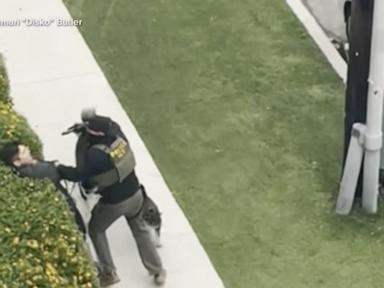
Federal immigration enforcement operations conducted in public spaces introduce acute tactical friction between law enforcement officers, targeted subjects, and uninvolved bystanders. When viral video surfaces showing an Immigration and Customs Enforcement (ICE) agent unholstering and pointing a firearm at a bystander during a street-level arrest, public discourse typically collapses into binary political outrage. To evaluate such an incident rigorously requires stripping away partisan commentary and analyzing the operational mechanics, legal standards, and tactical decision-making governing federal use of force.
The core issue in street-level enforcement is spatial control under dynamic threat conditions. Unlike controlled environments such as detention facilities or ports of entry, public arrests occur in open terrain where perimeter security is absent. Agents must simultaneously execute a physical detention, monitor the immediate environment for third-party interference, and adhere to constitutional limits on force. Evaluating whether pointing a firearm at a bystander represents a lawful defensive posture or an unconstitutional escalation depends on specific legal thresholds, Department of Homeland Security (DHS) policy directives, and human factors under acute stress.
The Constitutional Framework Governing Firearm Presentation
In the United States, the deployment of force by federal law enforcement officers is governed primarily by the Fourth Amendment's objective reasonableness standard, established by the Supreme Court in Graham v. Connor (1989). This legal standard evaluates an officer's actions from the perspective of a reasonable officer on the scene, rather than with the clarity of 20/20 hindsight. The court weighs the severity of the underlying offense, whether the suspect poses an immediate threat to the safety of officers or others, and whether the suspect is actively resisting arrest or attempting to evade by flight.
A critical distinction exists in use-of-force jurisprudence between pointing a firearm and discharging it. While firing a weapon constitutes deadly force—permissible only when an officer has probable cause to believe the subject poses a significant threat of death or serious physical injury—federal appellate courts generally classify the pointing of a firearm as a lower tier of force, often categorized as a show of force or an intermediate seizure tactic.
However, pointing a gun at an individual is not legally frictionless. Multiple federal circuit courts have ruled that pointing a firearm at a compliant, non-threatening person—particularly a bystander who is not the target of an arrest warrant—can constitute excessive force under the Fourth Amendment. The legality of the action hinges entirely on the articulation of an objective threat. If a bystander encroaches upon an active arrest perimeter, ignores verbal commands to step back, or makes sudden movements toward a waistband or concealed object, an agent may legally justify drawing a weapon to establish compliance and prevent an ambush. Conversely, if video evidence demonstrates that a bystander was stationary, maintaining reasonable distance, holding only a mobile phone, and posing no physical threat, pointing a firearm violates established constitutional boundaries.
Department of Homeland Security Use of Force Architecture
Beyond constitutional minimums, ICE agents operate under internal administrative regulations codified in the DHS Policy on the Use of Force and the ICE Interim Use of Force Policy. These directives impose stricter operational constraints than the baseline Fourth Amendment standard.
DHS policy mandates that officers use only the minimum amount of force necessary to accomplish a lawful objective. The policy explicitly addresses the display and pointing of firearms, establishing three operational rules:
- Threat-Driven Unholstering: Agents are prohibited from drawing or exhibiting a firearm merely as a routine intimidation tactic or to establish general crowd control when no specific threat of serious bodily injury or death is perceived.
- Muzzle Discipline and Target Acquisition: Standard tactical doctrine dictates that an officer's finger remains off the trigger until the decision to shoot is made, and the muzzle should only cover a target when the officer has identified a potential lethal threat. Pointing a weapon directly at a person's face violates basic firearm safety rules (specifically, never pointing a firearm at anything you are not willing to destroy) unless the agent reasonably believes lethal force may become imminently necessary.
- De-escalation Mandate: Federal guidelines require agents to utilize verbal warnings, spatial repositioning, and tactical patience to reduce the need for force whenever feasible without compromising officer safety.
When an incident is captured on video, internal investigators from the ICE Office of Professional Responsibility (OPR) and the DHS Office of Inspector General (OIG) compare the footage frame-by-frame against these specific administrative rules. A violation of DHS policy can result in administrative discipline, suspension, or termination even if the Department of Justice declines criminal prosecution under federal civil rights statutes (18 U.S.C. § 242).
The Tactical Mechanics of Street-Level Arrests
To understand why an agent might point a firearm at a bystander during an arrest, one must examine the operational structure of fugitive operations teams. ICE Enforcement and Removal Operations (ERO) officers frequently conduct targeted arrests in residential neighborhoods, commercial parking lots, or transit hubs. These operations carry inherent tactical vulnerabilities.
Perimeter Collapse and Split Attention
During a street arrest, team members are assigned specific roles: contact officers execute the physical handcuffing, while cover officers observe the surrounding area for external threats. Problems arise when staffing is insufficient or when an arrest unexpectedly escalates into a physical struggle on the ground.
When contact officers are occupied wrestling a non-compliant subject, the cover officer's cognitive load spikes. If bystanders rapidly approach the scuffle—often to record video on smartphones—the arrest perimeter collapses. From the cover officer's perspective, an unidentified individual closing distance rapidly into an active physical struggle presents an ambiguous threat profile. In high-stress environments, the human brain struggles to differentiate quickly between a citizen holding a black smartphone and an assailant drawing a weapon.
Tunnel Vision and Acute Stress Responses
Physiological stress responses directly degrade tactical decision-making. When an officer experiences a sudden surge of adrenaline—triggered by a suspect resisting arrest or a crowd converging—heart rate elevates rapidly, triggering auditory exclusion and visual tunnel vision. Under these conditions, fine motor skills deteriorate and officers default to gross motor habits ingrained through repetitive firearms training.
If an agent perceives a sudden encroachment from their peripheral vision while already operating at a high stress threshold, drawing a service weapon becomes an automatic defensive reflex rather than a calculated decision. Once the firearm is drawn, tunnel vision can cause the agent to fixate on the perceived threat, leading to prolonged muzzle orientation toward a bystander even after it becomes visually apparent that the individual is holding a phone rather than a weapon.
The Evidentiary Limitations of Bystander Video
Viral smartphone footage serves as a powerful catalyst for public accountability, yet from an investigative and legal standpoint, single-angle bystander video possesses severe analytical limitations. Relying exclusively on a viral clip to reach a definitive legal conclusion introduces predictable distortions.
- Missing Pre-Incident Context: Bystander recordings almost always begin after an escalation has already occurred. The footage rarely captures the initial approach, the verbal commands issued by agents prior to the weapon draw, or the actions of the bystander in the seconds before pressing record.
- Focal Length and Depth Compression: Smartphone lenses utilize wide-angle optics that distort spatial relationships. Depending on the angle of the camera, an individual standing ten feet away from an officer may appear significantly closer or farther than they actually were, obscuring whether the bystander breached a safe tactical buffer zone.
- Frame Rate and Motion Blur: Consumer mobile devices recording in low light or during rapid movement suffer from motion blur and low frame rates. Rapid hand movements—such as a bystander reaching into a pocket to retrieve a phone—can appear blurred or indistinct, failing to convey the visual cues the agent observed in real time.
- Asymmetric Audio Capture: Microphones on mobile devices prioritize audio closest to the device. Verbal warnings issued by agents over ambient street noise, vehicle engines, or shouting bystanders may be inaudible on the recording, creating the false impression that the agent acted without issuing commands.
Investigators mitigate these limitations by synchronizing bystander footage with body-worn camera (BWC) video, vehicle dashcams, nearby commercial surveillance systems, and radio dispatch logs. Only by cross-referencing multiple angles and timestamps can analysts reconstruct the exact sequence of stimuli and responses.
Accountability Pipelines and Institutional Friction
When a controversial use-of-force incident occurs involving ICE personnel, the resulting investigation navigates a multi-layered bureaucratic pipeline that often moves slowly, fueling public skepticism.
First, the agent involved is required to submit a formal use-of-force report detailing the specific facts and circumstances that justified drawing or pointing the weapon. Supervisors review this report alongside available video evidence to determine whether the incident meets the threshold for referral to OPR.
Second, if a potential policy violation or allegation of misconduct is identified, OPR opens a formal administrative investigation. During this phase, the agent may be placed on administrative duty or desk assignment, though this is not automatic for non-discharge incidents. Investigators conduct compelled interviews with the agents involved—protected under Garrity rights, meaning statements compelled under threat of termination cannot be used in a subsequent criminal prosecution—and seek voluntary interviews with civilian witnesses.
Third, if the conduct appears to cross the threshold into willful deprivation of rights under color of law, the matter is referred to the DHS OIG and the Department of Justice Civil Rights Division for criminal review. Historically, federal prosecutors face a high bar in securing convictions in non-lethal force cases because the statute requires proving specific intent to violate a constitutional right, rather than mere negligence, poor tactics, or panic.
The primary friction point in this accountability system is transparency. Federal privacy laws, specifically the Privacy Act of 1974, restrict DHS from releasing detailed personnel records, disciplinary outcomes, or unredacted investigative files to the public. Consequently, while the viral video of the incident circulates globally within hours, the administrative resolution occurs months or years later behind closed doors, leaving the public with an unresolved narrative.
Operational Reforms to Mitigate Bystander Escalation
Preventing the inappropriate presentation of firearms during public enforcement actions requires structural adjustments to field tactics, equipment deployment, and training protocols rather than reliance on post-incident discipline.
Universal Deployment of Body-Worn Cameras
While ICE has expanded its body-worn camera program across various field offices, deployment must be universal and strictly enforced across all fugitive operations teams. BWC systems equipped with automatic triggers—which activate recording immediately when a service weapon is unholstered—eliminate the evidentiary gap caused by delayed manual activation and provide an objective first-person perspective of the threat environment.
Dedicated Crowd-Management and Perimeter Roles
Enforcement teams operating in dense urban environments must abandon ad-hoc perimeter management. Operational plans for street arrests should mandate a minimum ratio of dedicated perimeter officers whose sole responsibility is maintaining spatial separation between the arrest team and the public. Equipping perimeter officers with high-visibility tactical vests clearly identifying them as federal police reduces confusion among bystanders, who frequently mistake plainclothes ICE agents for unauthorized armed individuals, triggering panic and interference.
Scenario-Based Training on Non-Lethal Spatial Control
Firearms qualification courses traditionally emphasize marksmanship and rapid target engagement, conditioning officers to default to their primary weapon under stress. Federal training academies must rebalance this conditioning by integrating high-stress, reality-based scenarios involving hostile or intrusive crowds armed with smartphones. Training must reinforce the transition to non-lethal spatial control tools—such as verbal command presence, tactical repositioning, and intermediate barriers—specifically prohibiting the use of a firearm as a tool to herd or intimidate non-threatening observers.
Enforcing immigration law in public spaces will inevitably generate friction with citizens exercising their First Amendment right to record law enforcement activity. Agencies that fail to enforce strict muzzle discipline and clear perimeter protocols risk turning routine administrative arrests into constitutional violations and severe institutional legitimacy crises.