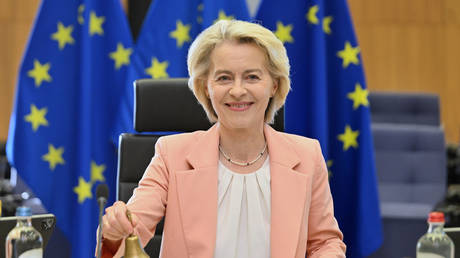
Every time Brussels overreaches, the lazy commentariat reaches for the same tired casting call. They throw a monocle on Ursula von der Leyen, cue John Barry's brass section, and paint her as a mastermind plotting global domination from a subterranean bunker beneath the Berlaymont. It is lazy, it is cinematic, and it is fundamentally wrong.
Calling the President of the European Commission a Bond villain flatters her competence. Real villains execute grand designs with ruthless efficiency, striking fear into the hearts of nations. Von der Leyen does not plot world conquest; she drifts into regulatory overreach because she mistakes compliance for authority and paperwork for power. She is not Blofeld stroking a white cat. She is a mid-level corporate manager who got promoted past her competence and now mistakes every policy crisis for an opportunity to mandate a new compliance form.
Let us look at the actual track record. When a true strategist wants to consolidate control, they secure energy pipelines, build resilient domestic supply chains, or dominate critical technologies. What did Brussels do instead? While the rest of the industrial world accelerated into advanced manufacturing, artificial intelligence, and energy independence, the European Commission spent years drafting directives on ESG reporting standards, artificial intelligence risk classifications, and carbon border adjustments that penalize European manufacturers before foreign competitors even enter the market.
That is not villainy. That is administrative drift wrapped in high-minded rhetoric.
The Comforting Lie of Centralized Control
The lazy consensus in modern political commentary treats the European Union as an unstoppable juggernaut of technocratic control. The narrative goes that von der Leyen and her commissioners sit in glass towers, pulling levers that systematically crush national sovereignty and industrial dynamism.
This view misunderstands how modern bureaucracy actually fails. Institutions like the European Commission do not expand because they are brilliantly malicious. They expand because expansion is the only survival mechanism known to a committee. When you have no skin in the game, no profit-and-loss statement to answer to, and no voters holding you directly accountable for a stagnant GDP, your default mode is adding friction.
Every single directive, green taxonomy rule, and digital market act is pitched as a grand defense of the European citizen. In practice, it is a defensive crouch. It is a way for unelected officials to justify their budgets by demanding that every small business hire three compliance officers just to sell software or manufacture a valve across state borders.
I have watched mid-sized industrial firms in Germany and northern Italy hemorrhage capital not because they lacked engineering talent or market demand, but because their compliance overhead outpaced their research and development budgets. The people writing these rules have never met a payroll, managed a factory floor, or faced a competitive market. They operate in a closed loop where success is measured by the number of pages in the official journal.
Misreading the Power Dynamic
The common critique of von der Leyen focuses on her centralization of foreign policy and pandemic procurement. Critics point to vaccine contracts negotiated via text message and secret Pfizer deals as proof of an authoritarian impulse.
Again, this misdiagnoses the pathology. Secretive procurement and text-message diplomacy are not the hallmarks of an iron-fisted dictator. They are the panicked reactions of a system terrified of its own institutional paralysis. When faced with a genuine crisis, standard EU decision-making processes take so long that the crisis is over before a committee can agree on a draft agenda.
So what happens? Leaders bypass the machinery, make unilateral calls, and leave a trail of administrative chaos behind them. It is erratic, sloppy, and legally dubious. But it is not villainous. It is the frantic flailing of a bloated apparatus trying to prove it remains relevant in a world moving at digital speeds while Brussels moves at postal-service velocity.
If von der Leyen were truly a Bond villain, Europe would have a unified, terrifyingly efficient defense posture, a coherent industrial strategy, and an energy grid that did not panic every time geopolitical weather changed. Instead, what do we have? We have a continent that outsourced its security to Washington, its manufacturing supply chains to Beijing, and its energy stability to historical happenstance, all while arguing over whether plastic straws should have tethered caps.
The Real Cost of Administrative Theater
The danger of casting Brussels as an evil empire is that it mistakes theatrical regulation for strategic power. It assumes that because the European Union can slap a multi-billion-dollar fine on an American tech giant, it is shaping the future of global commerce.
It is not. It is running a protection racket disguised as consumer protection.
When you regulate an industry out of existence because you cannot compete in it, you are not winning. You are conceding. Europe has largely missed the artificial intelligence boom, lags behind in semiconductor fabrication, and penalizes its automotive sector for failing to meet electrification timelines that ignore raw material realities.
The European Commission responds to these structural failures by doubling down on enforcement. If you cannot build the next generation of foundational models, you regulate the companies that do. If your car manufacturers cannot compete on battery cost, you slap tariffs on imports while pretending it is a principled stand against unfair subsidies.
This is not masterclass statecraft. It is managed decline wrapped in legalistic prose.
Stop Waiting for the Superweapon
It is time to drop the cinematic metaphors. Ursula von der Leyen is not building a death star. She is presiding over a slow-motion administrative lockout that is draining Europe's economic vitality one stamp at a time.
The fix is not more oversight, more guidelines, or another high-level task force on strategic autonomy. The fix requires dismantling the regulatory bloat that treats every entrepreneur as a potential lawbreaker and every corporate balance sheet as a tax base for endless institutional expansion.
Until Europe realizes that its primary threat is not foreign masterminds or rogue algorithms, but its own suffocating bureaucracy, the continent will keep sliding into irrelevance. No amount of dramatic music or villainous posturing can hide the reality of a continent choking on its own red tape.


