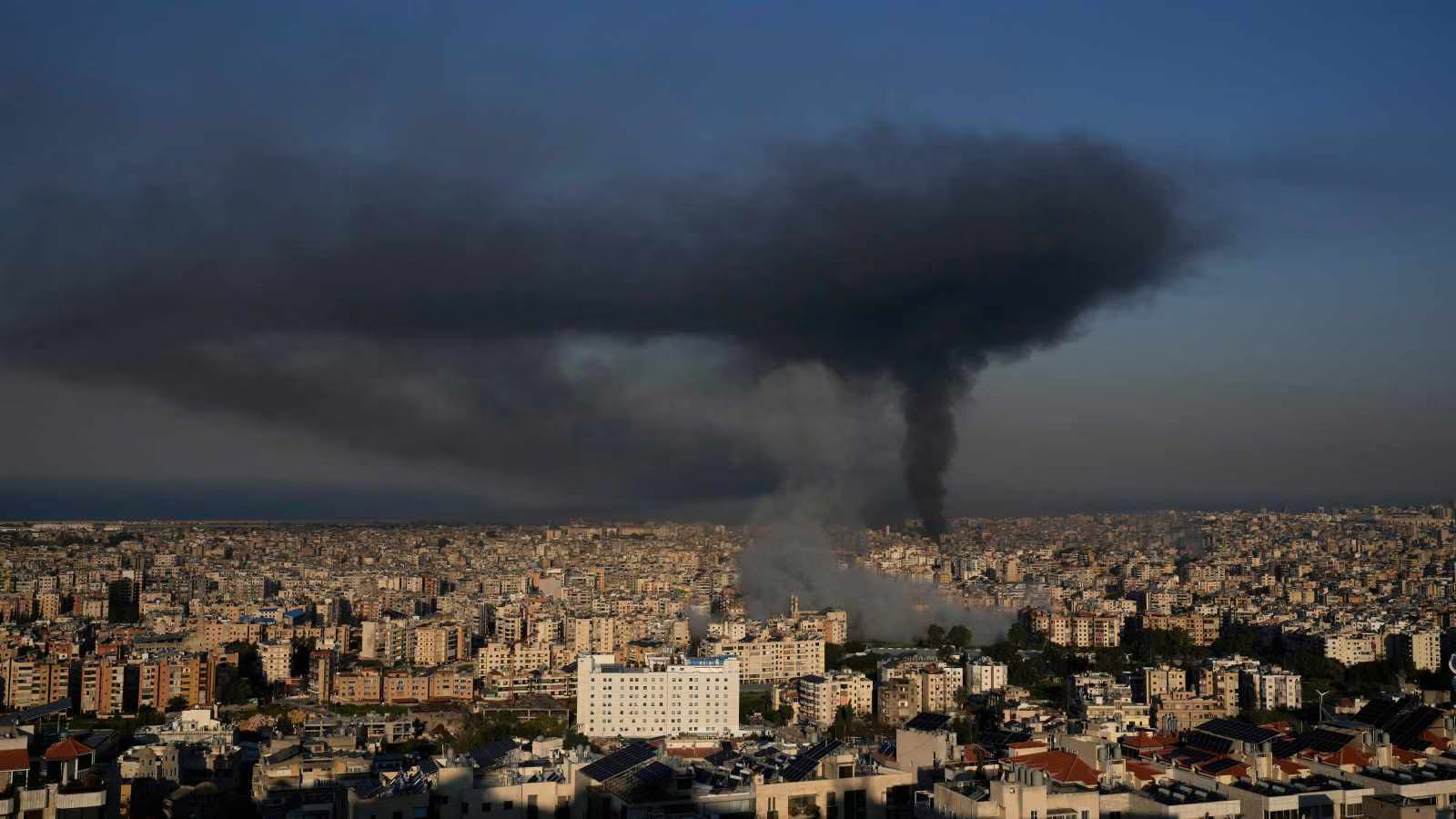
The defense establishment loves a dramatic map. Draw a big red circle around the Strait of Hormuz, point to a tiny speck of rock like Greater Tunb, and label it Iran's "unsinkable aircraft carrier." It sounds terrifying. It sounds high-stakes.
It is also a complete misunderstanding of modern naval warfare. If you found value in this post, you might want to read: this related article.
When commentators whisper about the United States striking Greater Tunb to neutralize a strategic chokepoint, they are repeating a lazy, decades-old consensus. They treat a static piece of rock as if it is a Nimitz-class supercarrier capable of projecting power across the Persian Gulf.
Let us stop pretending. Greater Tunb is not an asset. In a high-intensity conflict, it is a target-rich vulnerability. For another angle on this event, check out the recent coverage from USA Today.
The Island-as-a-Carrier Delusion
To understand why the "unsinkable aircraft carrier" trope is nonsense, we have to look at what an actual aircraft carrier does. A carrier moves. It hides in the open ocean. It uses speed, evasion, and a massive escort screen of destroyers and cruisers to survive.
An island does none of these things.
- Fixed Coordinates: Every military planner in the world knows the exact GPS coordinates of Greater Tunb down to the millimeter. You cannot maneuver an island out of the path of an incoming Tomahawk cruise missile or a swarm of precision-guided munitions.
- Logistical Fragility: A carrier is resupplied at sea or returns to port. An island relies on vulnerable, static supply lines. Cut off the surface transport and air bridges to Greater Tunb, and the garrison starves or runs out of air-defense interceptors within days.
- No Depth: Greater Tunb is tiny—barely a few square kilometers. There is no room to hide assets, no strategic depth to absorb strikes, and no way to disperse forces.
When analysts scream about Iran fortifying these islands with anti-ship missiles and surface-to-air systems, they ignore a fundamental reality of warfare. Fortifying a fixed, isolated position in the middle of a narrow body of water does not make it a fortress. It makes it a shooting gallery.
The Real Math of the Strait of Hormuz
Let us look at the actual geography. The Strait of Hormuz is narrow, yes, but the obsession with physical islands misses how modern anti-access/area-denial (A2/AD) networks operate.
Iran does not need Greater Tunb to close the Strait of Hormuz.
Iran's mainland is sitting right there. The Iranian coastline along the Persian Gulf and the Gulf of Oman stretches for over 2,000 kilometers. This coastline is mountainous, rugged, and filled with underground missile silos, mobile launchers, and hidden bases.
If Iran wants to target shipping or challenge the US Navy, it will do so using mobile launchers hidden in the mountains of Bandar Abbas or coastal caves.
| Feature | Greater Tunb | Iranian Mainland |
|---|---|---|
| Mobility | Zero (Static Island) | High (Mobile Truck Launchers) |
| Target Profile | Highly Concentrated | Diffuse and Hidden |
| Survivability | Low (Easily Isolated) | High (Deep Hinterland) |
| Logistics | Dependent on Sea/Air | Inland Road/Rail Networks |
Why would any competent military commander concentrate their best air defense systems and anti-ship missiles on a tiny, exposed rock when they can disperse them across hundreds of miles of mountainous mainland?
They wouldn't. The militarization of Greater Tunb is largely theater. It is a flag-waving exercise designed to project sovereign control over disputed territory, not a viable platform for fighting a war against a peer adversary.
The Fallacy of the Pre-emptive Strike
The common narrative suggests that in a escalating crisis, the US would strike Greater Tunb to "open the Strait."
This is backward. Striking Greater Tunb would be a colossal waste of expensive munitions for negligible strategic gain.
If the US Navy launches a massive strike package to wipe out the radar installations and missile batteries on the island, what have they actually accomplished? They have destroyed a few static launchers while leaving the vast, mobile mainland arsenals completely intact.
Furthermore, a strike on the island triggers the exact escalation scenario the US wants to avoid. It gives Iran the political cover to launch its mainland-based assets, mine the strait, and deploy its swarm boats—all while the US has wasted its opening salvo on an irrelevant rock.
I have watched defense analysts map out these scenarios on digital tabletops, treating every red dot on a map with equal weight. It is a spreadsheet mentality that fails the moment the shooting starts. If you spend $20 million in cruise missiles to blow up $10 million of static equipment on a rock, you aren't winning. You are being baited.
What Actually Matters: The Swarm and the Sub-Surface
If Greater Tunb is a distraction, where is the real threat?
It is low-tech, distributed, and incredibly cheap.
The real danger to shipping and naval vessels in the Gulf does not come from static missile batteries on disputed islands. It comes from:
- Unmanned Aerial and Surface Vehicles (Drones): Cheap, mass-produced attack drones launched from the mainland or disguised commercial vessels.
- Smart Sea Mines: Modern mines that can be deployed quickly by civilian-looking dhows, lying in wait on the shallow seabed.
- Mobile Coastal Artillery: Anti-ship cruise missiles mounted on the back of ordinary commercial trucks, moving constantly along mainland highways.
This is the asymmetric reality of modern coastal defense. It is highly mobile, easily hidden, and incredibly cheap to field. Focusing on Greater Tunb is like staring at a magician's waving hand while the other hand slips the watch off your wrist.
Dismantling the Status Quo
We need to stop analyzing 21st-century conflicts through the lens of World War II island-hopping campaigns.
Greater Tunb cannot be an unsinkable aircraft carrier because the very concept of an unsinkable carrier is an anachronism. In an age of hypersonic weapons, satellite surveillance, and precision drone warfare, static positions are liabilities, not assets.
If tension boils over in the Gulf, the opening moves will not be a dramatic, cinematic assault on a desert island. It will be a messy, confusing war of attrition fought across electromagnetic spectrums, cyber networks, and thousands of miles of rugged coastline.
Stop looking at the red dots on the island map. Start looking at the empty spaces on the mainland. That is where the real threat hides.