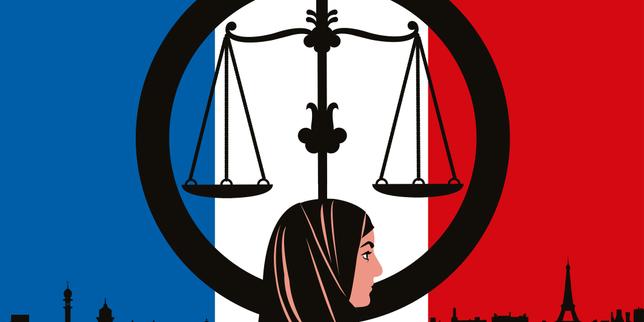
The air inside the courtroom of the Galerie Saint-Éloi in Paris is always heavy, but during the trials of the revenantes—the women who returned from the collapsed caliphate of the Islamic State—it turns entirely stagnant. There is a specific sound that punctuates these proceedings. It is not the bang of a gavel. It is the metallic, rhythmic clinking of handcuffs being unlocked inside a glass box.
For years, Europe looked at the women who left for Syria and Iraq through a lens of profound confusion. Were they victims? Brainwashed teenagers groomed online? Or were they dangerous operational actors, wolves in sheep's clothing hiding behind black abayas and the cries of their malnourished infants?
While neighboring countries debated, doubted, and hesitated, France made up its mind. Quietly, methodically, and with an iron fist, the French judicial system transformed itself into the most severe apparatus in Europe for judging the women of ISIS.
To understand how this happened, you have to look past the dense legal codes and into the eyes of the people sitting in that glass box.
The Myth of the Passive Housewife
Consider a hypothetical composite figure based on dozens of real case files from the Paris Court of Assizes. We will call her Samira. In 2015, she was twenty-one, living in a cramped apartment in the suburbs of Lyon, feeling profoundly alienated by a society she believed rejected her identity. A few months of intense, algorithmic radicalization on Telegram later, she crossed the Turkish border into Syria. She married a fighter she had never met. She raised children under the black flag.
When the caliphate burned to the ground at Baghouz in 2019, Samira ended up in the squalor of Kurdish-run detention camps. When she was finally repatriated to France, she expected mercy. She expected the narrative of the naive, manipulated housewife to save her.
It did not.
For the first few years of the conflict, French courts did occasionally view these women through a lens of relative leniency. They were often treated as victims of human trafficking or naive tag-alongs. But a profound shift occurred as the sheer horror of ISIS operations hit home on French soil. The Bataclan. Nice. The murder of Father Jacques Hamel. The national psyche fractured, and with that fracture came a total reassessment of complicity.
French prosecutors stopped looking at what these women did with their hands and started looking at what their presence facilitated.
The legal pivot was brilliant, devastating, and uniquely French. Prosecutors began systematically applying a single, sweeping charge: association de malfaiteurs terroriste (terrorist criminal association). Under this framework, you do not need to have strapped on a suicide vest. You do not need to have fired a single round.
By the simple act of traveling to the theater of war, by managing a household, by raising the next generation of fighters, and by providing emotional and logistical stability to an ISIS soldier, you contributed to the functioning of a terrorist enterprise.
Samira was no longer a misguided girl. She was a foundational brick in the infrastructure of terror.
The European Chasm
The severity of the French approach becomes startlingly clear when you cross borders.
In Germany, the legal system required specific proof of individual crimes for a long time. To secure a heavy sentence, prosecutors had to prove a woman kept a Yazidi slave, or actively participated in combat, or mistreated a child. Without that specific evidence, many returning women received minor sentences or avoided prison altogether.
In the United Kingdom, the strategy was often banishment. The British government stripped high-profile returnees of their citizenship, effectively making them someone else’s problem and leaving them to rot in Syrian camps.
France chose a different path. It refused to leave its citizens in the desert, but it promised them a reckoning upon arrival.
Step into a French courtroom and the numbers tell the story. While a returning woman in Germany or Belgium might receive a sentence of three to five years—often suspended or served under electronic surveillance—her French counterpart faces an average of ten to fifteen years in a maximum-security prison. In recent years, the courts have increasingly handed down maximum twenty-year sentences for women who held positions of responsibility within the morality police of Raqqa or who showed a total lack of remorse.
The policy is uniform. Systematic. Unyielding.
The Weight of the Gown
To sit through these trials is to witness a collision between two irreconcilable worlds. On one side are the defense lawyers, exhausted, fighting an uphill battle against a tide of public outrage and judicial resolve. They argue for nuance. They bring up the psychological fragility of their clients, the isolation, the abusive husbands, the desperate desire to escape a life that felt meaningless.
On the other side sits the prosecution, representing a Republic that still carries the scars of bullet holes and shrapnel.
The cross-examinations are brutal. They do not focus on the horrors of the war zone, but on the mundane details of daily life in the caliphate.
"Did you receive an allowance from the Islamic State?" the judge asks.
"Yes," the woman whispers.
"Did you know that money came from the oil wealth of a regime that was currently plotting to slaughter civilians on the terraces of Paris cafes?"
Silence.
The truth is, the French judicial system realized something fundamental that other nations missed or ignored. The domestic stability of the caliphate was its greatest weapon. Without the wives, without the mothers, without the functional society these women built and maintained, the foreign fighters would not have stayed. The state could not have existed.
Therefore, the women were not bystanders. They were the glue.
The Inside of the Cage
But what happens when the gavel falls and the prison doors slam shut? This is where the true, invisible stakes of the French strategy reveal themselves.
France has placed these women in some of the most restrictive radicalization prevention units in Europe. They are isolated, scrutinized, and subjected to intense psychological evaluation. The French state is gambling that a decade or more behind bars will break the ideological fever.
Yet, inside the prison walls, a quiet crisis brews.
Some of these women genuinely repent. They look back at their younger selves with a mixture of horror and disbelief. They want to heal, to reconnect with their children—who have been placed in foster care or with grandparents, growing up as strangers to the women who gave them birth. For these women, the crushing weight of a fifteen-year sentence can feel like an execution of their future, a barrier to any real rehabilitation.
Others do not repent. They dissimulate. They learn the vocabulary of regret. They tell the psychologists exactly what they want to hear, biding their time. The prison guards know this. The judges know this. The uncertainty breeds a climate of permanent suspicion.
It is an exhausting, terrifying tightrope walk for everyone involved.
The Human Ledger
There is an undeniable coldness to the French approach, a rigidity that can shock outside observers. It is a system born of trauma, designed to protect a secular Republic that feels perpetually under siege.
But as the years pass and the sentences accumulate, the question shifts from how we judge these women to what we do with what remains of them.
The children are the silent ghosts of this entire saga. Thousands of miles away from the rubble of Syria, they are growing up in quiet French towns. They go to school. They learn the values of Liberté, égalité, fraternité. But they carry a heavy, unspoken lineage. They are the children of the revenantes.
One day, those children will ask questions. They will look at old photographs. They will try to understand why their mothers spent the defining years of their lives behind thick glass and barbed wire.
The French state has provided its answer. It is written in thousands of pages of court transcripts, in the uncompromising jurisprudence of the Paris Court of Appeal, and in the long, silent corridors of the Fleury-Mérogis prison.
A final scene lingers from a recent trial. A woman, convicted and sentenced to fourteen years, was being led away by the guards. She turned back to look at her mother sitting in the public gallery. No words were exchanged. There were no tears left. There was only a slow, mutual nod of acceptance.
The door to the holding cell clicked shut. The metallic sound echoed through the ancient stone halls of the courthouse, a sharp reminder that in the eyes of the Republic, some debts take a lifetime to pay.