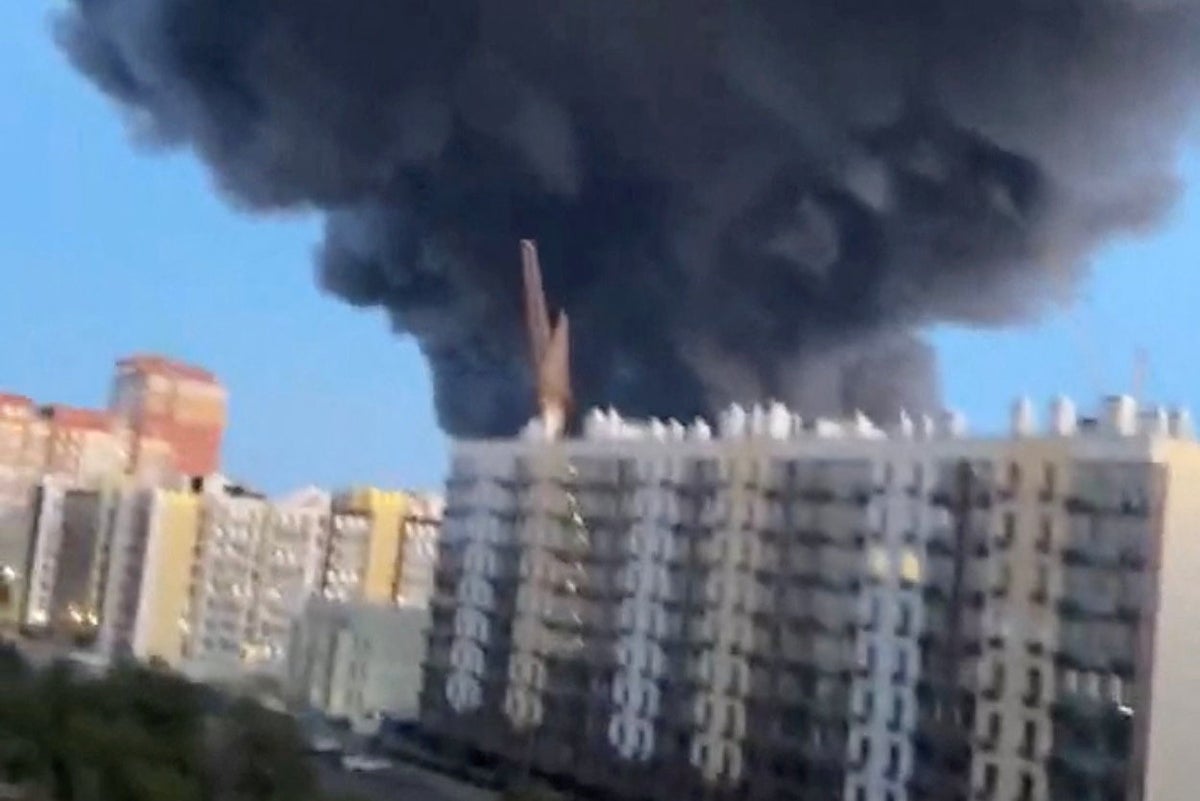
Every desk analyst in Western intelligence and every armchair general on social media loves a tidy narrative. The latest favorite: Ukraine launching strategic drone strikes against Wildberries, Russia's dominant e-commerce colossus, as a crippling blow to the Kremlin's war machine. The lazy consensus says that by burning fulfillment centers and disrupting online orders, Kyiv is cutting off the financial lifeblood of the Russian domestic economy and striking at the heart of civilian morale.
It is a clean story. It is also entirely detached from economic reality.
I have watched logistics networks fail under pressure across multiple continents, and I know how supply chains actually behave when blood starts spilling. Wildberries is not a traditional corporate entity that will fold because a warehouse catches fire. It is an anarchic, hyper-fragmented bazaar stitched together by hundreds of thousands of independent third-party sellers, local pickup points, and small-scale couriers. Hitting its distribution hubs is like swinging a sledgehammer at a swarm of hornets. You kill a few bugs, but the swarm simply reroutes, regroups, and keeps stinging.
By treating Wildberries as a traditional target like an oil refinery or an ammunition depot, military planners are committing a fundamental category error. They are fighting the last economic war while Russian commerce evolves past the point of vulnerability.
The Fallacy of the Monolithic Target
To understand why these strikes miss the mark, look at how Wildberries actually operates. Tatiana Bakalchuk built this empire not through centralized corporate efficiency, but through radical decentralization. Unlike Amazon, which relies heavily on massive, highly automated, corporate-owned fulfillment hubs, Wildberries operates on a localized franchise model.
Thousands of pickup points function as neighborhood storefronts, often run by individual entrepreneurs operating on razor-thin margins. When a major distribution center takes a hit, the inventory isn't gone forever; it is duplicated, diversified, and absorbed by regional dark stores and alternative logistics nodes within hours.
The Western press treats Wildberries like a monolithic pillar holding up the Russian state budget. That is flat-out wrong. Wildberries is a hydra. Chop off a head in Elektrostal or St. Petersburg, and three more micro-sellers pop up in Kazan or Novosibirsk to fill the shipping vacuum.
More importantly, targeting a consumer e-commerce platform does not generate the kind of systemic panic that strategic bombers are designed to inflict. If anything, it hardens consumer resolve and shifts retail traffic to domestic alternatives like Ozon or smaller regional players, keeping the domestic velocity of money spinning. Money in Russia isn't leaving the ecosystem; it's just sloshing around in a closed loop.
Why Civilian Infrastructure Is the Wrong Battlefield
There is a deeper strategic flaw here. Military strategy demands that every kinetic action degrade the enemy's capacity or will to fight. Let us look at what happens when you strike a civilian logistics network.
Imagine a scenario where a drone strike destroys millions of dollars worth of consumer goods—clothing, electronics, household appliances—destined for middle-class families in suburban Moscow. Does this cause a bread-riot style uprising against Vladimir Putin?
History says no. In fact, economic warfare against consumer populations almost always backfires. It triggers the rally-around-the-flag effect. The average Russian consumer does not blame the Kremlin for a burning warehouse; they blame the actor who lit the fuse. It validates the state narrative that the entire West and its proxies are out to destroy the ordinary citizen's way of life.
If you want to hurt the Russian war machine, you go after dual-use heavy industry, high-grade microelectronics supply chains, specialized metallurgy, and energy export terminals. You target things that cannot be easily replaced by parallel imports or domestic substitution. Targeting yoga mats, sneakers, and cheap kitchen gadgets stored in a Wildberries warehouse is an expensive way to achieve tactical irrelevance.
The Logistics of Resilience
Let us break down the mechanics of modern digital commerce under sanctions. Critics assume that because Western companies fled Russia, the consumer economy should have imploded into a Soviet-style wasteland of empty shelves.
That did not happen because parallel imports and domestic platforms adapted with terrifying speed. Wildberries, alongside Ozon, became the primary conduits for everything from Turkish apparel to Chinese smartphones. They built an alternative financial and shipping plumbing system that routes through Central Asia, the Caucasus, and the UAE.
This plumbing is decentralized by design. Payments are fragmented across smaller domestic banks, credit cooperatives, and digital wallets. Warehousing is distributed across thousands of independent commercial real estate holdings. When you strike a single company, you are hitting the storefront, not the foundation. The foundation is a massive, informal grey-market trading network that has survived decades of corruption, state meddling, and now, active warfare.
You cannot drone-strike a culture of entrepreneurial resilience born out of systemic instability. Russians have spent the better part of a century learning how to route around state and external collapse. Wildberries is just the latest vehicle for that survival instinct.
The Wrong Question
People ask: "How much financial damage do these strikes inflict on Wildberries' balance sheet?"
That is the wrong question entirely. The right question is: "Does any disruption to commercial retail spending actually alter the Kremlin's allocation of capital to the front lines?"
The answer is zero. The Russian state budget is insulated by oil revenues, state-directed credit, and sovereign wealth reserves. Consumer retail turnover, whether it happens via Wildberries or corner bodegas, is largely disconnected from the federal procurement budget funding artillery shells and armored vehicles. In fact, a vibrant consumer economy keeps the domestic middle class placated, employed, and quiet. Disrupting their shopping habits is a minor irritant, not a strategic pivot.
Unconventional Reality Check
If military planners want to disrupt Russian commerce effectively, they need to abandon kinetic theater and focus on the unglamorous, invisible work of secondary sanctions enforcement and digital infrastructure disruption.
That means choking off the financial rails in Bishkek, Dubai, and Istanbul that allow these e-commerce giants to settle transactions with Asian suppliers. It means targeting the software providers, logistics algorithms, and server infrastructure that keep these platforms humming.
Physical bombs on warehouses are expensive, flashy, and fundamentally useless against a digital-first, decentralized trading network. They make for great headlines and dramatic drone footage, but they do not shorten a war by a single afternoon.
Stop pretending that burning consumer goods constitutes a strategic offensive. It is expensive pyrotechnics masking a profound misunderstanding of how modern, distributed economies survive total friction.


