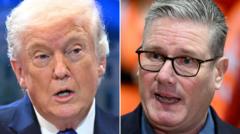
Donald Trump wants a total naval blockade of Iran, and he wants it now. But as the April 13 deadline hits, Keir Starmer has made it clear that the UK isn't interested in playing along with the latest escalation. While Washington is moving to choke off every drop of oil and every crate of goods entering or leaving Iranian waters, London is quietly backing away from the front line. It's a massive shift in the "special relationship," and it's happening right as the global economy teeters on the edge of another energy crisis.
The split over the Strait of Hormuz
The tension isn't just about geography. It's about a fundamental disagreement on how to handle a corner of the world that's already on fire. Trump’s plan, executed through US Central Command (CENTCOM), is simple and brutal. They’re enforcing an "impartial" blockade on all vessels entering Iranian ports. This follows the total collapse of peace talks in Islamabad, where the two sides reportedly agreed on 95% of issues before hitting a wall over Iran’s nuclear program.
Trump claimed on Fox News that the UK and other NATO allies would be sending minesweepers to help "clean out" the Strait. He even tried to frame it as a done deal. He was wrong. The UK government quickly shot that narrative down. While London is happy to talk about "freedom of navigation" and clearing mines to keep shipping lanes open, they’re drawing a hard line at participating in an active blockade.
Why Starmer is saying no
You have to look at the domestic picture to understand why the UK is being so cautious. The cost of living in Britain is already tied to the price of a barrel of oil. Any move that spikes energy prices further—like a full-scale naval confrontation in the world's most vital waterway—is political suicide for Starmer.
The UK's strategy right now is focused on three things.
- Avoiding a "toll" system: Iran has been trying to charge ships to pass through the Strait. The UK says no way.
- Building a different coalition: London is working with France and other European partners rather than just following the US lead.
- Maintaining international law: The UK is sticking to the UN Convention on the Law of the Sea (UNCLOS), which guarantees transit passage through straits. A blockade, in their view, is a legal minefield they don't want to step in.
Whitehall insiders are worried that following Trump blindly would just escalate the crisis into a full-blown war. Wes Streeting, the Health Secretary, didn't hold back, calling Trump’s rhetoric "incendiary" and "outrageous." That’s not the kind of language you usually hear from a top UK official about a US President. It shows just how deep the rift has become.
The ghost of Neville Chamberlain
Trump isn't taking the rejection well. He’s already taken to Truth Social and Fox News to lash out, even comparing Starmer to Neville Chamberlain. It's a classic Trump move—equating diplomatic caution with "appeasement." For Trump, you're either with him 100% or you're the enemy.
But the UK’s "no" isn't about being soft on Iran. It’s about being realistic. The UK already has mine-hunting systems and anti-drone tech in the region. They’re willing to use them to keep the lanes open for everyone, but they aren't willing to be the muscle for a US-led siege.
What this means for global trade
The Strait of Hormuz is the world's most important oil chokepoint. If it stays closed or becomes a permanent battleground, everyone loses. Oil prices already surged 8% immediately after Trump’s announcement.
- Supply chain chaos: Expect delays in everything from electronics to grain.
- Insurance spikes: Shipping companies are already seeing premiums skyrocket.
- Energy inflation: If the blockade holds, your heating bill and petrol costs are going up again.
The UK is trying to play the "grown-up in the room," hoping a coalition with France can stabilize the area without a total shutdown. It’s a high-stakes gamble. If Iran retaliates by laying more mines, the UK might find itself forced into the conflict anyway, just to keep its own economy from tanking.
The path forward for shipping and energy
If you're looking for what happens next, watch the French. The UK's pivot toward a European-led maritime security group is the real story here. They're trying to create a "safe passage framework" that keeps the oil flowing without the baggage of Trump’s "maximum pressure" 2.0.
For now, the UK is staying out of the blockade. They'll keep their ships nearby, they'll hunt for mines, and they'll talk about "international rules." But they won't be stopping tankers on Trump's orders. If you're involved in global trade or just worried about the price of gas, keep a close eye on the joint statements coming out of London and Paris over the next 48 hours. That's where the real strategy is being written.