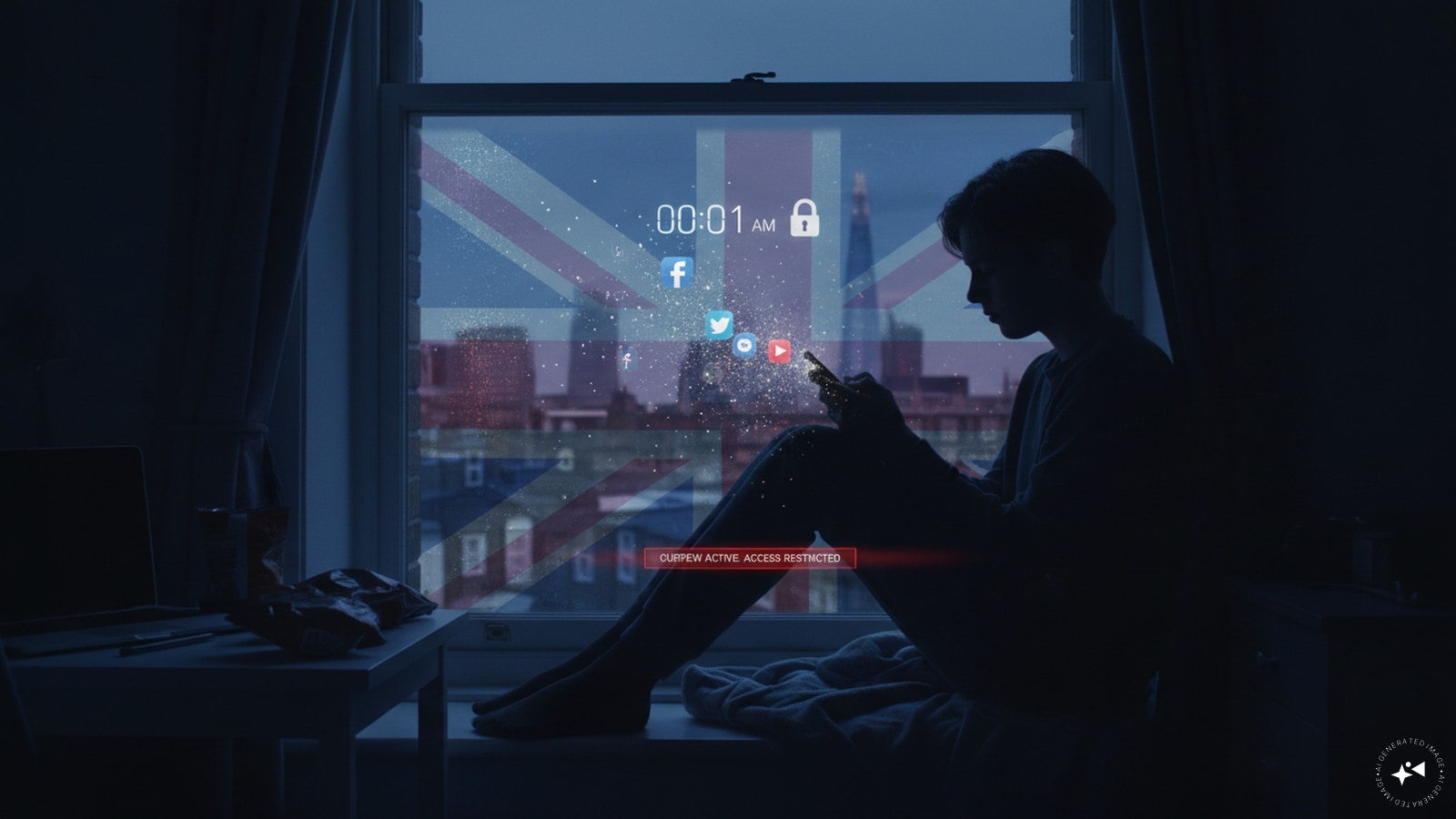
The British government has a long, storied history of trying to fix cultural problems with broken technology. The latest proposal—a default midnight social media curfew for 16- and 17-year-olds—is another classic of the genre.
It sounds wonderful in a press release. It satisfies the anxieties of middle-class parents who want a state-sponsored off-switch for their teenagers' screens. It targets the "lazy consensus" that the internet is a toxic wasteland that can be cured by simply locking the digital doors at midnight. In other updates, we also covered: Why the OpenAI Screenless Speaker Might Actually Work.
But as anyone who has actually built, secured, or audited digital infrastructure knows, this policy is a catastrophic misfire. It is not just unenforceable; it is actively dangerous. By attempting to mandate a digital bedtime, the state is about to drive millions of near-adults into the unmonitored, encrypted underbelly of the web, while simultaneously teaching them how to treat basic cybersecurity laws as a joke.
The Technical Illiteracy of State-Mandated Bedtimes
Let us look at how this actually works. Or rather, how it fails to work. MIT Technology Review has analyzed this critical subject in great detail.
To enforce a curfew, you must first know two things with absolute certainty: who the user is, and where they are. This requires a level of intrusive digital surveillance that would make authoritarian regimes blush, or it requires a reliance on third-party verification tools that are notoriously easy to bypass.
I have spent nearly two decades auditing digital systems and watching policy departments try to shoehorn physical-world laws into packet-switched networks. Every single time a government tries to build a digital wall, teenagers find the ladder.
Consider the mechanics of a midnight lockout. If Meta, ByteDance, and Google are forced to grey out their apps at 11:59 PM for users registered as 16 and 17, what happens next?
- The VPN Pivot: Within thirty seconds of the law taking effect, every moderately motivated teen in the UK will install a free virtual private network (VPN). By routing their traffic through Paris or Dublin, their local time zone suddenly shifts. The app thinks they are in a jurisdiction without a curfew.
- The Age Spoof: Young people will simply register accounts with fake birth dates. If the government mandates strict age verification (using passports or facial scanning), it creates a massive honeypot of highly sensitive biometric data. This data is held by third-party verification companies that are prime targets for hackers.
- The Rise of Alternative Networks: The moment you lock teenagers out of regulated, heavily moderated platforms like Instagram or TikTok, you do not cure their desire to socialize. You merely migrate them to unmoderated, decentralized, or end-to-end encrypted spaces. They will move to Discord servers hosted outside UK jurisdiction, Signal group chats, or alternative forums where safety tools, content moderation, and reporting mechanisms are non-existent.
By forcing kids off platforms that have thousands of content moderators, automated safety filters, and cooperation agreements with law enforcement, you push them into digital dark alleys. You are not putting them to sleep. You are putting them in danger.
The Oxford Research We Choose to Ignore
The political rhetoric surrounding screen time operates on a simple, flawed premise: social media use directly causes mental illness and sleep deprivation, and therefore, removing the screen cures the disease.
But the actual data does not support this linear narrative.
Look at the work of researchers like Andrew Przybylski and Amy Orben at the Oxford Internet Institute. Their large-scale, rigorous studies have consistently shown that the statistical link between adolescent well-being and digital screen use is incredibly small. In fact, it is comparable to the impact of eating potatoes or wearing glasses on mental health.
Yes, sleep deprivation is a massive issue for teenagers. But the assumption that the blue light of a smartphone is the sole culprit ignores the systemic pressures on modern youth.
Teenagers are staying up late because they are stressed. They are stressed about hyper-competitive university admissions, the collapse of entry-level job markets, climate anxiety, and the intense academic workloads placed upon them. The smartphone is a coping mechanism—a way to find peer support and wind down in a world where physical public spaces for teenagers have been systematically defunded and closed.
If you lock them out of their social lifelines at midnight, they do not suddenly fall into a peaceful, restorative sleep. They lie awake in the dark, isolated with their anxieties, stripped of their primary coping and communication tool.
The Infantilization of Young Adults
There is a bizarre hypocrisy in the UK’s legal definition of a 16- and 17-year-old.
At 16, a person in the UK can leave school, enter full-time employment, pay income tax, contribute to National Insurance, get married or enter a civil partnership (in Scotland), consent to medical treatment, and join the armed forces.
Yet, the government argues these same individuals lack the cognitive capacity to decide whether they should read a thread on Reddit or watch a cooking video on YouTube past midnight.
This is not protection; it is infantilization.
We are treating near-adults like toddlers. Instead of preparing them for the digital economy they will inherit and run, we are teaching them that the state will act as an arbitrary, incompetent parent.
If we want 17-year-olds to enter the workforce as capable, self-regulating adults, they must learn to manage their own relationship with technology. They must learn what sleep hygiene actually looks like through self-discipline, not state coercion. A hard curfew prevents the development of digital resilience. It replaces internal agency with external compliance, leaving them completely unprepared for the unregulated digital environments they will face the day they turn 18.
Who Actually Benefits from This Law?
We must ask ourselves who profits from this policy. It is certainly not the teenagers, and it is not the parents, who will now have to police the inevitable family arguments when their child's phone stops working during a late-night group study session.
The real beneficiaries are politicians looking for a cheap headlines.
A curfew is a highly visible, zero-cost way for a government to look like it is "doing something" about youth mental health without actually investing a single pound in mental health services.
If the government were serious about adolescent well-being, they would address the real crisis:
- Underfunded CAMHS: The Child and Adolescent Mental Health Services (CAMHS) in the UK have waiting lists that stretch for months, sometimes years. Teenagers in active crisis are routinely turned away because they are not deemed "critical" enough yet.
- Decimated Youth Services: Over the last two decades, local council budgets have been slashed, leading to the closure of thousands of youth clubs, sports facilities, and community centers. Teenagers have literally nowhere to go in the physical world.
- An Outdated School System: An educational system that measures self-worth entirely through high-stakes, high-stress testing environments that naturally disrupt sleep and elevate cortisol levels.
It is infinitely cheaper to pass a law telling Meta to turn off the lights at midnight than it is to fund mental health clinics, rebuild youth clubs, or reform the educational system. The curfew is a smoke screen designed to hide systemic state neglect.
The Double-Edged Sword of Digital Curfews
Let us address the inevitable counter-argument. Proponents will say: "Even if some tech-savvy kids bypass it, surely it will help the majority who won't bother with VPNs?"
This is a dangerous misunderstanding of how peer groups work.
Digital adoption is not individual; it is social. If the three most influential kids in a peer group install a VPN to bypass the curfew, the rest of the group will follow within forty-eight hours to avoid being excluded from the conversation. You will not get partial compliance. You will get a rapid, cohort-wide migration to workarounds.
Furthermore, this policy creates a dangerous security paradox. By making VPNs a mandatory utility for teenage social survival, you are exposing them to massive privacy risks.
To bypass the UK curfew, millions of kids will download free, sketchy VPN apps from the App Store and Google Play. Many of these free services monetise by harvesting user data, tracking browsing habits, and injecting ads.
The state will literally drive teenagers into the arms of data brokers and insecure proxy networks, all under the guise of keeping them safe.
Shift the Paradigm from Control to Resilience
We need to stop asking how we can lock down the internet and start asking how we can build stronger users.
Instead of futile, top-down prohibitions, we should be equipping young people with the tools to navigate the attention economy. This is not about soft, feel-good digital citizenship classes. It is about hard, practical education.
Imagine a curriculum that teaches:
- Attention Economics: Showing teenagers how algorithms are engineered to exploit dopamine loops, and teaching them how to actively configure their notifications, feeds, and screen settings to reclaim their attention.
- Threat Modeling: Teaching them how to evaluate the privacy policies of the apps they use, understand where their data goes, and recognize the security trade-offs of using bypass tools like VPNs.
- Peer-Led Sleep Hygiene: Empowering student-led initiatives to establish collective boundaries around late-night messaging, rather than imposing rules from an out-of-touch legislative body.
This approach is harder. It requires nuance, time, and active engagement. But unlike a midnight curfew, it actually works. It creates adults who can live, work, and thrive in a digital world without needing a government-mandated nanny to turn off their screens.
The midnight curfew is a lazy solution to a complex human problem. It is time to treat teenagers with the respect they deserve, dismantle the security theatre, and focus on the real, structural issues that are keeping our young people awake at night.