The corporate press is running its standard playbook: screaming about an "escalation that threatens to spin out of control" because Israel struck targets in western and central Iran following a Sunday missile barrage from Tehran. Donald Trump is playing his part too, leaking to journalists that he is telling Benjamin Netanyahu not to retaliate because "each of them had their fun."
This framework is completely detached from reality.
The media treats these military actions like an emotional, unpredictable bar fight. They pretend the fragile April 8 ceasefire was a real return to stability, and that these new strikes are an irrational disruption of a looming peace deal. Having spent fifteen years analyzing regional security structures, I can tell you this narrative is pure fiction.
The exchange of fire between Israel and Iran is not a breakdown of communication. It is the communication.
The Myth of the Uncontrolled Escalation
Mainstream commentators evaluate military strikes through a psychological lens. They talk about Netanyahu’s defiance or Iran's anger. This is lazy. Military actions between states are calculated moves in a brutal poker game, not emotional outbursts.
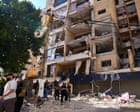
Look at the mechanics of the latest exchange. Iran fired a targeted barrage at the Ramat David Air Base. They did not launch a saturation strike aimed at leveling Tel Aviv. They targeted the specific infrastructure used to bomb Beirut's southern suburbs. In response, the Israeli Air Force hit localized military sites in central and western Iran.
This is highly disciplined, symmetric theater.
- The Input: Israel strikes Hezbollah assets in Beirut.
- The Response: Iran asserts its regional patron status by firing at the base responsible.
- The Counter-Response: Israel re-establishes its deterrence by proving it can bypass Iranian air defenses at will.
The media calls this an uncontrolled crisis. In reality, it is a rigidly controlled, violent negotiation. Both sides know exactly where the red lines are. If Iran truly wanted total war, they would not send pre-announced missile salvos that allow the IDF and U.S. forces to achieve a near-100% interception rate. They are managing risk, not expanding it.
Why Trump Can Not Just Call Bibi and Fix It
The White House operates under the delusion that personal diplomacy can override systemic geopolitical imperatives. Trump’s quote to the press—"Each of them had their fun... We don't need another one"—reveals a profound misunderstanding of Israeli strategic doctrine.
Israel is not striking Iran for "fun." It is striking Iran because the security architecture of the Middle East fundamentally transformed after Operation Epic Fury kicked off on February 28. The decapitation of Iran’s leadership, including Supreme Leader Ali Khamenei, did not create a passive, broken state. It created a volatile transition period where the new de facto leadership under Ali Larijani must constantly project strength to avoid internal collapse.
Imagine a scenario where Israel follows Trump's advice and stops retaliating entirely. The immediate result would not be peace. The result would be an aggressive surge from the Islamic Revolutionary Guard Corps (IRGC) to test the new boundaries.
Israeli defense officials know that a ceasefire is only as strong as the violence backing it up. For Israel, skipping a turn in the retaliatory cycle is interpreted as weakness, which invites greater aggression. Netanyahu is not defying Washington out of spite; he is adhering to a core tenet of Israeli survival: never let an enemy strike go unanswered, no matter what your superpower benefactor says.
The Deep Flaw in the Looming Peace Deal Narrative
Diplomats are currently whispering to reporters that a permanent peace treaty was "close" and that these strikes are ruining the progress. This is the biggest lie of all.
There is no viable peace deal on the table because the core issues are fundamentally irreconcilable under the current terms. Consider what the administration is demanding versus what it is willing to offer:
| The Diplomatic Illusion | The Brutal Reality |
|---|---|
| U.S. Demand: Iran must permanently reopen the Strait of Hormuz and halt support for the Axis of Resistance. | Iran's Position: The naval blockade has crippled their economy; closing the Strait and funding proxies are their only points of leverage. |
| U.S. Offer: Trump explicitly stated the U.S. will not lift sanctions or unfreeze assets up front, telling Iran to "behave" first. | The Strategic Impossibility: No sovereign state, especially a highly ideological regime fighting for survival after losing its Supreme Leader, will disarm and surrender its leverage in exchange for a vague promise of future good behavior. |
The U.S. approach assumes Iran is operating from a position of total defeat. While the air war damaged over 190 ballistic missile launchers and devastated naval vessels, the regime still retains thousands of operational drones and asymmetric capabilities. They are down, but they are not out. A diplomatic strategy built on demanding unconditional surrender while offering zero upfront sanctions relief is guaranteed to fail. The current strikes are not interrupting negotiations; they are the natural consequence of a diplomatic framework that was dead on arrival.
Dismantling the Premium Punditry
When evaluating this conflict, standard analysis fails because it asks the wrong questions. Let's correct the premises of the current debate.
Is the Middle East on the verge of a regional conflagration?
No. The regional conflagration already happened in March and April. The current exchanges are the residual friction of that war, not the prelude to a new one. Neither Saudi Arabia nor the UAE has any desire to reopen the conflict on their soil after experiencing the initial waves of Iranian drone retaliation. They are actively cooperating with defensive networks while maintaining quiet backchannels to Tehran. The regional consensus is containment, not expansion.
Will cutting off weapons to Israel force a resolution?
This is a favorite talking point among Western commentators. It ignores reality. Israel possesses domestic manufacturing capabilities for its primary strike assets and retains enough ordnance to sustain localized, symmetric exchanges indefinitely. Threatening to withhold future strategic systems does not stop an active air campaign designed to hit immediate targets in western Iran. It only signals a rift between Washington and Tel Aviv, which actually increases the likelihood of an Iranian miscalculation.
The Price of Realism
Admitting that this violence is structured and rational comes with a dark truth. It means accepting that military friction will remain a permanent feature of the region for the foreseeable future. There is no grand diplomatic breakthrough on the horizon that will magically transform Iran into a Western-style democracy or convince Israel to live alongside an existential nuclear threat.
The current status quo—characterized by a tightening U.S. naval blockade, localized Israeli airstrikes, and measured Iranian missile salvos—is the actual equilibrium. It is ugly, expensive, and disruptive to global shipping. The Pentagon has already requested an additional $200 billion to cover regional operations. But trying to force a premature, flawed peace deal based on personal phone calls and empty rhetoric will only destabilize this fragile equilibrium.
Stop waiting for the violence to end, and start understanding how it is being used to maintain the balance of power. The missiles flying over the desert are not an escalation. They are the baseline.