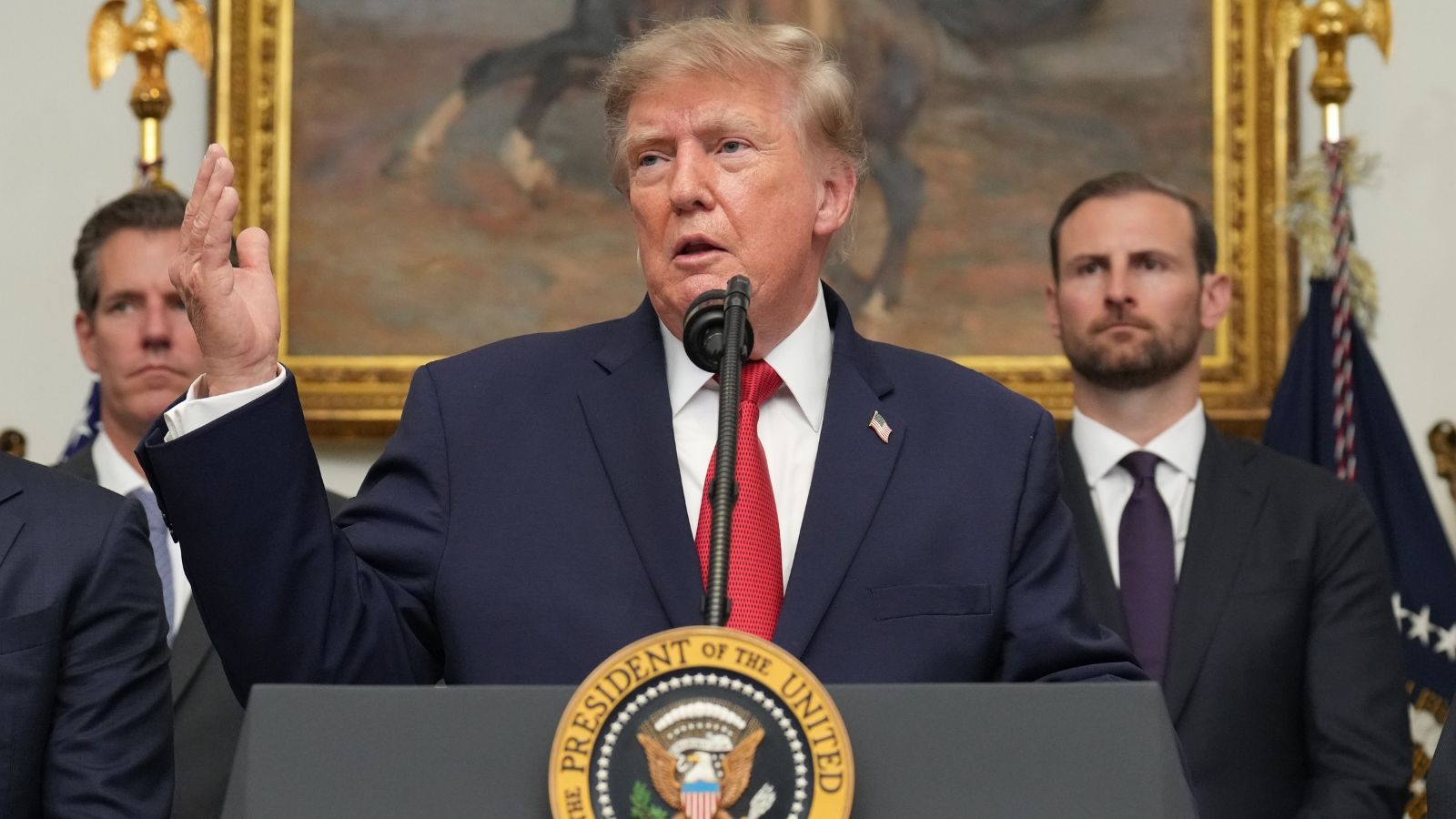
Every four years, Washington falls for the exact same bedtime story. A tough-talking leader steps up to a podium, squares his shoulders, and promises to wrap up a generational Middle Eastern quagmire before the next quarterly earnings report.
"We'll put it away very soon." "One way or the other."
Mainstream pundits eat this up. They frame the debate as a binary choice between decisive American strength and diplomatic weakness. They treat geopolitical conflict like a distressed real estate deal where you just threaten to walk away from the table until the other guy blinks. That framing is dangerously naive.
When Donald Trump vows a quick end to the Iran conflict, he is selling a fantasy built on a fundamental misunderstanding of asymmetric warfare, Persian statecraft, and the hard math of modern deterrence. You cannot "put away" a 45-year revolutionary enterprise in a fiscal quarter. Trying to force a rapid conclusion doesn't bring peace. It guarantees the exact regional conflagration the White House claims it wants to avoid.
The Myth of the Decisive Knockout Blow
Washington loves the idea of the silver bullet. In Beltway parlance, this usually translates to "maximum pressure" or a "calibrated kinetic strike." The logic seems clean on a whiteboard: squeeze Tehran's economy until the currency collapses, or hit enough missile depots and Revolutionary Guard commanders until the regime sues for peace.
We already ran this experiment.
During the first Trump administration, the withdrawal from the Joint Comprehensive Plan of Action (JCPOA) in 2018 and the subsequent maximum pressure campaign were explicitly designed to force Iran back to the negotiating table for a "better deal." Instead, Iran expanded its nuclear program from a breakout time of over a year to a matter of weeks, increased uranium enrichment to 60 percent, and accelerated its regional proxy attacks.
I have sat in briefing rooms in Washington and Brussels where analysts projected regime collapse within eighteen months based on rial depreciation charts. They were dead wrong. They measured Iran using Western macroeconomic indicators—inflation, GDP contraction, foreign currency reserves—while ignoring the survival mechanics of a revolutionary theocracy.
The Islamic Revolutionary Guard Corps (IRGC) doesn't care about the middle class losing its purchasing power. In fact, sanctions actively strengthen the IRGC. When legitimate international trade vanishes, smuggling networks take over. Who controls the borders, the ports, and the black market in Iran? The IRGC. Sanctions turned a military branch into an unassailable economic cartel.
If economic strangulation doesn't force a quick surrender, the "other way" implied by Trump's rhetoric is overwhelming military force. Yet military history offers zero comfort here. Carl von Clausewitz warned centuries ago that war is not a single short blow, and political objectives rarely align with purely kinetic timelines. You can bomb Natanz and Fordow. You can sink the Iranian navy in the Persian Gulf in an afternoon. Then what? You haven't erased the technical knowledge inside the heads of thousands of Iranian nuclear scientists, and you haven't occupied a mountainous country three times the size of France with 88 million people.
Why Tehran Operates on a Century Clock
To understand why a "quick end" is impossible, you have to understand the asymmetry of time.
American presidents operate on two-year and four-year election cycles. A policy that doesn't yield a photo-op before the midterms is considered a failure. Tehran operates on a civilizational clock. Supreme Leader Ali Khamenei and the clerical establishment view their struggle through the lens of Shia martyrdom and decades-long attrition. They do not need to win a conventional war against the United States. They only need to outlast the attention span of the American electorate.
Consider the strategic concept of strategic patience—or sabr-e rahbordi, as Iranian strategists call it. While Washington looks for a knockout punch, Tehran plays a game of cumulative exhaustion.
Imagine a scenario where the White House delivers an ultimatum: dismantle the nuclear program and halt proxy funding within 60 days, or face massive retaliatory strikes. Tehran doesn't say no. They say "maybe." They send a delegation to Oman or Doha. They quibble over definitions, demand sanctions relief upfront, and drag talks out through three rounds of technical committees. Meanwhile, Houthi drones disrupt Red Sea shipping lanes, spiking global freight insurance, and Iraqi militias launch sporadic, non-lethal rocket attacks at American bases. No single provocation crosses the threshold for an all-out American invasion, yet the cumulative cost—measured in naval deployments, interceptor missiles, and global inflation—bleeds Washington dry.
By the time the White House realizes it is being played, eighteen months have passed, oil prices are threatening a domestic recession, and the administration quietly lowers its demands just to claim a face-saving exit.
Dismantling the Wrong Questions
When news outlets cover Trump's rhetoric on Iran, they routinely fall into predictable analytical traps. They ask the wrong questions, which inevitably leads to terrible policy prescriptions.
Can maximum pressure force Iran into a better nuclear deal?
No. This question assumes the Iranian leadership prioritizes economic prosperity over ideological survival. It does not. The regime's foundational legitimacy rests on resistance to American hegemony (Estekbar-setizi). Capitulating publicly to an American ultimatum—especially one delivered with Trump's characteristic bravado—would fracture the hardline base that keeps the clerics in power. For Tehran, a bad deal signed under duress is more dangerous than no deal at all.
Will cutting off Iranian oil exports bankrupt the regime?
It hasn't, and it won't. When the U.S. squeezed traditional buyers like Europe, South Korea, and Japan, Iran simply built a shadow fleet of aging tankers, turned off their transponders, and sold discounted crude to independent "teapot" refineries in China. Beijing gets cheap energy outside the U.S. dollar system, and Tehran gets enough hard currency to fund Hezbollah and build Shahed drones. Unless the U.S. Navy is willing to physically board and seize Chinese-bound tankers on the high seas—an act that risks a direct naval confrontation with Beijing—zeroing out Iranian exports is a mirage.
Does targeted assassination of commanders cripple the Axis of Resistance?
Killing high-profile leaders creates a temporary organizational shock, not a strategic collapse. When the U.S. killed Qasem Soleimani in January 2020, pundits predicted the unraveling of Iran's regional network. Four years later, that network—comprising Hezbollah, the Houthis, and Iraqi militias—demonstrated more coordinated, multi-front firepower than at any point during Soleimani's life. Decentralized insurgency networks are designed to absorb decapitation strikes. You kill a general; a more radical, less predictable colonel takes his place.
The Asymmetric Math Nobody Wants to Do
Let's look at the brutal economics of modern warfare in the Middle East. This is the reality check that breaks every "quick victory" fantasy.
When Iranian-backed militants launch a one-way attack drone, it costs them roughly $20,000 to $50,000 to assemble using commercial off-the-shelf components. When an American Arleigh Burke-class destroyer in the Red Sea shoots that drone down, it fires an SM-2 or SM-6 interceptor missile costing between $2 million and $4 million.
Read those numbers again.
That is a 100-to-1 cost disadvantage for the United States. Every time the U.S. Navy "wins" an engagement by intercepting a cheap drone or ballistic missile, it loses the war of industrial attrition. American defense contractors cannot manufacture high-end interceptors fast enough to match the rate at which Iran and its proxies can mass-produce cheap munitions in underground bunkers.
| Strategic Factor | Washington's Assumption | Tehran's Reality |
|---|---|---|
| Time Horizon | 6 to 18 months (Election cycle driven) | 10 to 30 years (Regime survival driven) |
| Economic Pain | Triggers domestic revolt and capitulation | Consolidates IRGC black-market monopolies |
| Escalation Dominance | Overwhelming kinetic superiority wins | Asymmetric attrition bankrupts the defender |
| Proxy Networks | Hierarchical; breaks if you cut the head | Decentralized; adapts and hardens under fire |
A quick military campaign doesn't solve this math problem; it accelerates it. If the U.S. launches a massive air campaign against Iran, Tehran doesn't need to defeat the U.S. Air Force in dogfights. It just needs to close the Strait of Hormuz using sea mines, fast-attack boats, and coastal anti-ship cruise missiles. Twenty percent of the world's petroleum passes through that narrow waterway. Closing it for even two weeks would send crude oil past $150 a barrel, crater global stock markets, and guarantee an electoral wipeout for whichever American president pulled the trigger.
Tehran knows this. Washington pretends it doesn't.
The Heavy Hitters Who Tried and Failed
You don't need to take my word for it. Look at the track record of the sharpest minds in modern foreign policy.
Henry Kissinger spent years trying to manage Middle Eastern balances of power through intricate backchannels, yet failed to anticipate the 1979 Islamic Revolution that upended American strategy in the Gulf for half a century. Condoleezza Rice and the George W. Bush administration believed toppling Saddam Hussein in Iraq would create a democratic domino effect that would isolate and eventually transform Iran. Instead, removing Iraq as a regional counterweight handed Iran unprecedented influence from Baghdad to Beirut.
Barack Obama bet that the JCPOA would moderate Iranian behavior by reintegrating it into the global economy. He got a temporary freeze on nuclear enrichment, while Iran used the unfrozen assets to supercharge its regional proxy wars in Syria and Yemen.
Donald Trump bet that tearing up the JCPOA and applying maximum pressure would force a rapid, comprehensive surrender. He got neither a deal nor a nuclear freeze.
Every single administration approached Iran believing it held the leverage to force a clean resolution. Every single one left office with Iran closer to a nuclear weapon and deeper entrenched across the Levant. The common denominator isn't incompetence; it is hubris. It is the refusal to accept that some geopolitical problems cannot be solved—they can only be managed.
The Cost of Restraint
Admitting that there is no quick fix comes with a bitter pill that politicians hate to swallow. If you abandon the fantasy of a rapid knockout, you have to accept a strategy of prolonged, unglamorous containment.
Let's be brutally honest about the downsides of this contrarian approach. Containment is ugly. It requires accepting that Iran will remain a threshold nuclear state—capable of building a bomb if pushed into a corner, even if it chooses not to assemble one right now. It means tolerating a certain level of gray-zone friction in the region without overreacting to every provocation. It denies presidents the triumphant Rose Garden press conferences they crave, and it leaves the administration vulnerable to domestic critics screaming that America looks weak.
Worse, containment requires deep, sustained diplomatic coordination with allies—European nations, Gulf Arab states, and even reluctant partners like China—who have vastly different economic interests than Washington. Building and maintaining that coalition takes years of tedious, behind-the-scenes statecraft. It is the exact opposite of unilateral, loud-mouthed diplomacy.
What Actually Works Instead of Ultimatums
If the White House actually wants to curb Iranian aggression without stumbling into a catastrophic war, it needs to stop issuing deadlines and start changing the structural incentives on the ground.
- Shift from direct interception to supply-chain interdiction. Stop wasting $4 million missiles shooting down $20,000 drones over the water. Focus intelligence, cyber operations, and covert action on choking the specific microelectronics, gyroscopes, and commercial engines flowing from Western and Asian shell companies into Iranian drone factories. Target the supply chain before the weapons are built, not while they are flying toward a destroyer.
- Weaponize regional self-interest. Stop acting as the sole security guarantor for Gulf states that simultaneously hedge their bets with Tehran and Beijing. Force Saudi Arabia, the UAE, and Israel to integrate their air defense and intelligence networks into a cohesive regional architecture. When Tehran realizes its missiles can no longer penetrate a unified regional shield, the deterrent value of its arsenal drops precipitously without a single American boot hitting the ground.
- Offer a transactional, limited off-ramp. Drop the demand for total ideological surrender. You will never get Tehran to abandon its regional allies or dismantle its ballistic missile program in one grand bargain. Instead, pursue a strictly transactional "less-for-less" freeze: Iran caps enrichment at 3.67 percent and submits to intrusive international inspections in exchange for targeted humanitarian exemptions and frozen asset access under strict third-party escrow. It isn't permanent peace, and it won't win a Nobel Prize, but it buys time and prevents a nuclear breakout.
- Target the regime's domestic legitimacy, not its people. Broad-based economic sanctions starve ordinary Iranians while enriching the IRGC. Pivot entirely to hyper-targeted financial warfare against the personal wealth, foreign real estate, and offshore accounts of senior clerical families and IRGC commanders. Expose their corruption directly to the Iranian public—a population that already despises the regime's hypocrisy.
Stop Buying the Tough Talk
Voters love a leader who promises simple solutions to complex nightmares. When a politician says they will "put it away very soon," they are tapping into a deep American impatience with endless foreign entanglements.
That impatience is Iran's greatest weapon.
Tehran doesn't have an aircraft carrier. It doesn't have stealth fighters. It doesn't have a trillion-dollar defense budget. It has geography, patience, and an opponent that consistently mistakes loud rhetoric for actual leverage. Until Washington stops trying to win the Iran conflict on an election-cycle timetable, the only thing getting "put away" is American credibility.


