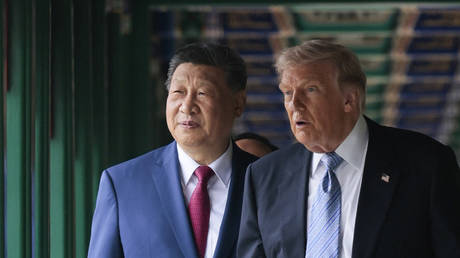
The chattering class is convinced they just watched the funeral of the American Century. They see a red carpet in Beijing and mistake hospitality for a surrender ceremony. They look at a few billion dollars in trade deals and see a tributary state paying homage to a new Middle Kingdom.
They are dead wrong.
What the mainstream analysis misses—mostly because it is blinded by a nostalgic obsession with the post-WWII liberal order—is that American primacy was never about being liked. It was about leverage. For thirty years, the U.S. played a "responsible stakeholder" game that allowed China to hollow out the American industrial base while hiding behind the shield of developing-nation status.
Trump’s trip didn’t signal the end of American power. It signaled the end of American charity. We aren't leaving the stage; we're finally charging admission.
The Myth of the Thucydides Trap
Every academic with a tenure track position loves to cite the Thucydides Trap. They claim that an established power (the U.S.) and a rising power (China) are destined for a collision that the U.S. is too fragile to win. This is a lazy reading of history and a worse reading of modern economics.
In the 5th century BC, power was territorial. Today, power is architectural. The U.S. still owns the plumbing of the global financial system. When a U.S. president lands in Beijing and demands structural changes to intellectual property and trade deficits, he isn't begging for a seat at the table. He is reminding the host who built the table.
China’s rise was subsidized by American consumerism and protected by the U.S. Navy. The "primacy" that the critics are mourning was actually a burden—a global policing role that cost trillions and yielded a $500 billion trade deficit with a single partner. If "primacy" means paying for your competitor’s growth, then losing it is the best financial decision the U.S. has made since the Louisiana Purchase.
Sovereignty is the New Globalism
The consensus view is that "globalization" is a fixed, unstoppable force and that any move toward bilateralism is a retreat.
I have spent two decades watching supply chains migrate based on the whims of central planners. I can tell you: the era of the borderless corporation is hitting a wall. The Beijing summit proved that the future isn't a unified global market, but a series of high-stakes bilateral negotiations where the bigger hammer wins.
The U.S. has the biggest hammer: the dollar and the largest consumer market on earth.
By bypassing multilateral groups like the WTO—which has proven about as effective at stopping Chinese mercantilism as a screen door on a submarine—the U.S. is reclaiming its right to act as a sovereign superpower. This isn't isolationism. It’s a return to realpolitik.
The Intellectual Property Heist
Let’s talk about the "theft" that the previous administration treated as a minor accounting error.
For years, the U.S. allowed China to extort technology transfers from American firms as a "cost of doing business." The lazy consensus says this was inevitable—that you can't stop the flow of information.
That is nonsense. You stop it with friction.
Trump’s aggressive posture in Beijing signaled that the U.S. is finally willing to weaponize its own market. If you want access to the American consumer, the price is no longer "your soul and your patents." The price is fair play.
Critics call this "protectionism." I call it a late-stage audit of a failing partnership. We are seeing the U.S. move from a "free trade" model (which was never actually free) to a "reciprocal trade" model. If China can protect its "national champions" like Huawei and Alibaba with a Great Firewall and massive subsidies, the U.S. is finally realizing it has the right to protect its own innovators.
The Debt Trap Fallacy
"But China owns our debt!"
This is the favorite ghost story of the decline-of-America crowd. It displays a fundamental misunderstanding of how sovereign debt works.
If you owe the bank $100,000, the bank owns you. If you owe the bank $1 trillion, you own the bank. China’s massive holdings of U.S. Treasuries aren't a weapon; they are a leash. If China dumps those bonds, they destroy the value of their own reserves and tank the very market they rely on to sell their goods.
In Beijing, there was a quiet acknowledgment of this mutual hostage situation. The U.S. isn't the one sweating. We can print the currency the debt is denominated in. China has to manufacture physical goods and ship them across an ocean guarded by the Seventh Fleet just to keep their GDP from falling below the 6% threshold that prevents domestic rioting.
Why the "Decline" Narrative is a Grift
The narrative of American decline is a profitable industry for consultants and "globalists" who want to justify moving capital to emerging markets.
Here is the reality:
- Energy Independence: While China is the world's largest oil importer, the U.S. has become a net exporter.
- Demographics: China is facing a demographic collapse thanks to the one-child policy. They are getting old before they get rich. The U.S. remains the only developed nation with a viable path to population stability.
- Innovation: No one is moving to Beijing to start the next OpenAI. They are still coming to Silicon Valley, Austin, and Boston.
The Beijing summit wasn't a passing of the torch. It was a cold-blooded assessment of a new reality. The U.S. is no longer playing the role of the benevolent, gullible hegemon. We are playing the role of a competitor.
Stop Asking if We Are Leading
The "People Also Ask" section of the internet is obsessed with: "When will China overtake the U.S.?"
That is the wrong question. The real question is: "When will the U.S. stop subsidizing its own replacement?"
The answer was 2017.
The pomp and circumstance in the Forbidden City was a distraction. The real work was the quiet dismantling of the "Chimerica" era. We are decoupling. It will be messy. It will be expensive. It will cause market volatility that will make your head spin.
But it is the only way to ensure American primacy survives the century.
True power isn't about being the "leader" of a group of nations that resent you. It’s about having the most leverage in a room full of rivals. By breaking the old rules, the U.S. isn't losing its place at the top; it's making sure the top is the only place left to stand.
The era of the U.S. as the world's piggy bank is over. If that looks like "decline" to you, you're looking at the balance sheet upside down.
Go ahead. Call it the end of an era. Just make sure you specify it’s the era of American naivety.
We are just getting started.