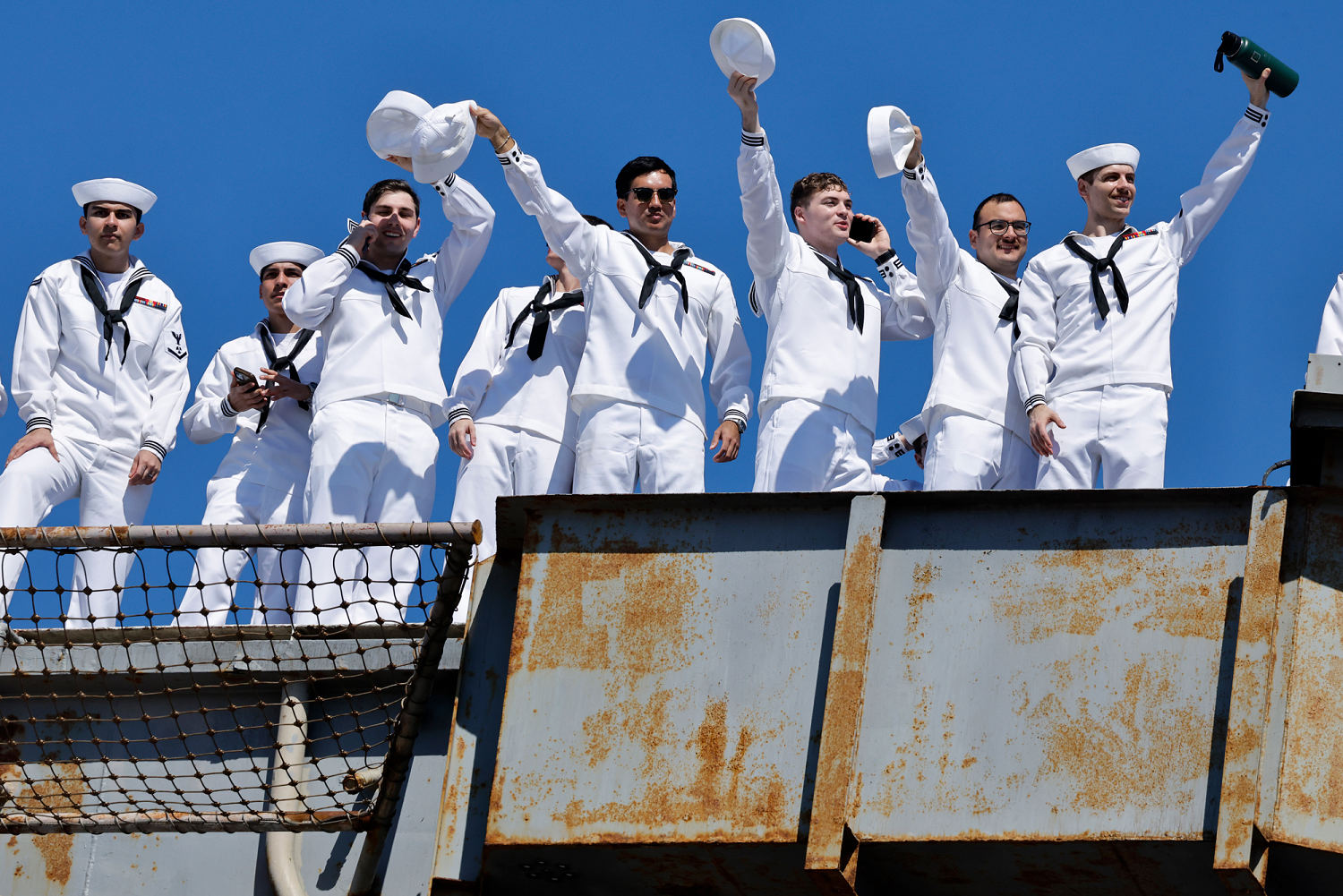
Every local news outlet loves a homecoming. You know the drill. Families pressed against chain-link fences, toddlers holding homemade signs splashed with glitter, and tired sailors marching off a grey hull into a blur of hugs and tears. The headlines write themselves. Thousands turn out to welcome weary crews after record-breaking deployments, framing the months at sea as an epic triumph of endurance. It makes for fantastic television. It generates warm fuzzies for the evening broadcast. And it completely sanitizes a brutal operational reality.
We treat these record-breaking deployments as badges of honor when they are actually red flags. When a carrier strike group spends nearly ten months continuously operating in a volatile theater, dodging drones and burning through munitions without a scheduled relief, that is not a testament to peak military efficiency. That is institutional failure masked by individual sacrifice.
Let us dispense with the feel-good narrative for a moment. I have spent enough time talking to logisticians and surface warfare officers to know that the applause on the pier obscures a deteriorating fleet architecture. While the public swoons over the emotional reunion photos, the maintenance backlogs compound, the supply chains fray, and the human capital burns out at an unsustainable rate.
The lazy consensus is simple. Our sailors are tough, our ships are durable, and when the mission demands an extended tour, they step up and get it done. That argument sounds patriotic, but it relies on a dangerous math. You cannot indefinitely stretch a rubber band without snapping it.
The Myth of the Infinite Extension
The fundamental misunderstanding in mainstream coverage of modern naval deployments centers on the concept of tempo. During recent high-profile carrier rotations, extensions have become less of an emergency exception and more of a standard operating procedure. When a strike group gets extended for the third or fourth time because the incoming relief is delayed in dry dock or caught up in training bottlenecks, we call it resilience.
That is not resilience. That is triage.
Look at the maintenance data across major naval shipyards. When a carrier like the USS Abraham Lincoln or any of its sister ships logs a historic deployment length, the wear and tear on the engineering plants, the radar arrays, and the air wings multiplies exponentially. Saltwater does not care about your mission statement. Corrosion accelerates. Mechanical components reach their mean time between failures long before the pier comes into view.
More importantly, the psychological toll on the crew follows a steep downward curve. Month six of a deployment looks very different from month nine. Cognitive fatigue sets in. Watchstanders miss critical anomalies on sonar or radar not because they lack training, but because sleep deprivation is an operational hazard. When we glorify the length of the deployment, we inadvertently incentivize leadership to push crews past safe operational thresholds.
Why the Replacement Model is Broken
People often ask why the Navy cannot simply rotate crews more frequently or keep a tighter leash on scheduling to prevent these multi-month overruns. The answer exposes a structural flaw in how we build and deploy force packages.
The traditional deployment model assumes a predictable cycle. Train, certify, deploy, maintain, repeat. That cycle worked fine in a predictable unipolar environment where opposing navies stayed in port. Today, that model is obsolete. Competitors in the Indo-Pacific and the Red Sea operate on a persistent, 365-day cadence. They do not take a seasonal break.
Yet, our force structure remains anchored to a cold war mindset of surge-and-return. When a crisis flares up, Washington looks at the map and asks one question: Where is the nearest carrier? Not: Can that carrier sustain operations without breaking its crew? Not: What deferred maintenance will we have to swallow next year to pay for this month's presence?
This creates a reactive loop. We burn out our assets today to plug a tactical gap, which creates a strategic vacuum tomorrow when those same assets are stuck in extended overhauls. The homecoming parade is the final act of a play where the stage is slowly collapsing.
The True Cost of Perpetual Presence
Let us look past the hardware and examine the human element. The retention crisis in the surface fleet is not a mystery. It is a direct mathematical output of extended deployments and unreliable schedules.
Imagine a scenario where you tell a skilled technician, a nuclear operator, or an experienced chief petty officer that their six-month deployment is suddenly stretching to nine months, with zero guarantee they will be home for the holidays, their child's birth, or any semblance of a normal family life. Then, the moment they finally return, they are given a brief stand-down before jumping straight back into the training cycle for the next patrol.
Retention plummets. The talent drain in the mid-grade ranks is catastrophic. We are hemorrhaging years of tactical knowledge because the system treats sailors as disposable consumables rather than irreplaceable professionals.
The contrarian truth is uncomfortable. Every time we celebrate a record-breaking deployment, we are celebrating a failure of fleet sizing, industrial capacity, and strategic restraint. We are holding together a global posture with duct tape and willpower, then throwing a parade when the tape holds for one more month.
Fixing the Broken Compass
If we want a Navy that can actually deter peer competitors over the long haul, we have to stop romanticizing exhaustion.
First, defense planners need to decouple presence from deterrence. The idea that a grey hull must sit in every contested body of water every single day to prove our commitment is an expensive delusion. True deterrence comes from lethality, readiness, and unpredictability, not from predictable circles burned into the ocean by a rusted ship running on borrowed time.
Second, we must overhaul shipyard capacity. The reason ships stay out too long is often because the ships that are supposed to replace them are rotting in civilian or naval repair yards waiting for dry-dock space. Until we fix the industrial base, every deployment will be a crisis management exercise.
Third, leadership needs the courage to say no. When operational commanders demand another thirty-day extension because it is convenient for theater posture, someone at the top needs to weigh the long-term cost to the human element and push back.
The sailors walking down the gangway after a grueling tour deserve our respect, our gratitude, and our cheers. But they also deserve a system that respects their limits, honors their schedules, and stops treating their exhaustion as a marketing strategy. Stop applauding the record-breaking deployment. Start demanding a fleet that doesn't need miracles just to come home on time.