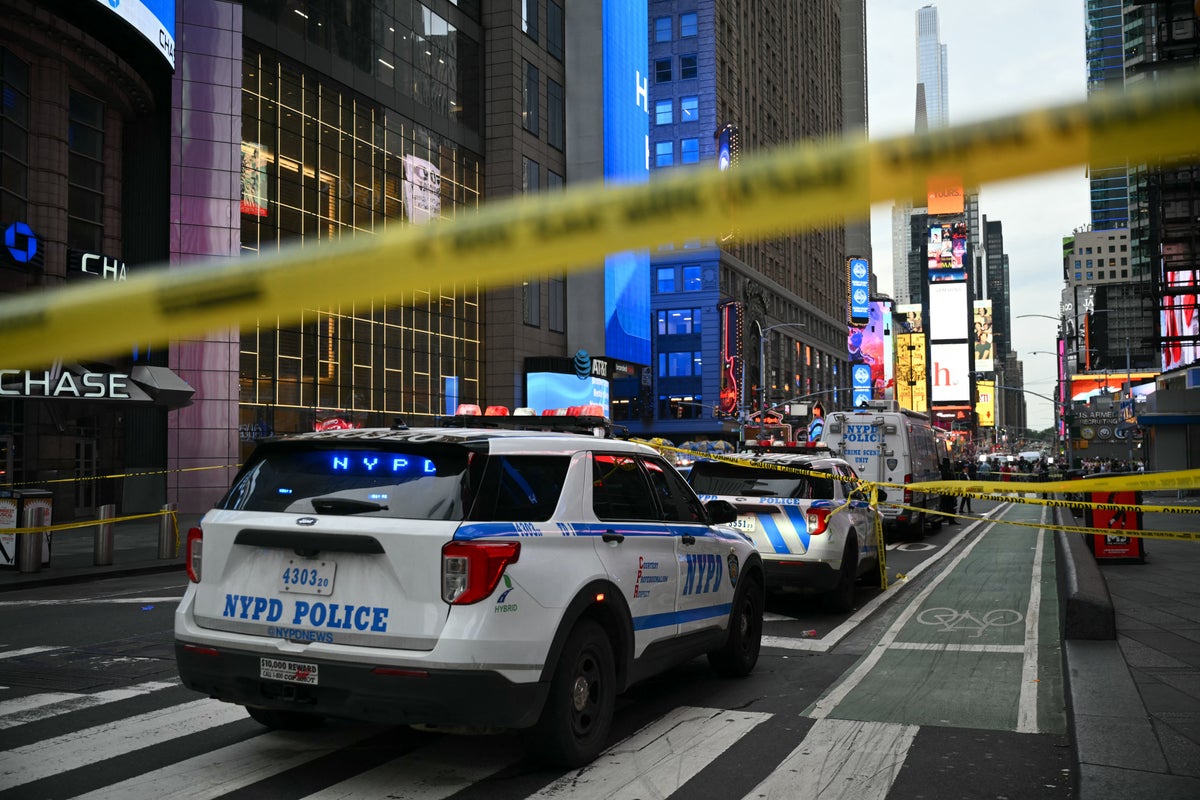
High-density urban environments operate on a continuous calculus of risk, transit velocity, and institutional response times. When that calculus breaks down in a micro-locale like Times Square, the systemic failures manifest rapidly. The fatal attack on Bank of America vice president Erin Piacenti and the wounding of a 68-year-old male pedestrian by 49-year-old Pamela Cisneros exposed acute structural vulnerabilities in public safety interventions, mental health tracking, and street-level threat mitigation. Deconstructing the sequence reveals clear operational breakdowns rather than simple anomalies.
The timeline established by the New York Police Department places the entire kinetic window of the assault at approximately twenty seconds. Cisneros retrieved two large knives from a red Target bag near West 41st Street and Seventh Avenue, targeted her first victim near a subway exit, and progressed north toward 42nd Street to strike Piacenti. This velocity underscores a fundamental operational reality: ultra-short-duration violent events outpace standard police response vectors, rendering reactive deployment models obsolete during the initial phases of kinetic violence. Security architecture in high-traffic zones cannot rely solely on post-incident interdiction.
The assailant’s profile highlights structural gaps within municipal mental health intervention frameworks. Records confirmed documented interactions with the New York Police Department in 2018 and 2019, yet these touchpoints yielded no sustained institutional containment or preventative case management that prevented escalation to lethal violence. When public health systems lack the legal mechanisms or resource capacity to compel treatment for individuals manifesting severe, unmanaged psychiatric deterioration, the burden shifts entirely to street-level law enforcement. Police officers are thus transformed into frontline psychiatric crisis responders without the specialized tools required for non-lethal neutralization of armed, highly resistant subjects.
The tactical engagement phase further demonstrates the limitations of standard subdual protocols. Responding officers attempted verbal de-escalation for several minutes before deploying a Taser, which failed to neutralize the threat. Cisneros explicitly stated an intent to kill the responding personnel before advancing with drawn blades. This sequence isolates the friction point between policy mandates favoring non-lethal compliance tools and the physical realities of close-quarters edged-weapon attacks. The reactionary gap—the distance required for an officer to recognize a threat, draw a weapon, and fire—is often measured in fractions of a second, whereas an assailant armed with a contact weapon can cover short distances instantaneously.
Corporate vulnerability mapping in Midtown Manhattan requires recalculation in light of these persistent street-level risks. Financial institutions clustered around Bryant Park and Times Square face an environment where executive talent commutes through high-entropy public spaces daily. While firms invest heavily in internal perimeter defense and executive protection within corporate footprints, the transit corridor leading to those offices remains an unmanaged variable. The recurrence of high-profile attacks against financial sector employees in New York transit hubs and commercial corridors points to an urgent need for localized public-private intelligence sharing regarding threat vectors.
Municipal authorities must transition from post-crisis mitigation to predictive intervention architectures. Deploying passive surveillance networks combined with real-time behavioral analytics offers a technical pathway to flag erratic individuals brandishing weapons before kinetic contact occurs. Simultaneously, expanding mobile crisis intervention teams with statutory authority to intervene in cases of severe psychiatric breakdown reduces the probability of unmanaged actors reaching high-density transit nodes.
Urban safety in high-density corridors depends entirely on shrinking the response loop between behavioral anomaly detection and tactical interdiction. Until municipal agencies bridge the gap between mental health tracking and proactive street-level containment, high-velocity urban attacks will continue to exploit the lag between systemic identification and physical intervention.