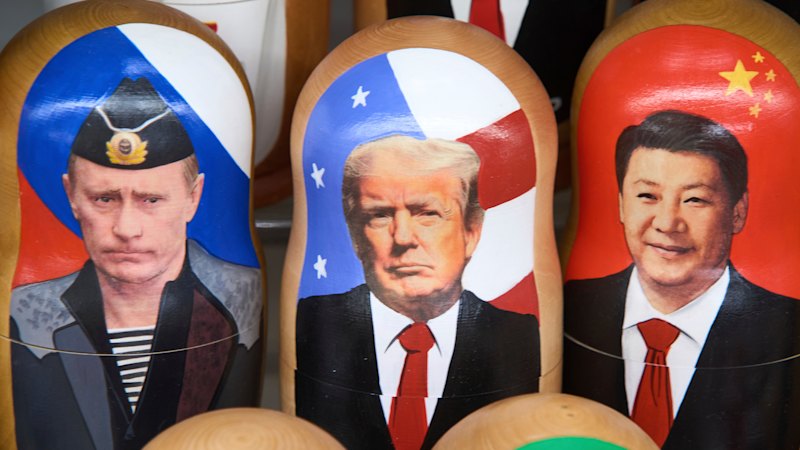
The fluorescent lights of a mid-sized machine shop in Toledo, Ohio, hum at a frequency that eventually settles into your teeth. Ask Frank Miller. He spent thirty-four years listening to that hum while cutting precision steel components for agricultural equipment. When Frank looks at a newspaper headline announcing a summit in China between Donald Trump, Xi Jinping, and Vladimir Putin, he does not see a geopolitical chessboard. He sees the price of cold-rolled steel. He sees the sudden disappearance of a buyer in Rotterdam who used to order four pallets of hydraulic valves every third Tuesday.
Geopolitics is usually sold to us as a spectator sport played by giants in tailored suits. Pundits dissect body language, count the seconds of a handshake, and debate the seating arrangements at a state banquet as if they were reviewing a Broadway play. That coverage misses the point entirely. When the leaders of the United States, China, and Russia sit down in the same city, the air pressure changes in rooms thousands of miles away. Mortgages shift. Fertilizer costs climb. Microchips vanish from assembly lines.
Three men. One city. Eight billion lives caught in the draft.
To understand what actually happens behind the closed, heavily guarded doors of Beijing, you have to strip away the diplomatic theater. Forget the scripted toasts and the motorcades sweeping down Chang'an Avenue. What matters are three specific fault lines running beneath the floorboards of the global economy—and the very real people standing directly over them.
The Invisible Hand on the Thermostat
Consider a hypothetical scenario to make the mechanics plain. Picture Elena, a thirty-eight-year-old logistics coordinator working out of a cramped office overlooking the port of Busan, South Korea. Her entire job consists of matching shipping containers to vessels, a high-stakes game of Tetris played with billions of dollars in consumer electronics, raw lithium, and grain. For the last decade, Elena’s software assumed one fundamental truth: goods flow along the path of least financial resistance.
That rule is dying.
The first thing to watch when Trump, Xi, and Putin converge is the weaponization of supply chains—specifically, the quiet hardening of trade blocs into fortified camps. For years, Washington and Beijing operated like a divorced couple who still shared a bank account because separating the assets was too painful. American consumers wanted cheap goods; Chinese factories needed American buyers. Meanwhile, Moscow stood at the edge of the yard, selling oil and gas to whoever had cash and fewer questions.
Now, the lawyers are finally dividing the furniture.
When Trump sits across from Xi, tariffs are the loudest weapon on the table, the blunt instrument everyone expects to see swung. Tariffs are easy to explain on television. A twenty percent tax on imported goods sounds like a clean, simple wall. Yet tariffs are merely the surface tremor. The deeper shift involves export controls on foundational technologies—semiconductors, rare earth minerals, and the specialized machinery required to etch circuits smaller than a human virus.
China controls roughly sixty percent of the world’s rare earth mining and nearly ninety percent of the processing capacity. Those minerals are not abstract commodities; they are the reason your smartphone vibrates, the reason wind turbines spin, and the reason precision-guided munitions hit their targets. If Xi tightens the spigot on gallium or germanium, Elena’s shipping manifests in Busan scramble overnight. Factories in Germany stall. Assembly lines in Michigan go quiet.
Putin’s presence in Beijing complicates this bilateral tug-of-war into a three-body problem, the classic physics puzzle where predicting the motion of three gravitational masses becomes mathematically chaotic. Under the weight of Western financial sanctions, Russia has pivoted its economic center of gravity eastward. Trade between China and Russia surged past two hundred and forty billion dollars in recent years, settled overwhelmingly in yuan and rubles rather than the US dollar.
Listen closely to the silence around the dollar during this summit. Every barrel of Russian crude sold to a Chinese refinery in yuan chips away at the undisputed dominance of the American currency. For decades, the dollar’s status as the world’s reserve currency allowed Washington to borrow cheaply and project financial power across the globe with the stroke of a pen. When Trump, Xi, and Putin meet, they are negotiating the terms of a parallel financial plumbing system. If that system holds, sanctions lose their teeth, and the cost of borrowing money for a starter home in Ohio quietly edges upward.
The Architecture of Unspoken Agreements
I remember standing on the tarmac at an airfield outside Geneva years ago, watching the aftermath of a minor bilateral trade talk. The official communique released to the press was four pages of bureaucratic anesthesia—phrases about "mutual respect," "constructive dialogue," and "shared prosperity." Everyone in the press pool groaned. Nothing had happened.
Three weeks later, a major European telecommunications firm quietly canceled a multi-billion-dollar contract with a Chinese vendor, citing sudden regulatory hurdles. No one announced a trade war. No one banged a shoe on a podium. The real deal had been struck in the margins, whispered in a hallway while the cameras were focused on the flags.
This brings us to the second critical signal to watch in China: the side-deals that never make the joint press conference.
Summits of this magnitude rarely produce sweeping, signed treaties. Modern leaders are too wary of domestic blowback, and legislative ratification is a minefield. Instead, they trade in ambiguity and tacit understandings. Think of it like two neighbors who hate each other's dogs but agree, without ever signing a contract, to keep their respective gates latched after sunset.
Watch what happens around three specific flashpoints:
- The Taiwan Strait: Trump has historically viewed alliances through a transactional lens, questioning the cost of defending partners who do not pay their share, while simultaneously projecting unpredictability as a deterrent. Xi views reunification with Taiwan not as a policy preference, but as a historical inevitability tied to his own legacy. Any subtle shift in language—a dropped phrase about strategic ambiguity, a sudden pause in military exercises, or an unexpected approval of an arms package—will tell you whether the gates are staying latched.
- The War in Ukraine: Putin arrives in Beijing needing two things from Xi: dual-use technology to keep his defense factories humming and a diplomatic shield against total global isolation. Trump arrives having repeatedly claimed he could end the conflict in a day, leaning heavily on the threat of cutting off American aid to force Kyiv to the table, or threatening Moscow with economic ruin if it refuses to deal. The triangle here is razor-sharp. Xi does not want a humiliated Russia on his northern border, nor does he want a prolonged war that unites NATO and tanks European demand for Chinese electric vehicles.
- Energy and Agricultural Flows: American farmers in the Midwest are perpetually caught in the crossfire of great-power politics. During previous tariff disputes, Beijing simply stopped buying American soybeans and turned to Brazil. Watch for sudden, massive agricultural purchase orders immediately following the meetings. They are the oldest diplomatic currency in the book—a quick, visible win Trump can take back to rural voters, bought by Xi at the cost of a few billion dollars in grain.
The danger lies in miscalculation. When three leaders who prize strength and personal authority share a room, the temptation to bluff is overwhelming. History is littered with crises sparked not by a desire for war, but by one leader assuming the other was too weak or too distracted to respond. In October 1962, John F. Kennedy and Nikita Khrushchev nearly stumbled into nuclear annihilation over Cuba because each misread the other’s domestic political constraints. Beijing is not Havana, and this is not the Cuban Missile Crisis, yet the psychological mechanics remain stubbornly unchanged. Men under pressure rarely admit they are cornered.
The Specter of the Empty Factory
Let us go back to Frank Miller in Toledo, and let us introduce another real-world pressure point: the green transition.
If you drive through the industrial heartland of northern China today, you will see sprawling, hyper-automated gigafactories churning out electric vehicles, solar panels, and lithium-iron-phosphate batteries at a scale that defies easy comprehension. China produces more solar panels than the rest of the world combined. It builds electric cars with sleek interiors and four-hundred-mile ranges that sell domestically for less than fifteen thousand dollars.
To Western policymakers, this is "industrial overcapacity"—a state-subsidized flood of cheap goods designed to bankrupt competitors in Detroit, Wolfsburg, and Nagoya before raising prices once the competition is dead. To Beijing, this is survival. With its domestic property market mired in a multi-year slump that wiped out trillions in household wealth, Xi Jinping has bet China’s economic future on high-tech manufacturing exports. He cannot turn off the factories without risking mass unemployment and social unrest at home.
This is the third and perhaps most volatile element of the summit: the collision of incompatible economic survival strategies.
Trump’s political movement is built on the promise of bringing those exact manufacturing jobs back to American soil, shielding domestic industries behind high tariff walls and deregulating fossil fuels to lower energy costs for American plants. Putin’s economy, meanwhile, is entirely dependent on selling those very fossil fuels—oil, natural gas, coal—to keep his war machine funded and his population pacified.
Look at the geometric impossibility of their goals:
- Xi needs open global markets to absorb China’s green-tech manufacturing surplus.
- Trump needs closed or heavily taxed markets to protect American re-industrialization.
- Putin needs high global fossil fuel prices and a fractured Western alliance to sustain his geopolitical ambitions.
You cannot satisfy all three equations simultaneously. Something has to give.
I will admit something that most foreign policy analysts refuse to say out loud: nobody knows how this resolves without breaking something vital. We are living through the demolition of an economic order that kept major powers from fighting each other directly for eighty years. The post-World War II consensus assumed that if nations traded enough washing machines, microchips, and barrels of oil, war would become too expensive to contemplate. That theory died in the mud of eastern Ukraine and is being buried in the semiconductor fabs of East Asia.
When you watch the news clips of the summit—the stiff smiles, the interpreters leaning in close to whisper into the leaders' ears, the manicured gardens of the Diaoyutai State Guesthouse—pay attention to the exhaustion behind their eyes. They are trying to manage forces larger than any single government. Artificial intelligence is rewriting the rules of warfare and labor faster than diplomats can draft regulations. Climate change is redrawing shipping lanes through a melting Arctic where Russian icebreakers and Chinese research vessels are already staking claims.
The Weight of a Single Signature
Consider what happens next in our hypothetical port of Busan.
Elena, the logistics coordinator, gets an alert on her terminal at 4:15 AM on a Tuesday. A new executive order has just dropped in Washington, mirrored within hours by a retaliatory directive from the Ministry of Commerce in Beijing. Overnight, three thousand containers sitting on the dock—filled with battery components, medical imaging parts, and industrial magnets—are flagged for secondary customs inspection and punitive duties.
The ship scheduled to carry them to Long Beach sails half-empty.
Four weeks later, a mid-sized hospital in Pennsylvania delays upgrading its MRI machines because a specific superconducting magnet is backordered until next autumn. Six weeks after that, Frank Miller’s machine shop in Toledo cancels its Friday night shift. Not because Frank did anything wrong. Not because his steel wasn't true or his tolerances weren't exact. Simply because the invisible web connecting a mine in Inner Mongolia, a refinery in Siberia, a port in South Korea, and a factory floor in Ohio finally snapped under the tension.
We tend to think of history as something that happens in grand, cinematic sweeps—armies crossing borders, walls falling, treaties signed with gold pens. Mostly, history arrives as an invoice that costs thirty percent more than it did last month. It arrives as a "temporarily out of stock" notice on a screen, or a quiet conversation with a supervisor about cutting overtime hours until things settle down.
In Beijing, three men will sit across polished mahogany tables, each convinced he holds the leverage, each acutely aware of the domestic vulnerabilities he must hide from the other two. Cameras will flash. Translators will smooth over the rough edges of threats translated from English to Mandarin to Russian.
And thousands of miles away, in the fluorescent hum of a machine shop in Ohio, Frank Miller will wipe grease from his hands, look at the morning paper, and wait to see what the weather brings.