Two miles.
On a clear morning before the water rose, you could stand on the eastern bank of the Dnipro River in Oleshky and see the apartment blocks of Kherson across the channel, close enough to watch the sun catch the glass on the upper balconies, close enough to hear the low rumble of morning traffic carrying over the reeds. Two miles of water and marshland separated an occupied town from a liberated city. Yet for the thousands of civilians trapped in Oleshky after the Kakhovka dam collapsed in June 2023, those two miles became an impassable ocean, forcing the survivors onto a grueling, thousand-mile arc through Crimea, Russia, and Belarus just to reach the free soil of their own country.
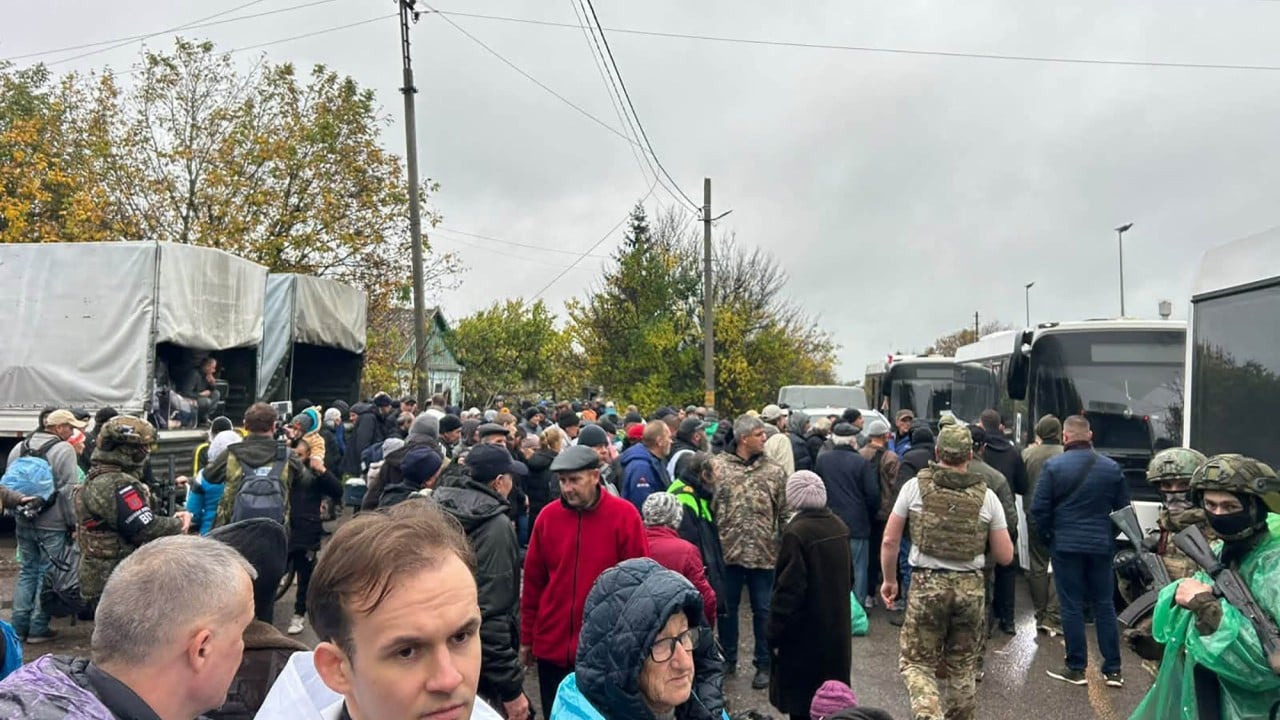
You have likely seen the headlines reduced to dry geopolitical shorthand. Evacuees from Russian-occupied Oleshky cross into Belarus, with Ukraine as their next destination. Five or six words on a ticker. A brief dispatch buried beneath louder news of front-line artillery duels and diplomatic summits. When a crisis is compressed into a wire headline, the human cost evaporates, leaving behind only arrows on a map and numbers in a ledger.
Look closer at that map, though, and the sheer absurdity of the geography begins to ache.
To understand what that journey actually demands of a human body and a human mind, picture a composite character drawn from the documented testimonies of volunteers and survivors who made the crossing—let us call her Olena, a sixty-four-year-old retired schoolteacher who spent thirty years teaching literature in a town known for its sandy pine forests and summer melons. When the floodwaters surged through Oleshky in the dark hours after the dam breached, Olena did not pack a suitcase. Nobody packs a suitcase when muddy water is rising up the stairwell at a foot an hour. She climbed onto her roof with a plastic bag holding her internal passport, a bottle of blood pressure pills, and a damp wool cardigan.
For three days, she sat under a blistering June sun while boats operated by local volunteers dodged sniper fire and artillery shells to pull neighbors from attics and rooftops. Russian occupation authorities, initially paralyzed and then hostile to independent rescue efforts, blocked Ukrainian boats from crossing the river from Kherson. The shortest path to safety—a ten-minute boat ride west—was sealed shut by war.
So Olena went east. Then south. Then north. Then west again.
The Geography of a Detour
Think of the route as a massive, crooked horseshoe drawn across Eastern Europe, where the two ends nearly touch in southern Ukraine, yet the road between them stretches across four borders and thousands of kilometers of checkpoints. Because the front line along the Dnipro River is a militarized kill zone of mines, drones, and flooded trenches, civilians cannot simply walk across a bridge. There are no bridges left standing.
Instead, evacuees leaving Oleshky must travel deeper into the territory controlled by the very force occupying their hometown. First comes the long drive south through the dry steppes of the Kherson region toward the narrow land bridge into Crimea, a peninsula annexed by Russia in 2014 and turned into a heavily fortified bottleneck. At the checkpoints—places like Chonhar and Armiansk—time ceases to move in hours and begins to move in interrogations.
Russian border guards and security officers conduct what they call filtration. It is a clinical word for an intimate dismantling of a person's privacy. Phones are confiscated and plugged into extraction devices that scour deleted messages, browser histories, and photo galleries for any hint of sympathy toward Kyiv. Men are ordered to strip so officers can inspect their shoulders for bruises left by rifle butts and their skin for patriotic tattoos. Questions repeat in circles designed to trip up a tired mind. Where were you during the flood? Who gave you food? Do you have relatives in the Ukrainian military? Why are you leaving now?
Imagine sitting on a plastic chair in a cramped, fluorescent-lit trailer at three in the morning, dehydrated and smelling of river mud, trying to keep your voice steady while a stranger scrolls through photos of your grandchildren. One wrong word, one misunderstood text message from a cousin in Lviv, and the journey ends in a basement detention cell.
Those who pass filtration step onto buses bound for the Kerch Strait Bridge or through occupied Mariupol and Rostov-on-Don, entering the Russian Federation itself. Here, the psychological disorientation deepens. You are a refugee carrying documents that the state around you refuses to recognize as legitimate unless you accept a Russian passport, yet you are moving through Russian train stations, buying bread with rubles in roadside kiosks, and sleeping on the floors of volunteer shelters run by quiet networks of ordinary Russians and Ukrainians risking arrest to help strangers get out.
Why Belarus Became the Narrow Gate
A reader looking at a map for the first time inevitably asks a practical question: why go all the way north to Belarus instead of crossing directly into the Baltic states or Finland?
The answer lies in a tangle of border closures, missing paperwork, and cold bureaucratic math. For many evacuees from Oleshky, the flood washed away everything—birth certificates, international travel passports, property deeds, even the plastic cards proving they had ever existed on paper. Estonia, Latvia, and Lithuania, tightening security along their frontiers with Russia, began turning back travelers who lacked valid biometric international passports or who had spent months under occupation without clear documentation.
Belarus, despite its government's close alliance with Moscow, maintained a quiet, unusual anomaly along its southern border with Ukraine. At the Kolotilovka-Pokrovka crossing between Russia's Belgorod region and Ukraine's Sumy region, shelling had become so relentless that the corridor repeatedly shut down under mortar fire, forcing elderly and disabled evacuees to drag suitcases across craters while drones buzzed overhead. When that crossing grew too lethal, the quiet backdoor shifted west to the Mokrany-Domanove checkpoint on the frontier between Belarus and Ukraine's Volyn region.
Belarusian border guards, operating under a silent understanding that nobody in Minsk or Kyiv publicly advertises, allowed Ukrainian citizens—even those carrying nothing more than a water-damaged domestic ID or a temporary certificate issued by consular intermediaries—to walk across the neutral zone into Ukraine.
It is one of the quietest paradoxes of the war. A country that served as a staging ground for the 2022 invasion became, by geographic necessity and diplomatic backchannels, the safest corridor home for civilians fleeing the floodwaters of the south.
Inside the Neutral Zone
The bus ride from Moscow or St. Petersburg to Brest, in southwestern Belarus, takes roughly fourteen hours through endless birch forests and flat farmland. By the time evacuees reach the final approach toward the Ukrainian border, most have been on the road for five to ten days. Their ankles are swollen from sitting upright. Their money has dwindled to a few crumpled bills.
Then comes the walk.
Between the Belarusian checkpoint at Mokrany and the Ukrainian post at Domanove stretches roughly a mile and a half of paved road flanked by dense forest and barbed wire. No commercial buses cross this strip. People walk it on foot, pushing wheelchairs over cracked asphalt, carrying toddlers on their hips, dragging canvas bags whose wheels broke somewhere near Voronezh.
Let us return to our hypothetical schoolteacher, Olena, stepping past the final Belarusian barrier into that quiet stretch of forest road. For the first time in over a year, there are no Russian tricolor flags flying over administrative buildings. There are no armored personnel carriers roaring past at intersections. There is only the sound of wind in the pines and the crunch of gravel under worn shoes.
Halfway across, the blue and yellow flag appears above the Ukrainian checkpoint.
Volunteers from organizations like Helping to Leave and the Ukrainian Red Cross wait just beyond the gate with folding chairs, hot tea in paper cups, and spare SIM cards so travelers can call family members who have not heard their voices since the water rose. People who held their composure through five interrogations and two thousand kilometers of checkpoints often collapse onto those folding chairs and weep uncontrollably the moment someone greets them in Ukrainian without asking to see their phone.
The Invisible Stakes Behind the Numbers
It is easy to treat this transit corridor as a logistical footnote—a humanitarian success story where people eventually make it out. That framing misses what is actually happening on the ground in occupied Kherson.
Every person who boards a bus out of Oleshky leaves behind a house that is either rotting from floodwater or waiting to be seized under occupation decrees declaring abandoned property municipalized. In the months following the Kakhovka disaster, Russian authorities tied basic survival—insulin, pensions, flood compensation, even permission to pass through local roadblocks—to the acceptance of Russian citizenship. Staying meant absorbing a new identity under duress; leaving meant abandoning every physical trace of a lifetime.
Consider the demographics of the people making this journey. The young and the agile mostly fled during the first months of the invasion in 2022. Those remaining in Oleshky when the dam blew were disproportionately the elderly, the bedridden, single mothers caring for disabled children, and people who stayed behind to tend aging parents who could not survive a long road trip. When the water filled their living rooms, the choice was no longer between staying and leaving. It was between drowning in place or enduring an odyssey that would test an athlete, let alone a seventy-five-year-old diabetic with a walker.
Volunteer networks coordinating these evacuations operate like an underground railroad built on encrypted messaging apps and crowdfunded fuel tanks. A volunteer driver in Crimea hands a passenger off to a coordinator in Rostov, who buys a train ticket to Minsk using funds donated by strangers in Warsaw or Toronto, who then alerts a minibus driver near Brest to meet the morning train at platform three. If one link in that chain breaks—if a driver is detained, if a checkpoint closes due to drone strikes, if an elderly passenger suffers a hypertensive crisis in a transit hostel—the entire rescue stalls in hostile territory.
What Comes After the Border
Crossing into Ukraine at Domanove is an arrival, not a resolution.
Evacuees step off the border shuttle into temporary transit centers in Kovel or Lutsk, carrying everything they own in two plastic bags. Many have nowhere to go. Their hometown sits under artillery fire on the wrong side of a ruined river, its orchards salted by floodwater and seeded with mines carried downstream from the front lines. Their savings were wiped out when local banks shut down or when black-market currency exchangers took a thirty percent cut just to convert hryvnias into rubles for bus fare.
State agencies and international NGOs register them as internally displaced persons, issuing modest monthly stipends that barely cover rent in western Ukrainian cities already crowded with millions of displaced families. Trauma arrives late, usually a week or two after the adrenaline of escape wears off. Survivors wake up in quiet apartments in Lviv or Kyiv reaching for a go-bag that is no longer beside the bed, or flinching at the sound of running tap water because it mimics the rush of the Dnipro breaking through a basement door.
Yet if you speak to those who made the journey—real people whose testimonies fill the logs of humanitarian monitors from Kherson to Volyn—a singular thread runs through almost every account. Nobody regrets leaving. Even after losing their homes, their gardens, and the graves of their parents to a war zone they cannot visit, the ability to speak freely in the street without lowering their voice carries a weight that no property deed can match.
Two miles across the water from Kherson, Oleshky remains quiet at night, its flooded streets dark and its remaining residents waiting out the war behind shuttered windows. Far to the north, on a forest road between Belarus and Ukraine, another bus pulls up to the barrier before dawn. The doors hiss open. An old man steps down onto the asphalt, grips the handle of a faded plaid bag, and begins walking toward the blue and yellow flag two hundred yards ahead.