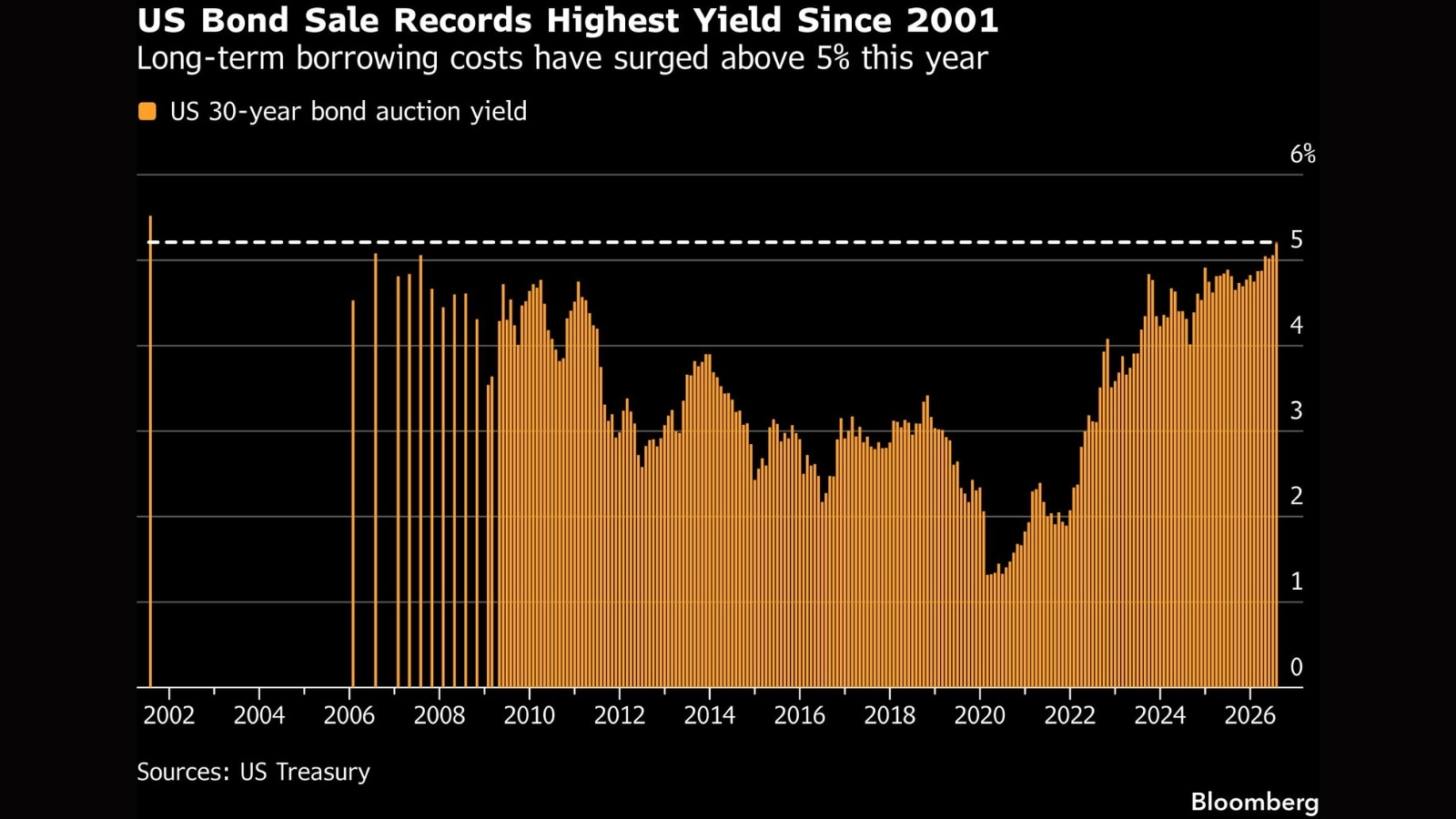
The benchmark US 30-year bond yield has climbed to levels unseen since the Treasury Department briefly suspended issuance of the long bond back in 2001. This is not a routine market fluctuation. It represents a fundamental repricing of American sovereign risk. Wall Street desks are scrambling. Pension funds are bleeding liquidity. The plumbing of the global financial system is under severe strain, and the traditional safety anchors of conservative portfolios are dragging down the very institutions meant to rely on them.
To understand why this is happening, you have to look past the superficial noise of Federal Reserve rate path projections. The short-term policy rate matters, but the long end of the yield curve is governed by an entirely different set of forces. Term premium is back. Investors are demanding unprecedented compensation for the risk of holding US debt over three decades, driven by runaway federal deficits, persistent inflation stickiness, and a structural imbalance in supply and demand.
Washington keeps printing debt. The market is finally pushing back.
The Ghost of 2001
When the Treasury Department halted 30-year bond issuance in October 2001, the federal government was running budget surpluses. Bill Clinton's final fiscal years left Washington with a surplus problem, leading officials to believe they could retire the national debt entirely. The 30-year bond was deemed obsolete.
That hubris lasted less than a decade. Wars in the Middle East, the 2008 financial crisis, and subsequent fiscal expansions turned temporary surpluses into permanent, compounding deficits. When the Treasury brought back the 30-year bond in 2006, the world was different. Interest rates were trending downward. Central banks were aggressive buyers. Quantitative easing eventually pinned long-term yields near historic lows for over a decade, lulling investors into a false sense of security.
Now, that era is dead. The 30-year yield is soaring because the structural conditions that suppressed long-term borrowing costs for fifteen years have reversed simultaneously.
Why the Long End Broke Free
Short-term yields are anchored by what the Federal Reserve does at its policy meetings. Long-term yields are anchored by what investors think the United States will look like in the year 2056.
Consider the current fiscal trajectory. The national debt sits above thirty-five trillion dollars. Annual budget deficits routinely cross the trillion-dollar mark, even during periods of economic expansion. Every month, the Treasury must auction off historic volumes of notes and bonds to finance the government's obligations.
Supply is flooding the market. Demand is not keeping pace.
Foreign buyers like foreign central banks, long the bedrock purchasers of American paper, have scaled back their exposure. Japan and China, historically the two largest foreign holders of US Treasuries, are dealing with their own domestic economic pressures and currency defense issues. They are net sellers, not buyers.
Domestic buyers are filling the gap, but they require a higher price for taking on duration risk. Inflation has proven stubborn. Even if consumer price growth cools from its post-pandemic peaks, the baseline expectation for future inflation is permanently higher than the tranquil 2010s. Investors buying a 30-year bond today are locking in a fixed coupon for a generation. If they suspect inflation will erode that purchasing power over thirty years, they demand a hefty insurance policy built into the yield.
That insurance policy is why yields are hitting 2001 extremes.
The Mechanical Pain of Duration Risk
Fixed income math is merciless. When yields rise, bond prices fall. For a 30-year bond, the duration risk is massive.
Imagine a hypothetical pension fund that bought 30-year Treasury bonds in 2020 when yields hovered near historic lows. Those bonds paid a meager coupon. As benchmark yields surged over the subsequent years to current levels, the market value of those older bonds collapsed. The fund is sitting on massive paper losses. If they are forced to sell those assets to meet immediate retiree payouts, those paper losses become permanent catastrophes.
This dynamic is not restricted to pension funds. Regional banks, insurance companies, and asset managers carry trillions of dollars in legacy debt securities on their balance sheets. While accounting rules sometimes allow institutions to hold these assets to maturity without marking them to market, the opportunity cost is crushing. Capital is trapped in low-yielding paper while current issuance offers vastly superior returns.
The Term Premium Explosion
For years, the term premium—the extra return investors demand for holding long-term bonds instead of rolling over short-term bills—was near zero or even negative. Central bank market intervention depressed this metric artificially.
That artificial suppression has vanished. The term premium has turned sharply positive.
Bond vigilantes are back, whether Wall Street wants to admit it or not. They are refusing to absorb endless supplies of sovereign debt without exacting a heavy toll. Every time the Treasury announces a new quarterly refunding estimate with larger-than-expected borrowing needs, the long end of the curve tremers.
The Political Indifference
The most unsettling aspect of this bond market revolt is the profound silence emanating from Washington.
Monetary policy gets all the airtime. Politicians and pundits endlessly debate whether the Federal Reserve will cut rates by a quarter-point or hold steady at the next policy meeting. Yet the real fiscal leverage rests in Congress, where spending bills are written and passed with bipartisan enthusiasm.
Neither major political party has a credible plan to address the structural deficit. Entitlement spending is locked on autopilot. Defense spending is expanding. Interest payments on the existing national debt now consume a staggering share of federal tax revenues, rivaling major domestic budget items.
When the cost of servicing government debt surpasses the defense budget, fiscal policy enters a doom loop. To pay the interest on old debt, the government must issue new debt at higher yields. Higher yields mean higher interest expenses, which require even more borrowing.
The market sees this loop clearly, even if lawmakers refuse to acknowledge it. The 30-year bond yield is the thermometer measuring a feverish fiscal body.
The Global Fallout
American sovereign debt forms the bedrock collateral of the entire international financial architecture. Derivatives contracts, corporate borrowing rates, mortgage pricing, and cross-border lending all reference the US yield curve.
When the 30-year Treasury yield spikes, the shockwaves propagate globally.
Corporate borrowers face a harsh reality check. Companies that gorged on cheap debt during the pandemic era are now facing refinancing cliffs. Refinancing corporate bonds at current long-term rates cuts straight into profit margins. Capital-intensive industries like utilities, real estate development, and heavy manufacturing find expansion plans economically unviable under a high-yield regime.
Mortgage rates, which loosely track the 10-year and 30-year Treasury benchmarks, remain elevated. The housing market is locked in a standoff. Buyers cannot afford peak prices combined with elevated borrowing costs, and sellers refuse to lower prices, leading to frozen transaction volumes that ripple through construction and real estate services.
Emerging market economies face acute pressure as well. As US yields climb, global capital flees developing nations for the high, risk-free returns of American sovereign debt. Currencies in developing economies depreciate, importing inflation and forcing foreign central banks to hike their own interest rates defensively, choking off global economic growth.
The Inevitable Reckoning
Markets can endure dysfunction for a long time, but imbalances eventually resolve themselves through pain or policy correction.
The idea that the United States can continue running fiscal deficits approaching double-digit percentages of GDP while the global reserve currency absorbs trillions in new supply without consequence is a fantasy. The 30-year bond yield hitting levels not seen since 2001 is a warning shot fired by the smart money.
The structural demand for safety will always keep the United States from running out of buyers entirely, but the price of that safety has changed. The era of cheap, frictionless government borrowing is over. Washington must eventually face a fiscal arithmetic that does not care about election cycles, partisan talking points, or central bank wishful thinking. Until then, the long bond will continue to exact its penalty, punishing balance sheets and rewriting the rules of global finance.