The sky over southern England turned the color of a bruised plum three minutes before the horizon vanished.
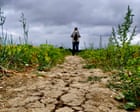
Arthur adjusted the brim of his cap, his boots sinking a fraction of an inch into the concrete-hard clay of his allotment. For seven months, this patch of earth had possessed the stubborn consistency of an iron skillet. He had broken two trowels trying to carve out a trench for autumn leeks, the metal whining against soil that had baked beneath a relentless sun. The meteorological office had whispered of change, warning of a sudden shift in the jet stream, promising relief.
Then the heavens broke.
It was not rain. It was an assault. Sheets of gray water slammed into the parched earth with a dull, heavy roar, bouncing off the crust like thrown gravel. Arthur watched, mesmerized and uneasy, as tiny rivulets began to race across the surface of his garden. Within ten minutes, standing water pooled around his apple trees, glittering dully under the dark afternoon glare.
To anyone watching from a passing train, it looked like a rescue. The drought was over. The reservoirs would fill. The yellow fields would green.
Arthur knew better. He reached down, plunging his fingers past the shiny veneer of mud, searching for what lay beneath. Half an inch down, his knuckles hit stone. Bone dry. Dust.
The Physics of Rejection
Water does not always behave like a welcome guest. Sometimes, when a house has been locked up and starved for too long, it pushes back.
To understand why a summer downpour on baked soil is an illusion of recovery rather than a cure, we have to look past the puddles pooling in our driveways and examine the microscopic architecture of the earth. When ground bakes under prolonged heatwaves, a physical transformation occurs. The clay particles, desperate for moisture, shrink and crack. Capillaries seal shut. Organic matter bakes into a hydrophobic crust, effectively turning soil into a natural ceramic.
Hydrophobic. Water-fearing.
When heavy rain falls on this surface, it cannot sink. It has nowhere to go. Physics demands that it obey gravity, sweeping sideways instead of downwards. The velocity of the drops strips away the topsoil, carrying away vital nitrogen and phosphorus that took decades to accumulate.
Consider what happens next on a national scale. The Environment Agency issues flood warnings not because the country has too much water, but because the earth has temporarily forgotten how to drink. Flash floods tear through suburban streets and rural valleys alike, turning quiet country lanes into churning brown rivers. Cellars flood. Cars stall in dips in the road. Drain covers pop like champagne corks under the hydraulic pressure of water seeking an escape hatch.
Yet, six inches below that raging torrent, the water table remains parched. The deep aquifers—the ancient, subterranean vaults that supply our taps and sustain our rivers during dry spells—remain untouched. The rain is a tourist. It visits the surface for an hour, causes chaos, and rushes away into the sea, leaving the depths as empty as it found them.
A History Etched in Dust
We tend to view weather as an event rather than a relationship. We treat water like an on-off switch. Turn it on, the drought vanishes. Turn it off, we panic.
I remember the summer of ninety-five. I was younger then, living in a drafty farmhouse where the well gave up by late August. We carried water in plastic crates from a standpipe down the lane, rationing every drop between the kettle, the dog, and the tomatoes. When the autumn storms finally arrived, they came with a violence that shook the roof tiles loose. We stood by the kitchen window, watching the yard turn into a lake, breathing a collective sigh of relief.
The drought is broken, my grandfather had said, wiping condensation from the pane.
He was wrong. Three weeks later, the sun came back out, the puddles evaporated into thin air, and the well stayed dry until winter properly set in. The heavy rain had done nothing for the water table. It had merely washed the top layer of our misery down into the ditch.
That realization changes how you look at the British landscape. We pride ourselves on our green and pleasant land, assuming our damp reputation protects us from the arid realities facing southern Europe or the American West. But our climate is shifting its baseline. Winters are warmer and wetter, summers are sharper and more punishing, and the soil is caught in the middle of a violent negotiation.
When rain falls at extreme rates—the kind of torrential cloudbursts made more frequent by a warming atmosphere—the soil's infiltration rate is simply outpaced. Think of pouring an entire gallon of milk through a tiny kitchen funnel all at once. The funnel overflows, spilling white liquid everywhere, while barely a drop makes it into the bottle below. The capacity of the soil is overwhelmed by the delivery method.
The Hidden Stakes
The danger of the heavy rain illusion is complacency.
When headlines blare about flash floods and submerged cars, the psychological weight of the drought lifts. People wash their cars again. Hosepipes reappear in gardens. Water companies ease restrictions, bowing to public pressure and the visual evidence of flooded intersections.
This is the invisible trap.
Beneath our feet, the cumulative deficit remains staggering. Rivers like the Thames and the Test rely on steady, persistent, soaking rain over months—the gentle, mizzling drizzle that poets curse and gardeners ignore—to recharge their underground springs. A single afternoon of biblical deluge does not feed a chalk stream. It suffocates it with silt and chemical runoff from urban roads, choking the trout and clouding the gravel beds where salmon lay their eggs.
Arthur stood up from his allotment, wiping wet clay from his hands onto his trousers. The storm was already passing, the bruised plum sky splitting to reveal a pale, mocking sliver of blue. The puddles in his pathways were already beginning to reflect the returning sunlight, shimmering brightly before starting the slow process of evaporation.
He looked down at his leeks, still listing sideways in the mud, their roots as dry as matchsticks.
The rain had come and gone. The flood had risen and receded. But deep in the dark, silent earth, the thirst remained.